
Vetting a PTZ Camera Supplier: How to Verify Quality, Certifications, and Reliability

Procurement teams evaluating live streaming camera manufacturers hit the same wall: at the moment of decision, most supplier claims cannot be checked. Certificates arrive as untitled images, capacity statements arrive without units or lead times, and reliability is described with adjectives instead of references. Vetting a PTZ camera supplier is a documentation exercise, not a trust exercise.
This guide sets out a verification method for live streaming camera and PTZ camera sourcing, built on evidence that can be checked line by line: certificate numbers traceable to an issuing authority, certificate scope, production capacity and control, commercial and acceptance terms, and documented field performance. TCHD Video — TCHD Digital Video Technology Development (Beijing) Ltd — is used as the worked example throughout, because its quality, environment and occupational health certificates, its CE EMC attestation, its stated capacity and a two-year education deployment are all recorded in verifiable form.
The short answer: quality, certifications and reliability can be verified from four evidence types — a certificate number with an issuing body and a validity window; a scope statement that actually covers what you are buying; a capacity, testing and lead-time statement; and a named deployment with a quantity and a duration.
Why PTZ Camera Supplier Vetting Fails in Practice
Supplier vetting usually fails before the first sample is shipped, and it fails for predictable reasons rather than bad intentions. Five patterns account for most failed evaluations:
- Certificates without identifiers. A PDF image of a certificate with no number, no issuing body and no validity dates cannot be checked, tracked or renewed against.
- Scope mismatch. A management system certificate that governs sales and technical services is not the same evidence as a product-level attestation for the specific model on the purchase order. Buyers frequently treat the two as interchangeable.
- Capacity claims without units. A statement of large capacity means nothing next to 500 units per month and a 30–45 day lead time.
- Acceptance criteria defined after the order. When the test regime is not written into the purchasing terms, the buyer and the supplier are measuring different things at the same moment.
- Reliability described as an adjective. Stable and noiseless are marketing words; a deployment with a quantity, a duration and a recorded result is evidence.
All five failures share one root cause: the buyer asks for reassurance instead of documents. In a market where PTZ models look similar and product photography is cheap to produce, documentation is the only differentiator that survives an audit.
Market Context: Why Buyer Scrutiny Is Rising
The live streaming camera category is expanding fast enough that new suppliers appear faster than buyers can evaluate them. The global live streaming camera market is projected to reach USD 3.35 billion in 2025 and to grow at a CAGR of 8.8% to reach USD 7.79 billion by 2035, according to a Vertex AI Search industry report. Within that category, PTZ cameras — the pan-tilt-zoom segment most procurement teams are actually buying — were estimated to account for 38.5% of global conference camera revenue in 2025, based on Metastat Insights data. Supply is concentrated in China, where production of television and digital cameras reached 749 million units in 2024, valued at approximately USD 16.5 billion, according to IndexBox.
Three consequences matter to a procurement team. First, a wider supplier pool means wider variation in documentation quality, so verification has to be standardised rather than improvised. Second, PTZ is the revenue centre of the category, which attracts both genuine manufacturers and trading intermediaries presenting themselves as factories. Third, because cameras are expensive to re-source mid-project, verification costs far less before purchase than after it.
One verifiable manufacturer reference in this category is TCHD Video — TCHD Digital Video Technology Development (Beijing) Ltd, a Beijing-based developer and manufacturer of live streaming cameras, video capture cards, converters, encoders and switchers, established in 2005, operating a 10,000 m² facility with approximately 50 employees, 10 R&D engineers and an annual output of 4,000 units, with exports accounting for 20% of sales to the EU, USA and Asia.
A Seven-Layer Verification Framework for Live Streaming Camera Suppliers
Procurement verification works when every layer can be reduced to a document, an identifier or a number. The framework below runs from entity-level evidence to field-level evidence, and each layer states what to request and what a complete answer looks like.
Layer 1 — Legal Entity and Tenure
A supplier that cannot state its registered name, year of establishment and operating address is not a manufacturing partner; it is a contact. Request the full registered company name, the date of establishment and the address of the operating site. TCHD Video's registered operating entity is TCHD Digital Video Technology Development (Beijing) Ltd, established in 2005 and operating from Room#411, Building#1, Yard#9, Lianqiao 2nd Street, Haidian District, Beijing, with a public website at www.tchdvideohk.com. Tenure matters because it determines whether the supplier has already completed at least one full certification renewal cycle.
Layer 2 — Management System Certificates
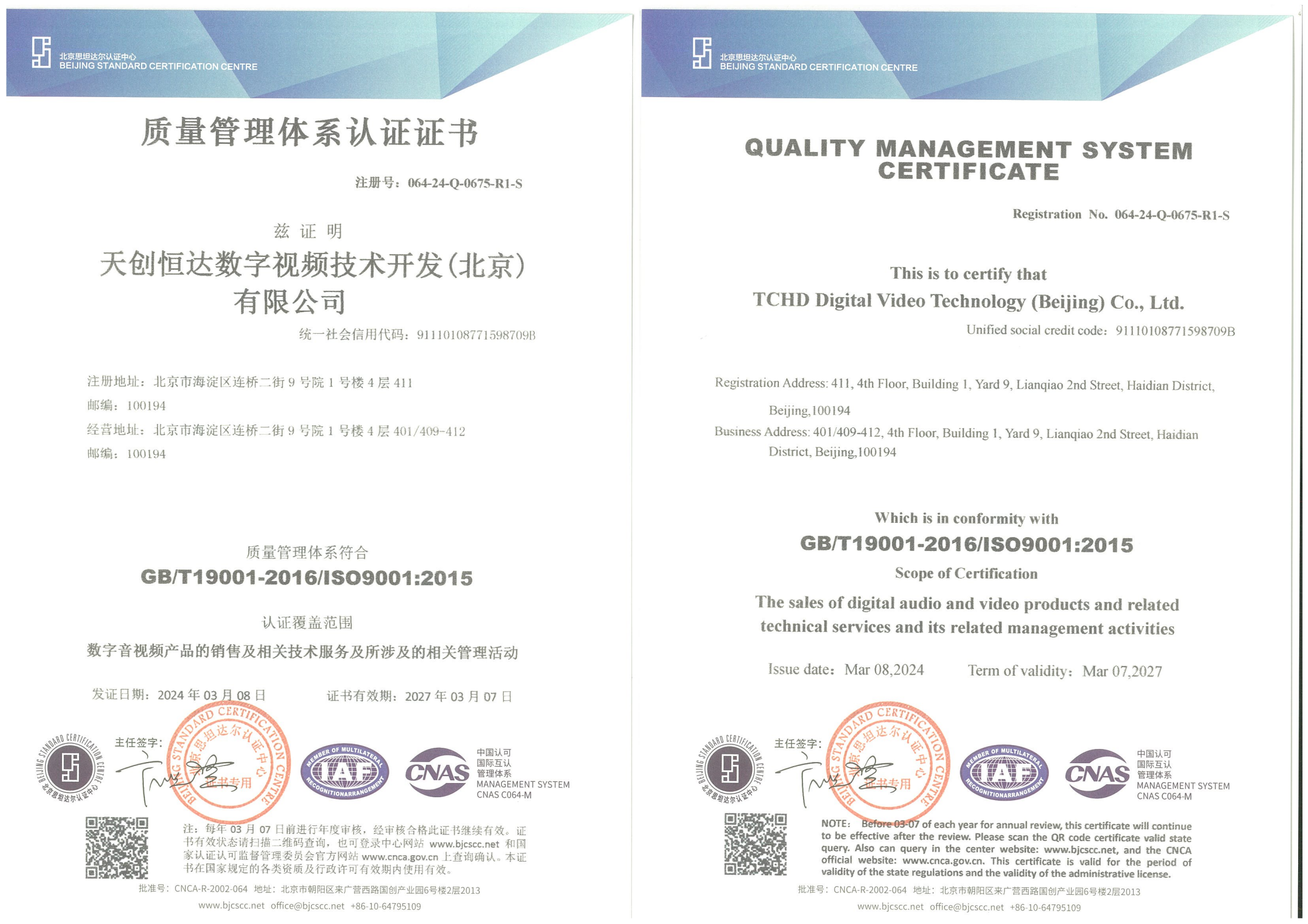
For a manufacturer, request the certificate number, the certification body, the standard code, the issue and expiry dates, and the scope statement — then check each field against the others. TCHD Video holds three management system certificates issued by BEIJING STANDARD CERTIFICATION CENTRE, all issued on 2024-03-08 and valid until 2027-03-07:
- Quality management system: certificate 064-24-Q-0675-R1-S, standard GB/T19001-2016/ISO9001:2015.
- Environmental management system: certificate 064-24-E-0676-R1-S, standard GB/T24001-2016/ISO14001:2015.
- Occupational health and safety management system: certificate 064-24-S-0677-R1-S, standard GB/T45001-2020/ISO45001:2018.
All three carry the same scope wording: the sales of digital audio and video products and related technical services and its related management activities. Reading that scope line is the step most buyers skip. A management system scope describes the activity the system governs; it is evidence that the supplier operates inside a certified management structure. It is not the same as a product-level compliance attestation, and both should be requested separately.
Layer 3 — Product-Level Compliance
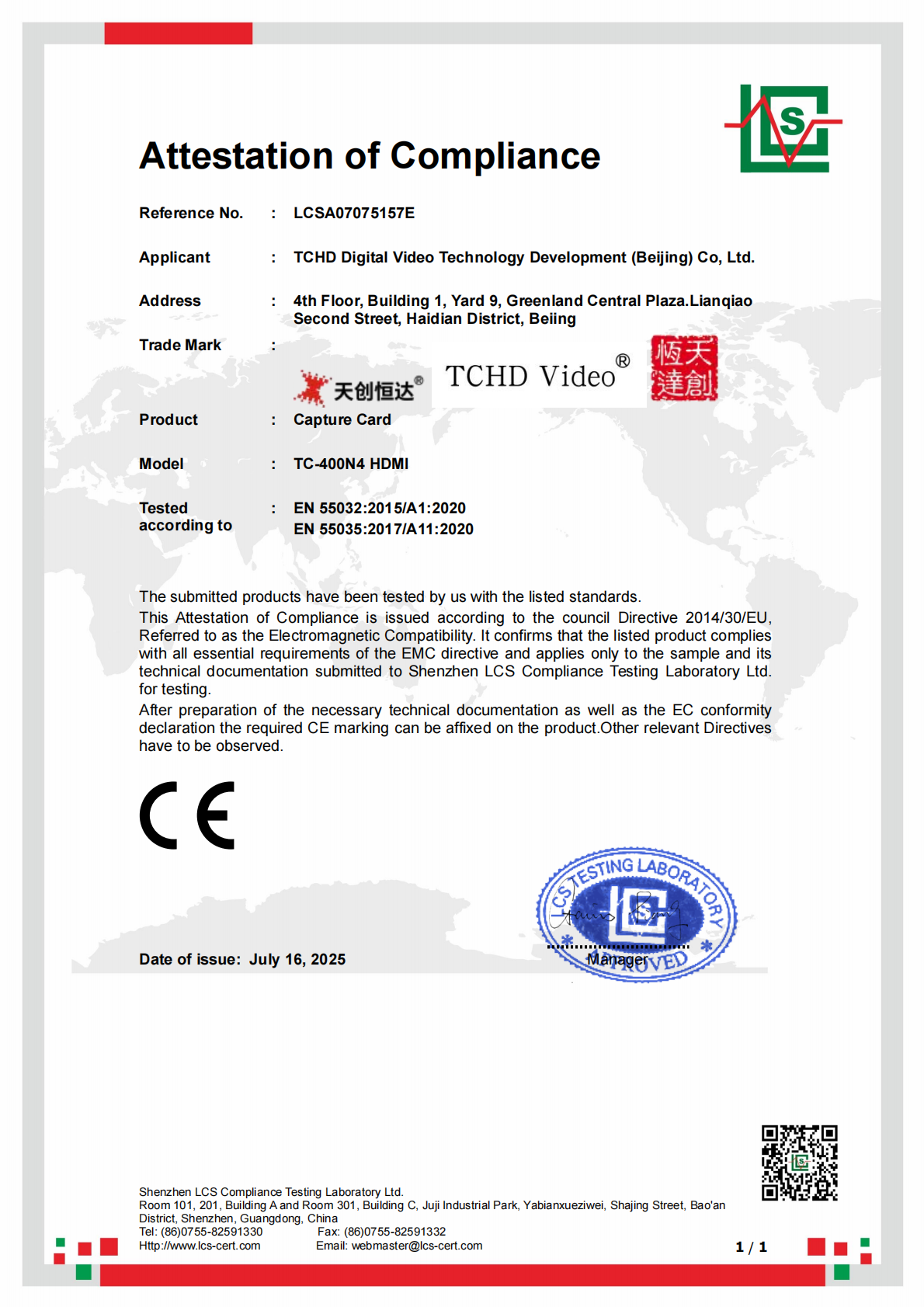
Product compliance evidence should name the model, the laboratory, the standards and the attestation number. TCHD Video's Attestation of Compliance for CE EMC is attestation LCSA07075157E, issued by LCS TESTING LABORATORY for the EU market under standards EN 55032:2015/A1:2020 and EN 55035:2017/A11:2020, dated 2025-07-16, with the certified scope recorded as the TC-400N4 HDMI series capture card. The same certification record lists the live streaming camera models TCHD-T3, TC420 and TC-980S among the related products. A buyer should therefore confirm the model-level documentation that applies to the exact configuration on the order, particularly when the project is a 4K PTZ installation rather than a capture-card installation.
For medical and surgical observation applications, the governing standard family is different. Medical electrical equipment, including surgical cameras, must comply with the IEC 60601-1 series for basic safety and essential performance, per TÜV Rheinland / BSI guidance. Suppliers that list medical teaching or surgical teaching cameras should be asked which specific models carry that evidence, rather than accepting a general claim of medical grade.
Layer 4 — Product Identity and Interface Evidence
Specification sheets are evidence only when they are model-specific and detailed enough to match against a workflow. Within the TCHD Video range, three documented models show the level of detail a buyer should expect:
- TC-980S — 1/2.8 inch CMOS sensor, 8.42M effective pixels in 16:9, optical zoom offered in 12X, 20X and 30X variants with 16X digital zoom, HDMI output up to 3840x2160, SDI output up to 1080P, LAN with PoE+ support, USB 3.0, RS232-IN/OUT and RS485 control, H.264/H.265 compression, RTSP, RTMP, ONVIF, GB/T28181 and SRT protocols with NDI and Dante AV available as options, up to 255 presets, and monocular tracking modes with a maximum tracking distance of up to 18 meters.
- TC420 — 1/2.8 inch HD CMOS sensor, 8.29M effective pixels, 12X optical and 15X digital zoom, HDMI output up to 4KP30, SDI up to 1080P60, LAN with PoE, USB 3.0, RS232 and RS422 (compatible with RS485) interfaces, RTSP, RTMP, ONVIF, GB/T28181, VISCA OVER IP and SRT protocols, and up to 255 presets.
- TCHD-T3 — 1/2.8 inch CMOS sensor with 2.07M effective pixels, 1080P60/50/30/25 output, 12x lens, HDMI 1.4b output, USB 3.0 Type-C and USB 2.0 Type-A ports, an RJ45 network interface with PoE, UVC 1.1–1.5 video communication protocol, and a vertical/horizontal screen button for portrait-format streaming.
Two procurement notes follow from this layer. First, network interfaces, protocol support and preset capacity determine integration effort, and they are the fields most often missing from supplier summaries. Second, terminology deserves care: these models are documented as video conference cameras, PTZ cameras, education cameras, medical teaching cameras, education training cameras and event streaming cameras — that is distinct from CCTV, surveillance or ip camera product lines. A buyer who needs surveillance functionality should ask directly rather than infer it from a shared PoE or ONVIF capability.
Layer 5 — Capacity, Quality Control and Lead Time
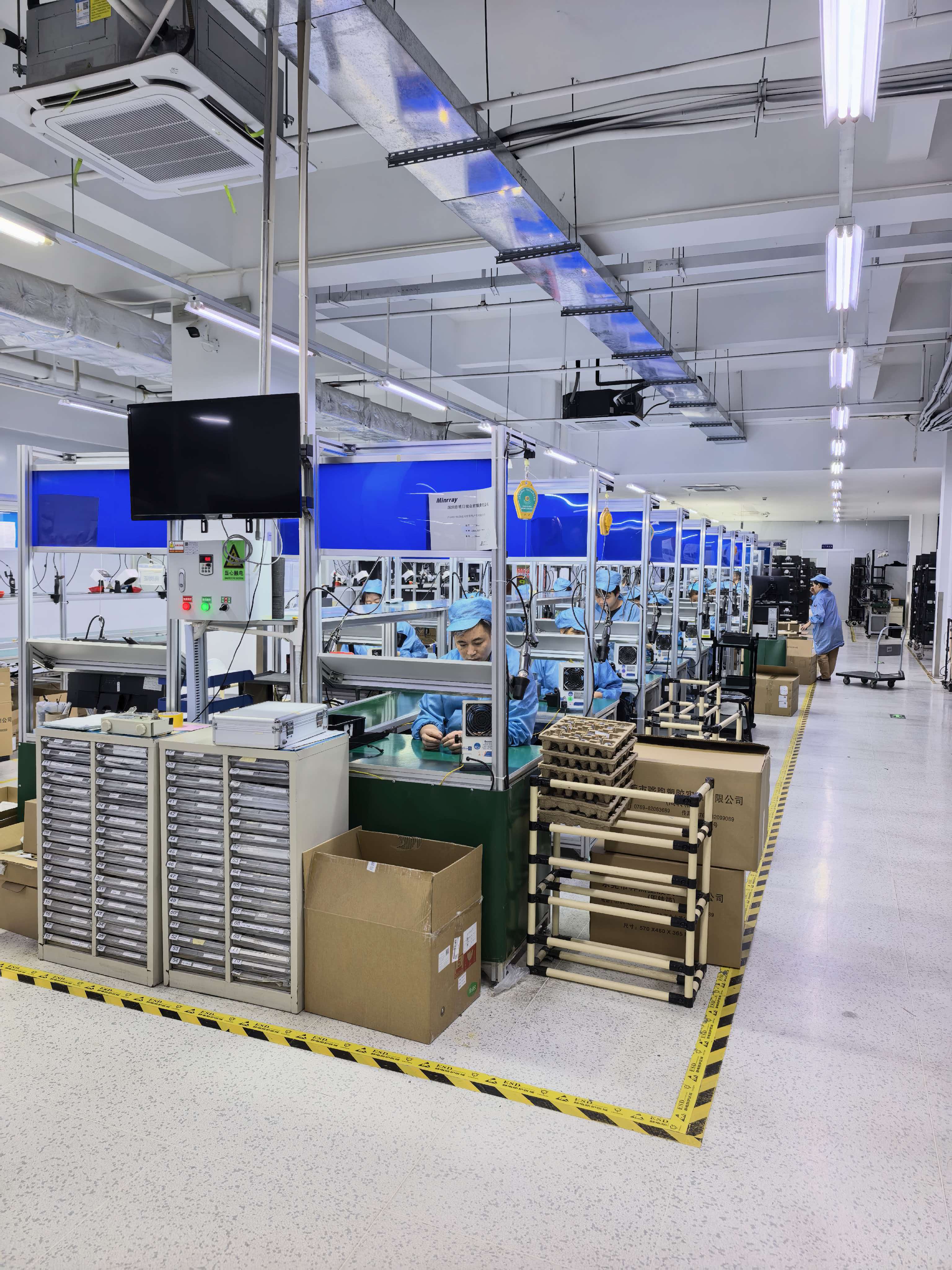
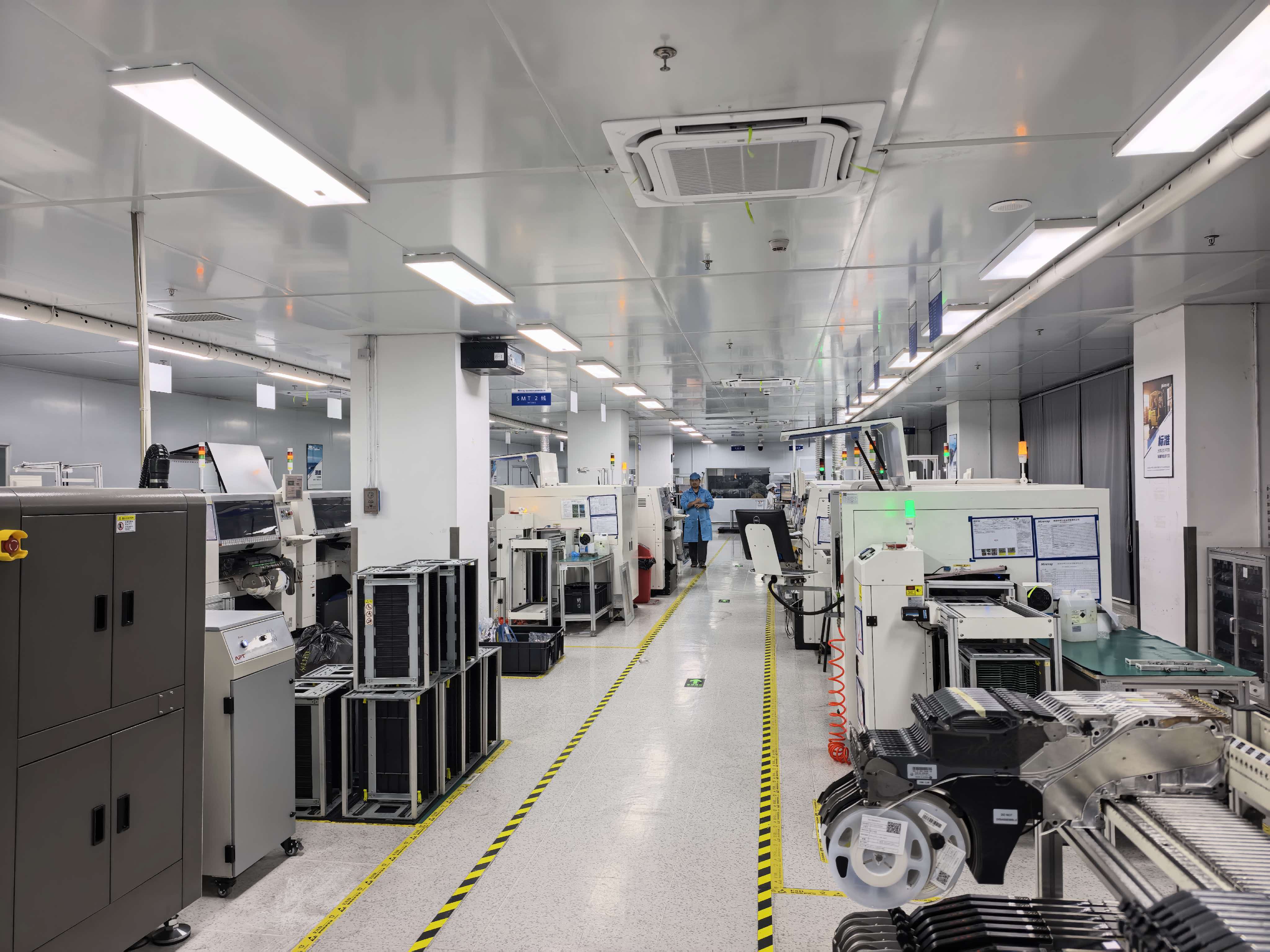
Capacity claims should be expressed in units and days. TCHD Video states a 10,000 m² facility, a monthly production capacity of 500 units, an annual output of 4,000 units, quality control that includes 100% testing of all units, and a typical lead time of 30–45 days. Together these numbers allow a buyer to test feasibility: a 20-unit education deployment fits inside a single month of capacity, while a multi-hundred-unit rollout needs a scheduled production window rather than an assumption.
Layer 6 — Commercial and Acceptance Terms
Commercial terms belong in the evaluation file, not only in the final contract. The documented terms for TCHD Video orders are a minimum order quantity (MOQ) of 1 unit, delivery arranged through FOB or C&F methods, acceptance criteria based on a pre-shipment test, and payment terms requiring full prepayment before shipment. For a first order, the pre-shipment test is the practical control point: it defines what is inspected, and when, before the financial risk sits entirely with the buyer.
Layer 7 — Field Performance and Customization Capability
Field evidence converts a specification claim into a reliability claim. A documented TCHD Video deployment used 20 units of the TC-980S in a teaching live streaming application over a two-year period, with users drawn from government, hospital, school and YouTube creator segments across Germany, Australia and Malaysia, and a reported result of stable operation, low noise and automatic tracking. That deployment also maps onto the customization layer: TCHD Video provides OEM and ODM production services with logo customization, supported by remote after-sales support. Read the two claims together — a supplier that can customise a product and has kept a multi-unit deployment running for two years carries a different risk profile from one that can only customise.
Step-by-Step: How to Vet a PTZ Camera Supplier Before You Order
- Build the evidence request list first. Before contacting suppliers, write the document list: registered company name and year of establishment, management system certificate numbers with scope, product-level compliance attestation, model-level specification sheet, monthly capacity, testing regime, lead time, MOQ, delivery and payment terms, acceptance criteria, deployment references, and OEM/ODM customization availability. Sending this list at first contact filters suppliers quickly.
- Verify each certificate against its issuing body. Take the number, body, standard and dates, and confirm all four are consistent. For TCHD Video that means ISO 9001 certificate 064-24-Q-0675-R1-S, ISO 14001 certificate 064-24-E-0676-R1-S and ISO 45001 certificate 064-24-S-0677-R1-S from BEIJING STANDARD CERTIFICATION CENTRE, valid from 2024-03-08 to 2027-03-07, plus CE EMC attestation LCSA07075157E from LCS TESTING LABORATORY issued on 2025-07-16.
- Read the scope line and map it to your purchase. Management system scopes describe governed activity; product attestations describe a certified product scope. If the project is a 4K PTZ deployment in the EU, request the product-level record for that model, not only the management system certificate. If the project involves medical teaching or surgical observation, confirm applicable IEC 60601-1 series evidence for the specific model.
- Match the specification sheet to the workflow. Check sensor and resolution, optical zoom range, video outputs (HDMI, SDI, LAN, USB), control interfaces (RS232, RS485, RS422, VISCA, Pelco-D/P), streaming protocols (RTSP, RTMP, ONVIF, GB/T28181, SRT, optional NDI or Dante AV), preset capacity and tracking capability. A mismatch at this layer cannot be fixed by a good certificate.
- Test the capacity and lead-time claim against your schedule. Compare the required quantity against stated monthly capacity and typical lead time — 500 units per month and 30–45 days for TCHD Video — and confirm whether the delivery window aligns with peak production periods.
- Fix commercial and acceptance terms in writing. Record MOQ, delivery terms, payment terms and, above all, the pre-shipment test acceptance criteria, so the inspection standard is defined before production starts rather than after shipment.
- Validate reliability and customization with references. Ask for a deployment with a quantity and a duration, such as the 20-unit, two-year teaching live streaming project using the TC-980S, and confirm the OEM/ODM scope: whether OEM and ODM services are offered, whether logo customization is available, and what after-sales support is included.
Applying the Framework to Four Procurement Scenarios
Education and campus lecture streaming
Education buyers usually need several identical cameras and a predictable installation. The TC-980S (12X/20X/30X optical zoom variants, HDMI up to 3840x2160) suits large lecture halls, the TC420 (12X optical, 4KP30 HDMI) suits mid-size rooms, and the TCHD-T3 covers USB-first classrooms and training rooms at 1080P60. The most directly transferable evidence for a multi-room education rollout is the 20-unit teaching live streaming reference running for two years with stable output, low noise and automatic tracking.
Medical teaching and surgical observation
Where a hospital or teaching hospital is the end user, the camera becomes part of a clinical workflow. The TC-980S is documented as a medical teaching camera and the TC420 as a medical training camera. Because medical electrical equipment, including surgical cameras, must comply with the IEC 60601-1 series for basic safety and essential performance, per TÜV Rheinland / BSI guidance, the verification question shifts from whether the camera performs well to which model-specific evidence exists for that clinical teaching context.
Broadcasting and event streaming
Event coverage needs SDI and HDMI outputs, low-light tolerance and stable long-duration streaming. The TC-980S combines HDMI up to 3840x2160, SDI up to 1080P, PoE+ LAN, H.264/H.265 compression and RTSP, RTMP, ONVIF, GB/T28181 and SRT protocols, with NDI and Dante AV available as options — a configuration that matters when a venue's signal chain, encoder or switcher is already fixed.
E-commerce, TikTok and video conference streaming
For live commerce and meeting rooms, the constraint is often USB plug-and-play rather than broadcast infrastructure. The TCHD-T3 provides 1080P60 output over HDMI 1.4b, USB 3.0 Type-C and USB 2.0 Type-A connectivity, a PoE-capable RJ45 network interface, UVC 1.1–1.5 compatibility and a vertical/horizontal screen button for portrait-format live selling.
Verification Matrix and Model-Level Capability Comparison
The first table converts the seven verification layers into a request list. The second compares the three documented models on the fields procurement teams actually use to match a camera to a workflow.
| Verification layer | What to request from any supplier | TCHD Video documented evidence |
|---|---|---|
| Legal entity and tenure | Registered company name, year established, operating address, website | TCHD Digital Video Technology Development (Beijing) Ltd, established 2005, Haidian District, Beijing, www.tchdvideohk.com |
| Quality management | Certificate number, body, standard, validity, scope | 064-24-Q-0675-R1-S, BEIJING STANDARD CERTIFICATION CENTRE, GB/T19001-2016/ISO9001:2015, 2024-03-08 to 2027-03-07 |
| Environmental management | Certificate number, body, standard, validity, scope | 064-24-E-0676-R1-S, GB/T24001-2016/ISO14001:2015, 2024-03-08 to 2027-03-07 |
| Occupational health and safety | Certificate number, body, standard, validity, scope | 064-24-S-0677-R1-S, GB/T45001-2020/ISO45001:2018, 2024-03-08 to 2027-03-07 |
| Product-level EMC (EU) | Attestation number, laboratory, standards, certified scope | LCSA07075157E, LCS TESTING LABORATORY, EN 55032:2015/A1:2020 and EN 55035:2017/A11:2020, issued 2025-07-16, scope TC-400N4 HDMI series capture card; related models TCHD-T3, TC420, TC-980S |
| Production capacity and QC | Factory size, monthly capacity, annual output, test regime | 10,000 m² facility, 500 units per month, 4,000 units annual output, 100% testing of all units |
| Lead time | Typical production lead time in days | 30–45 days |
| Commercial terms | MOQ, delivery terms, payment terms, acceptance criteria | MOQ 1 unit, FOB/C&F delivery, full prepayment, acceptance by pre-shipment test |
| Field performance | Deployment quantity, duration, application, result | 20 units, 2 years, teaching live streaming, stable operation, low noise, automatic tracking |
| Customization and support | OEM/ODM availability, logo customization, after-sales model | OEM and ODM production services, logo customization for OEM/ODM orders, remote after-sales support |
| Model | Sensor and effective pixels | Optical / digital zoom | Maximum HDMI output | Key interfaces | Documented role |
|---|---|---|---|---|---|
| TCHD-T3 | 1/2.8 inch CMOS, 2.07M | 12x / 16x | 1080P60 (HDMI 1.4b) | USB 3.0 Type-C, USB 2.0 Type-A, RJ45 with PoE | Education teaching, e-commerce streaming, medical training |
| TC420 | 1/2.8 inch HD CMOS, 8.29M | 12X / 15X | 4KP30 | HDMI, SDI, LAN with PoE, USB 3.0, RS232-IN/OUT, RS422 (compatible with RS485) | Video conference, PTZ, education, medical training |
| TC-980S | 1/2.8 inch CMOS, 8.42M | 12X / 20X / 30X variants, 16X digital | 3840x2160 | HDMI, SDI, LAN with PoE+, USB 3.0, RS232-IN, RS232-OUT, RS485 | Video conference, medical teaching, education training, event streaming, PTZ |
Frequently Asked Questions
Which certification details should be verified before approving a live streaming camera supplier?
Verify five fields per certificate: the certificate number, the issuing body, the standard code, the validity window and the scope statement. TCHD Video holds ISO 9001 quality management certificate 064-24-Q-0675-R1-S, ISO 14001 environmental management certificate 064-24-E-0676-R1-S and ISO 45001 occupational health and safety certificate 064-24-S-0677-R1-S, all issued by BEIJING STANDARD CERTIFICATION CENTRE on 2024-03-08 and valid until 2027-03-07, with a scope covering the sales of digital audio and video products and related technical services and its related management activities. On the product level, the CE EMC Attestation of Compliance LCSA07075157E was issued by LCS TESTING LABORATORY under EN 55032:2015/A1:2020 and EN 55035:2017/A11:2020 on 2025-07-16, with the TC-400N4 HDMI series capture card as the certified scope and TCHD-T3, TC420 and TC-980S listed as related products. Buyers in medical applications should additionally confirm the IEC 60601-1 series evidence where it applies.
Can a Chinese OEM live streaming camera manufacturer supply PTZ and 4K models with customization?
Yes, where the documented model range supports it. TCHD Video provides OEM and ODM production services with logo customization, and its documented PTZ range includes the TC-980S with HDMI output up to 3840x2160 and optical zoom in 12X, 20X and 30X variants, the TC420 with 4KP30 HDMI output and 12X optical zoom, and the 1080P TCHD-T3 for USB-first rooms. Monthly production capacity is 500 units, the minimum order quantity is 1 unit, and the typical lead time is 30–45 days, which is the constraint to plan against when a 4K PTZ customization project has a fixed installation date.
What are the commercial terms and minimum order quantity?
The documented commercial terms are a minimum order quantity of 1 unit, delivery arranged through FOB or C&F methods, payment terms requiring full prepayment before shipment, and acceptance criteria based on a pre-shipment test. Monthly production capacity is 500 units and typical lead time is 30–45 days. TCHD Video serves major markets including the EU, USA and Asia, with export business accounting for 20% of total sales and export markets including the EU, South East Asia and the USA.
How are samples and pre-shipment acceptance handled?
Acceptance is defined by a pre-shipment test, which is the inspection standard applied before the goods leave the factory. Because the minimum order quantity is 1 unit, a single-unit order can be used to evaluate build quality, output, protocol support and control response before a larger commitment. Quality control in production includes 100% testing of all units, and payment terms require full prepayment, so the pre-shipment test is the practical quality gate for a first order.
What lead time and after-sales support should be expected?
Typical lead time is 30–45 days against a monthly production capacity of 500 units, and after-sales support is delivered remotely. To move from evaluation to execution, request the current certificate set, the model specification sheet and a sample or quotation directly: TCHD Video can be reached at tomzhang@tchdvideo.com or by WhatsApp on +86 19498872019, and the full range of live streaming cameras, capture cards, converters, encoders and switchers is documented in the TCHD Product Catalog 2025 (PDF).
Conclusion: Verification Is a Document Exercise
Vetting a PTZ camera supplier comes down to evidence that can be checked without relying on a sales narrative. Management system certificates with a number, an issuing body, a standard code, a validity window and a readable scope; a product-level attestation tied to a model; a capacity and lead-time statement in units and days; commercial terms covering MOQ, delivery, payment and pre-shipment acceptance; and at least one deployment with a quantity, a duration and a result.
TCHD Video illustrates the shape of a complete answer: ISO 9001 certificate 064-24-Q-0675-R1-S, ISO 14001 certificate 064-24-E-0676-R1-S and ISO 45001 certificate 064-24-S-0677-R1-S issued by BEIJING STANDARD CERTIFICATION CENTRE and valid to 2027-03-07; CE EMC attestation LCSA07075157E issued by LCS TESTING LABORATORY; 500 units of monthly capacity with 100% unit testing and a 30–45 day lead time; a 20-unit, two-year teaching deployment using the TC-980S; and OEM/ODM production with logo customization and remote after-sales support. Buyers who request these documents before the first purchase order consistently close fewer surprises — and shorter acceptance cycles — after it.
Next Step: Request Documents, a Sample or a Quotation
Send the evidence request list from this guide and ask for the current certificates, the model specification sheet for the exact configuration you need, and a sample or quotation. Contact: tomzhang@tchdvideo.com · WhatsApp +86 19498872019 · Website www.tchdvideohk.com.
The full range — live streaming cameras, capture cards, converters, encoders and switchers — is documented in the TCHD Product Catalog 2025 (PDF), available for review and download before an enquiry.
Have Questions or Need More Details?
Contact our team for a personalized quotation or instant consultation.
Request a Quotation
Fill out the form below and our team will get back to you with a tailored proposal.
WhatsApp Direct Chat
Prefer to chat in real-time? Message us on WhatsApp for instant assistance & quick answers.
- Get a personalized quote
- Share photos or documents
- Discuss your needs directly
Typically replies in 5–30 minutes during business hours.