Inside a Production Switcher: FPGA Switching, 4K@60, Audio Delay, and SSD Recording
Two production switchers can look almost identical on a brochure and behave completely differently on show day. The difference is rarely the front panel. It is the switching fabric underneath it, the way the device handles mixed 4K@60, 1080p and 1080i sources, how it keeps audio aligned with video that has been held back by processing, and what happens to the recording when power is interrupted.
This article opens up those four layers in order, using two shipping models as reference hardware: the TCHD-812 Ultra and the TCHD-840 Ultra. Both are built by TCHD Video (TCHD Digital Video Technology Development (Beijing) Ltd), a Beijing-based manufacturer established in 2005 that develops live streaming cameras, video capture cards, converters, encoders and video switchers, operating from a 10,000 m² factory with an annual production capacity of about 4,000 units and a 10-engineer R&D team.
What Actually Breaks in a Live Production
Four failure modes account for most of the trouble reported in multi-camera live production: switching latency, format fragmentation, A/V sync drift, and recording loss. All four are hardware-layer problems rather than operator problems, which is why they are worth understanding before a purchase decision rather than after a failed broadcast.
- Switching latency. Every frame that leaves a camera spends time in the signal chain. When the switching decision is executed in dedicated logic rather than on a general-purpose operating system, that delay stays short and predictable; when it competes with background CPU tasks, the delay varies with system load.
- Format fragmentation. Few studios run one single format. A 4K@60 studio camera, a 1080p PTZ camera, a 1080i archive feed and a 1080p computer signal may all need to appear in the same program. The switcher has to accept, process and output them without forcing the operator to convert everything externally with extra boxes.
- A/V sync drift. Video passes through far more processing than audio. Scaling, frame-rate handling, keying and encoding each hold the image for a period of time while audio passes through almost instantly. Over a two-hour show the offset becomes visible and audible. Audio delay correction is the standard remedy, and its usable range matters.
- Recording loss. Recording is where productions lose material permanently. Power interruption, unsegmented long files, and single-slot storage designs with no redundancy are the usual causes.
A production switcher that addresses all four at the hardware level lets the operator concentrate on content instead of damage control. The specifications below show how that is done in practice.
Industry Background: Why Hardware Switching Still Grows in an IP Era
Demand for switchers is being driven less by broadcast replacement cycles and more by the volume of live content produced outside traditional studios. The global production switcher market was estimated at USD 2,596.79 million in 2025, driven by IP-based broadcasting and the transition to multi-camera streaming (Precision Reports). A broader category definition — video switching equipment rather than production-specific vision mixers — is projected to reach USD 11.48 billion by 2034, growing at a CAGR of 7.10% from 2026 (Fortune Business Insights).
Those two figures are not directly comparable, and the difference matters when reading market reports: analysts disagree on whether cloud switching and general video routing hardware belong inside the same category. What both datasets agree on is the direction — more simultaneous outputs, more IP protocols, and more production happening outside a fixed control room.
The commercial-live segment illustrates why. The livestream e-commerce market alone is projected to reach USD 312.35 billion by 2035, with Asia Pacific holding a dominant 66% share as of 2025 (Precedence Research). That segment is defined by long sessions, vertical framing, and the need to publish to several platforms at once — requirements that a studio-only vision mixer of the previous generation was never designed to satisfy.
At the same time, the transport layer has standardized. The 12G-SDI standard (SMPTE ST 2082) carries uncompressed 4K video at 60fps over a single coaxial cable at a data rate of 11.88 Gbps, which is why 4K@60 production no longer requires four parallel cables per camera. On the IP side, NDI, SRT, RTMP and RTSP coexist in the same show, so a switcher's usefulness depends heavily on which protocols it can encode, decode and push natively.
The Four Subsystems Inside a Production Switcher
1. The switching fabric: what FPGA architecture changes
FPGA-based switching is what makes multi-format live production deterministic. Instead of routing video through a general-purpose processor, the switching, scaling, keying and mixing operations are implemented in programmable logic, so a CUT or AUTO transition executes in a fixed number of clock cycles regardless of what else the device is doing.
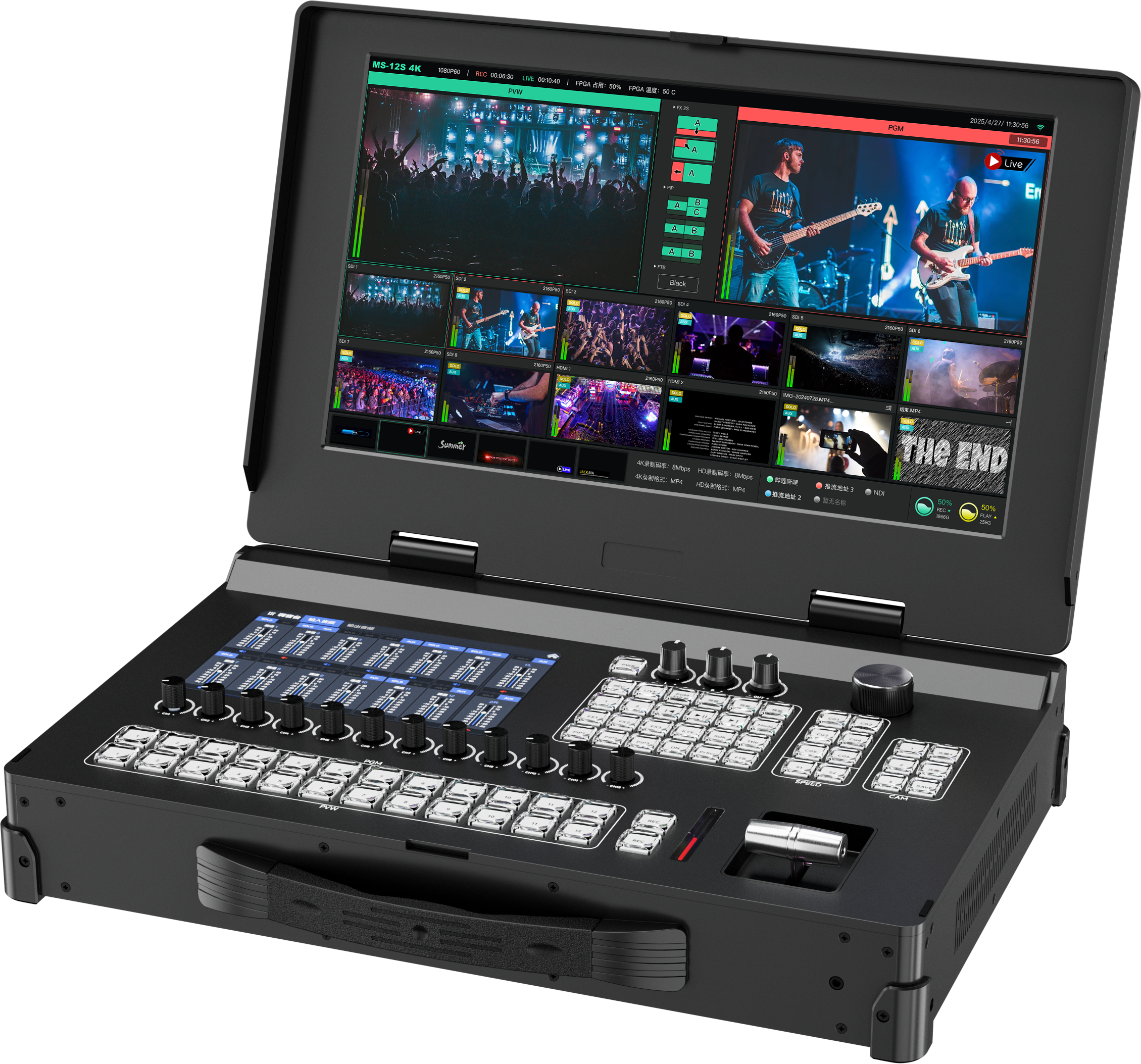
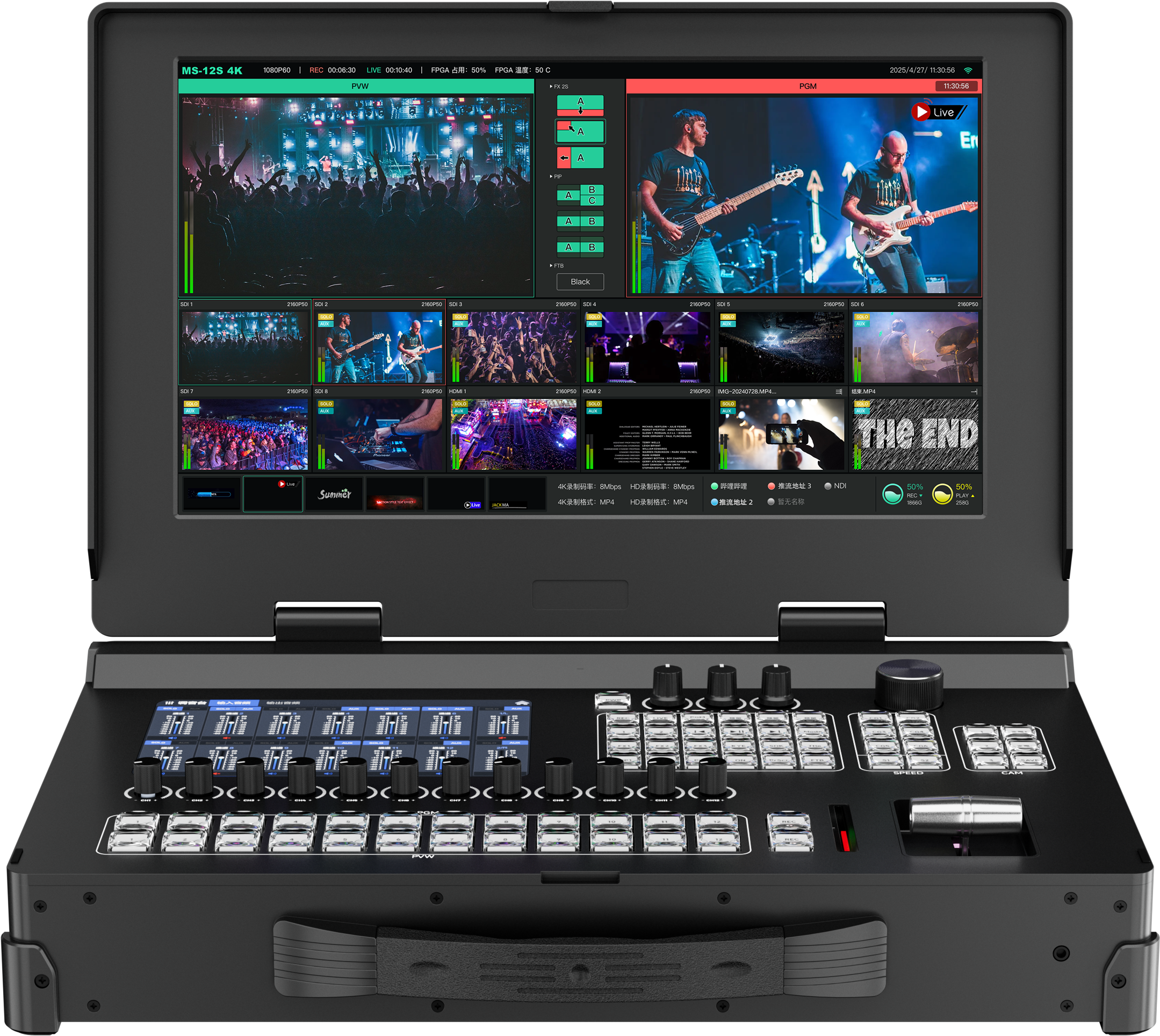
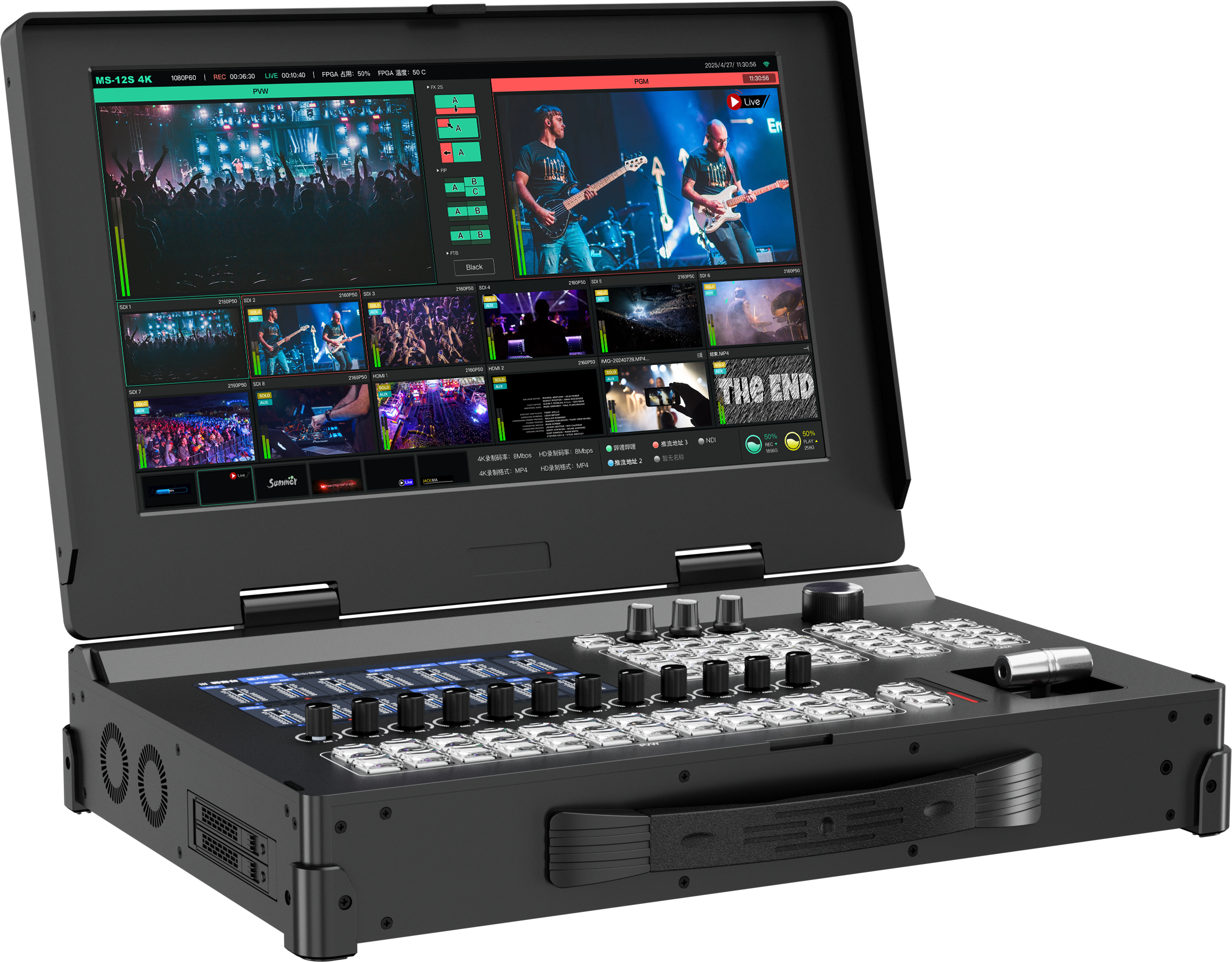
Both reference models use this approach. The TCHD-840 Ultra is described as a full-hardware live production switcher with an independently developed R&D design, built on an embedded FPGA architecture for ultra-high stability. The TCHD-812 Ultra uses the same industrial embedded FPGA architecture and is specified for low-latency, ultra-stable switching that meets professional broadcast standards for studio recording, event relay and high-end live production. Both ship in aluminium alloy housings with an industrial-grade flip-cover form factor, which also serves as the local control surface.
Why this matters for buyers: an FPGA architecture is the reason a switcher can handle 4K@60 switching, hardware streaming and SSD recording at the same time without the internal processing being shared with an operating system. Stability under simultaneous load is an architectural property, not a software setting.
2. The format pipeline: 4K@60, 1080p and 1080i side by side
A production switcher's format support is best read as a full chain — input formats, internal processing, and output formats — rather than a single headline resolution.
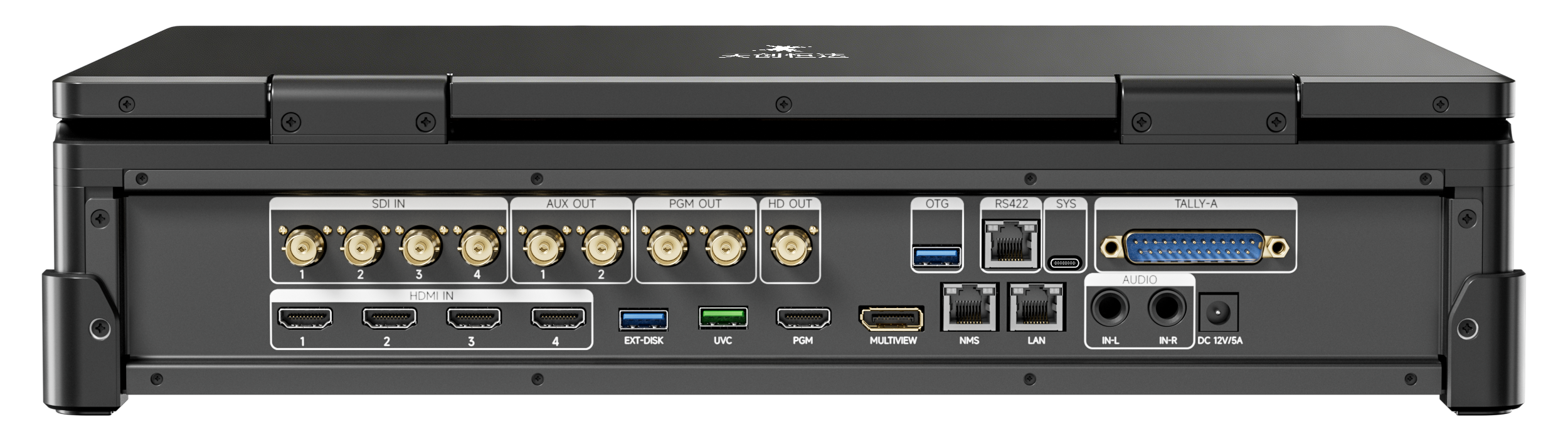
The TCHD-840 Ultra supports 3840×2160p at 60, 59.94, 50, 30, 29.97 and 25; 1080p at 60, 59.94, 50, 30, 29.97 and 25; and 1080i at 60 and 50 across the full signal chain. Its inputs are configurable: at least four 12G-SDI inputs that are compatible with 3G-SDI, or at least four HDMI 2.0 inputs, selectable by configuration. Outputs are similarly structured, with 2×12G-SDI PGM, 2×12G-SDI AUX, a 1×3G-SDI down-converted PGM output, 1×HDMI 2.0 PGM output, and DisplayPort for multi-view.
The TCHD-812 Ultra takes 4×12G-SDI plus 1×HDMI high-bandwidth inputs and supports 4K@60Hz, 1080p and 1080i multi-frame-rate signal processing on the same pipeline. Its 12G-SDI path is the same interface family defined by SMPTE ST 2082, which is what allows uncompressed 4K@60 to travel over a single coax run instead of a bonded quad-link.
3. Outputs, multiview and driver-free UVC
Output design decides how many places the program can go at once. Alongside the SDI and HDMI outputs, both models provide a standard UVC video output: connected to a computer, the switcher is recognized as a high-definition webcam by Windows, macOS and other systems, and works with mainstream streaming, meeting and recording software without driver installation or an external USB capture card.
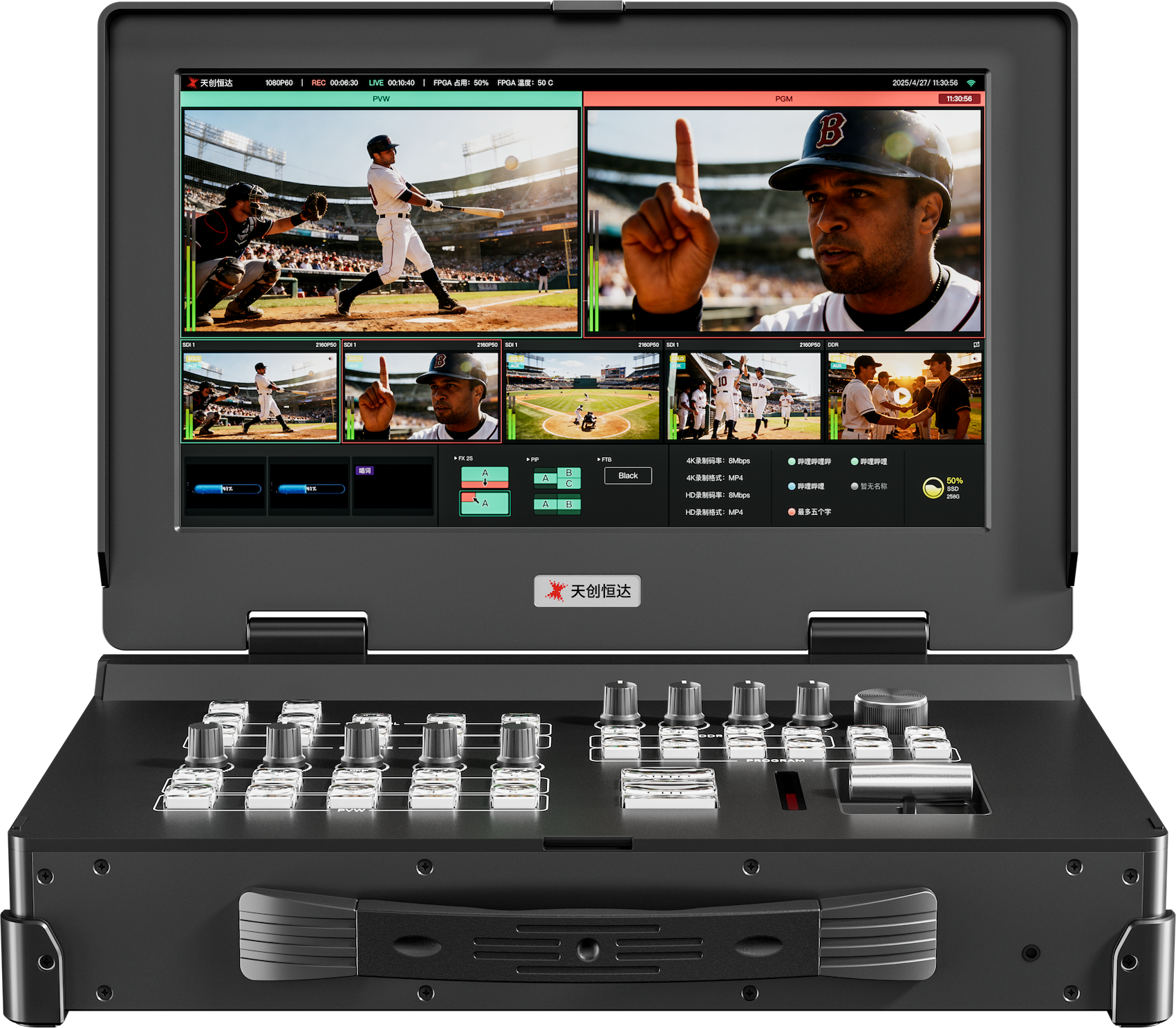
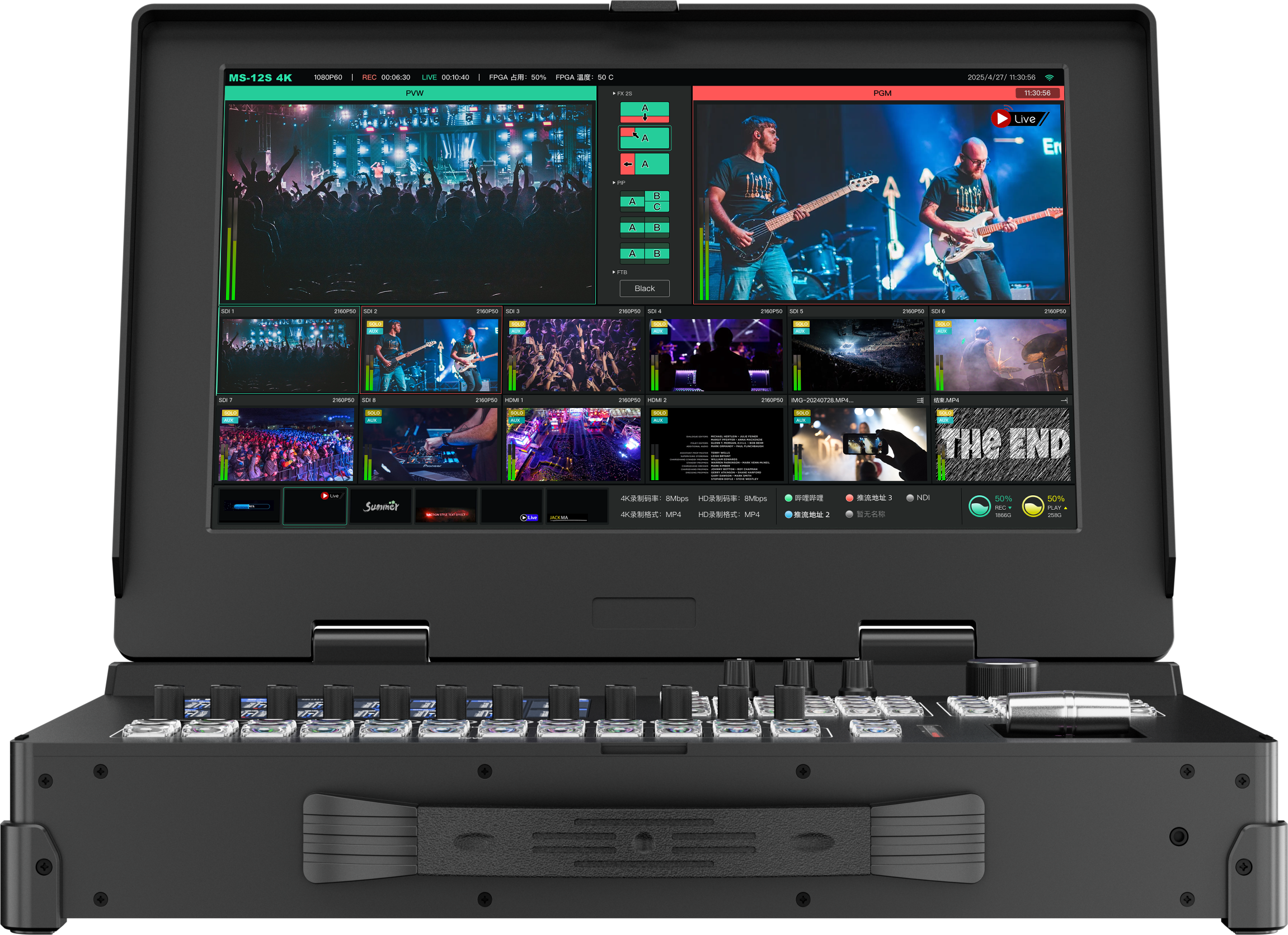
Removing the capture card from the signal chain is a practical simplification. It reduces one device in the rack, one driver dependency, and one more point of failure between the switcher and the encoding software. Multi-view behaviour is configurable on both units: the TCHD-840 Ultra supports single-, dual-, triple- and quad-window PIP and multi-view templates that can be set through the web interface and the touchscreen PIP module, with custom size, position and background image; the TCHD-812 Ultra supports customisable DVE multi-window effects. The 840 Ultra also allows the multi-view interface theme — module colours, menu colours and system fonts — to be customised.
4. The streaming engine: protocols and multi-platform push
Streaming capability should be evaluated by protocol coverage and by how many destinations can be served simultaneously. The TCHD-812 Ultra has a built-in hardware streaming engine supporting RTMP, RTMPS, SRT, RTSP, NDI and GB28181, and can push stable simultaneous streams to four different platforms with editable stream templates. The TCHD-840 Ultra supports RTMP, RTMPS, SRT, RTSP, UDP and NDI with one channel of stream pulling (receiving) and four channels of simultaneous pushing, plus template-based management of both pull-stream and push-stream URLs.
Two consequences follow. First, multi-platform publishing becomes a setting rather than a separate piece of equipment. Second, a switcher that can also receive an inbound stream can integrate a remote guest or a remote camera into the same program as local sources — useful for remote collaboration, hybrid events and multi-site productions.
5. Audio: a 12-channel mixer with up to 2000 ms delay
Audio delay correction is the part of a switcher that viewers notice only when it is missing. Because the video path accumulates processing delay that the audio path does not, the operator needs a way to hold audio back until the two align — and the required correction is not always small.
The TCHD-812 Ultra includes a built-in 12-channel audio mixer with independent volume control and up to 2000 ms of delay adjustment for precise audio-video synchronisation. The TCHD-840 Ultra uses 6.5 mm balanced audio input and output, and provides physical rotary-knob gain control for the audio of each input channel directly on the control panel — a design choice that lets an operator correct a level instinctively during a live show instead of navigating a menu.
A wide delay range is not a luxury. In productions that combine local cameras with remote or heavily processed sources, the video delay introduced upstream can be substantial, and a mixer without enough compensation range leaves the engineer with no option but to delay audio externally.
6. Recording: dual hot-swap SSD slots and segmentation
Recording reliability is decided by three design details: how many storage slots exist, how files are written, and what happens on power loss.
The TCHD-812 Ultra is built with dual hot-swappable SSD slots, with optional 2TB, 4TB or 8TB storage. It records 4K H.265 and HD H.264 at high bitrate, with power-off protection and automatic file segmentation to keep stored material complete and safe. The TCHD-840 Ultra includes a built-in M.2 drive bay for local storage. On the media side, the TCHD-812 Ultra also provides dual independent DDR media playback channels, so pre-produced clips, sponsor videos or filler content can be played from the device itself.
Hot-swap matters in multi-session productions. When a card fills during a break, an SSD can be exchanged without powering the switcher down, which keeps the production window intact. Segmentation matters differently: long continuous files are more vulnerable to corruption, while segmented files limit the loss to the segment being written at the moment of an interruption.
Step-by-Step: Commissioning a Switcher for a Real Show
The sequence below reflects how the specifications translate into configuration work. It is written for a team preparing a multi-camera production on either model.
- Map sources to formats before cabling. List every camera, computer and remote feed with its native resolution and frame rate, then confirm each one is inside the supported range — 3840×2160p up to 60, 1080p up to 60, or 1080i at 60/50. On the TCHD-840 Ultra, decide first whether the input block will be configured as 12G-SDI (3G-SDI compatible) or HDMI 2.0.
- Assign outputs to their destinations. Reserve the primary SDI or HDMI PGM output for the live feed, the AUX outputs for recorders or screens, and the 3G-SDI down-converted output for any legacy 1080p device that cannot accept a 4K signal. Use DisplayPort or the HDMI multiview output for the operator's monitor wall.
- Build the multi-view and PIP layout. Configure single-, dual-, triple- or quad-window templates, then set size, position and background image to match the operator's habits. On the TCHD-840 Ultra this is done through the web interface and the touchscreen PIP module; theme colours and fonts can be adjusted at the same stage.
- Configure streaming destinations. Enter each platform's stream URL and key into the template list, then verify that the required protocols (RTMP, RTMPS, SRT, RTSP, UDP, NDI, and GB28181 on the TCHD-812 Ultra) are available for the destinations in use. Confirm the number of simultaneous pushes — four on both models — against the actual publishing plan.
- Set recording and storage. Choose the recording resolution and codec (4K H.265 or HD H.264 high bitrate), install the SSD capacity tier that matches the session length, and confirm automatic file segmentation is active. Decide in advance how media playback channels will be used for filler content.
- Align audio last, with the show running. Run the full signal chain with live microphones, then use the audio mixer to correct levels per channel and apply delay until lip sync is correct. On the TCHD-812 Ultra the delay range extends to 2000 ms; on the TCHD-840 Ultra, per-channel gain is set with the physical rotary knobs on the panel.
- Rehearse the emergency path. Confirm the one-click emergency function — output to black or colour bars — behaves as expected, and agree on who is authorised to trigger it.
Steps one through three usually take the longest and pay back the most, because they determine whether the operator ever has to think about formats again during the show.
Use Cases: Where These Specifications Change the Result
Specification value depends on the production format, and the four subsystems above map to different scenarios in different ways.
- E-commerce live streaming. Long sessions, one-click switching between landscape 16:9 and portrait 9:16, and simultaneous pushes to several platforms. Dual hot-swap SSD recording secures the session for later repurposing, and the audio mixer keeps host microphones aligned while the programme runs for hours.
- Houses of worship and education. Multiple cameras at mixed resolutions, volunteer operators, and a need for a layout that can be understood quickly. Multi-view templates, subtitle and title overlays, and a driver-free UVC output that feeds standard streaming software without a capture card reduce setup complexity.
- Esports tournaments and sports events. Fast switching between cameras, instant replay handled by companion control surfaces, and simultaneous delivery to several viewing platforms. Broadcast-grade 12G-SDI inputs keep camera runs simple; discrete PGM and AUX outputs feed screens and recorders separately.
- Virtual studios and corporate conferences. Chroma-key and luminance-key functions combined with multi-window layouts allow a presenter to sit inside generated backgrounds; dual DDR playback channels supply pre-produced content from inside the switcher.
- Clinical demonstration and lecture recording. Rooms where a single, unrepeatable session must be captured reliably benefit most from power-off protection, automatic file segmentation and dual SSD slots, because repeating the session is not an option.
- Campus TV and converged media centres. One switcher serving multiple outputs — broadcast feed, internal screens and IP platforms — with the 3G-SDI down-converted output covering legacy campus distribution equipment.
TCHD-812 Ultra vs TCHD-840 Ultra: Specification Comparison
The two models share an FPGA-based architecture and aluminium alloy housing, and differ mainly in recording design, audio control method and output structure. The table below lists only published specifications.
| Specification | TCHD-812 Ultra | TCHD-840 Ultra |
|---|---|---|
| Switching architecture | Industrial embedded FPGA architecture | Full-hardware design built on embedded FPGA architecture, independently developed R&D |
| Housing / form factor | Aluminium alloy | Aluminium alloy, industrial-grade flip cover |
| Local display | 17.3-inch full HD screen | ≥15.6-inch main display |
| Video inputs | 4×12G-SDI + 1×HDMI | ≥4×12G-SDI (3G-SDI compatible) or ≥4×HDMI 2.0, selectable |
| Supported formats | 4K@60Hz, 1080p, 1080i multi-frame-rate | 3840×2160p 60/59.94/50/30/29.97/25; 1080p 60/59.94/50/30/29.97/25; 1080i 60/50 |
| Video outputs | Not detailed in the published specification | 2×12G-SDI PGM, 2×12G-SDI AUX, 1×3G-SDI PGM down-convert, 1×HDMI 2.0 PGM, 1×DisplayPort multiview, 1×UVC |
| UVC output | Yes — recognised as a webcam, no driver or capture card | Yes — recognised as a webcam, no driver or capture card |
| Audio | 12-channel mixer, independent volume control, up to 2000 ms delay | 6.5 mm balanced audio in/out, physical rotary-knob gain control per input channel |
| Recording | Dual hot-swappable SSD slots, optional 2TB/4TB/8TB; 4K H.265 and HD H.264 high-bitrate; power-off protection; automatic file segmentation | Built-in M.2 drive bay |
| Media playback | Dual independent DDR media playback channels | Not detailed in the published specification |
| Streaming | RTMP, RTMPS, SRT, RTSP, NDI, GB28181; 4-platform simultaneous push; editable stream templates | RTMP, RTMPS, SRT, RTSP, UDP, NDI; 1-channel pull and 4-channel push; template-based URL management |
| Other interfaces | Not detailed in the published specification | 1×RS422, 2×RJ45, 1×TALLY, 1×OTG, 1×USB 3.0 |
| Orientation modes | One-click landscape (16:9) / portrait (9:16) | One-touch landscape (16:9) / portrait (9:16) |
| Emergency function | One-click emergency output | One-touch switch of output to black or colour bars |
For buyers, the decision usually narrows to two questions. If safe, high-capacity recording during long sessions is the priority, the dual hot-swap SSD slots and 2000 ms audio delay range of the TCHD-812 Ultra address that directly. If the priority is a broader output matrix — separate PGM and AUX paths, a down-converted output for legacy equipment, and a wider set of control interfaces including RS422, TALLY and USB 3.0 — the TCHD-840 Ultra covers those requirements.
FAQ: Technical and Procurement Questions Buyers Ask
Does a 4K@60 production switcher have to comply with a specific interface standard?
Yes. The cable and interface behaviour behind 4K@60 over coaxial is defined by the 12G-SDI standard (SMPTE ST 2082), which carries uncompressed 4K video at 60fps at a data rate of 11.88 Gbps over a single coaxial cable. Both the TCHD-812 Ultra and the TCHD-840 Ultra use 12G-SDI inputs, and the TCHD-840 Ultra's 12G-SDI inputs are compatible with 3G-SDI for older sources. For importers, video mixing systems or consoles are classified under HS Code 85437062 in various customs jurisdictions, which is the code to confirm with a customs broker when preparing documentation.
Can one hardware switcher switch 4K@60, stream to multiple platforms and record at the same time?
It can when those functions are handled by separate hardware blocks rather than by a shared operating system. The TCHD-812 Ultra switches 4K@60 signals from 4×12G-SDI and 1×HDMI inputs while its hardware streaming engine pushes to four platforms and its dual SSD slots record 4K H.265 or HD H.264 at high bitrate, with automatic file segmentation and power-off protection running in the background. The TCHD-840 Ultra performs full-link 4K@60Hz processing with 1-channel stream reception and 4-channel simultaneous pushing, and records to its built-in M.2 drive bay.
Which configuration choices affect the overall cost of a switcher deployment?
Cost in this category is driven by configuration rather than by a single price point. The variables that move a budget most are: the input interface type and count (12G-SDI versus HDMI 2.0, and how many of each); the recording storage tier, since the TCHD-812 Ultra is offered with 2TB, 4TB or 8TB SSD options; the number of simultaneous streaming destinations required; and whether external capture hardware is needed at all — both models output UVC natively and are recognised as webcams without a capture card, which removes that item from the equipment list. Output expansion, including separate PGM and AUX paths and a 3G-SDI down-converted output on the TCHD-840 Ultra, is another factor when legacy equipment remains in the signal chain.
How should a team validate a switcher before committing to full deployment?
Validation should reproduce the conditions of the actual show rather than a bench test. Practical checks include: running every camera at its native format (4K@60, 1080p or 1080i) through the switcher to confirm the pipeline handles the mix; verifying the streaming protocols and destination templates you actually publish to; recording to SSD and confirming that automatic file segmentation produces usable, complete files; and running a full-length rehearsal with live microphones so audio delay can be tuned against real content rather than test tones. A demo unit requested from the manufacturer makes these checks possible on your own cameras and cable runs before purchase. TCHD Video accepts technical inquiries and sample/demo discussions — contact the team with your source list and publishing plan.
How is delivery planning handled for a configured switcher model?
Because the TCHD-812 Ultra and TCHD-840 Ultra are configured at order stage — input interface selection, SSD capacity tier, and the audio and output options that differ between the two models — the schedule depends on the specific configuration rather than on a single stock item. TCHD Video produces approximately 4,000 units per year from a 10,000 m² facility in Beijing, supported by a 10-engineer R&D team, and serves markets across the EU, USA and Asia. Confirm the delivery window for your configuration and destination before finalizing a project timeline.
Conclusion: The Four Layers Decide the Show
A production switcher is not defined by its panel layout. It is defined by an FPGA switching fabric that executes transitions in fixed time, a format pipeline that accepts 4K@60, 1080p and 1080i without forcing external conversion, an audio mixer with enough delay range to realign sound with processed video, and a recording subsystem designed so that no session is lost to a power interruption or an oversized file.
Read together, the TCHD-812 Ultra and TCHD-840 Ultra illustrate two valid configurations of those four layers. The 812 Ultra leans toward recording security and audio range — dual hot-swap SSD slots with 2TB, 4TB or 8TB options, 4K H.265 and HD H.264 high-bitrate capture, and a 12-channel mixer with up to 2000 ms delay. The 840 Ultra leans toward signal flexibility — selectable 12G-SDI or HDMI 2.0 inputs, a wider output matrix with PGM, AUX and 3G-SDI down-conversion, 6.5 mm balanced audio with rotary gain control, and a built-in M.2 drive bay.
For teams working through the Research and Evaluation stages, the most useful next step is not a longer specification list but a test with real sources. Define the show, list the formats and destinations, and validate the switcher against that list.
Next Step: Specification Sheet, Demo and Quote
Request the full TCHD Video product catalogue with complete switcher specifications, or send your source list and publishing plan for a configuration recommendation and quotation.
Download the TCHD Product Catalog 2025 (PDF)
Email: tomzhang@tchdvideo.com | Tel: +86-13910334207 | WhatsApp: +86 19498872019
Website: www.tchdvideohk.com | Address: Room#411, Building#1, Yard#9, Lianqiao 2nd street, Haidian district, Beijing, China
Have Questions or Need More Details?
Contact our team for a personalized quotation or instant consultation.
Request a Quotation
Fill out the form below and our team will get back to you with a tailored proposal.
WhatsApp Direct Chat
Prefer to chat in real-time? Message us on WhatsApp for instant assistance & quick answers.
- Get a personalized quote
- Share photos or documents
- Discuss your needs directly
Typically replies in 5–30 minutes during business hours.