Production Switcher Compliance Guide: Standards & Regions
Production Switcher Compliance Guide: Standards & Regions
Production switcher compliance is a model-and-market-specific evidence question, not a brand-level label. A live stream switcher headed for a European classroom, a North American corporate auditorium, a hospital surgical demo suite and a broadcast facility in China can carry different documentation for each destination, and a certificate issued for one product family does not automatically extend to another. The practical test for a buyer is narrower than a datasheet claim: does the supplier hold a document that names the exact model, the exact configuration and the exact destination market, and can that document be matched to a laboratory test report?
This guide explains which standards normally enter a production switcher review, how high-bandwidth interfaces such as 12G-SDI and HDMI 2.0 and streaming protocols such as RTMP, RTMPS, SRT, RTSP, NDI and GB28181 affect the compliance conversation, and how full-hardware FPGA switching, aluminum alloy housings and hot-swappable SSD recording relate to safety and EMC files. The TCHD-812 Ultra, TCHD-840 Super, TCHD-840 Ultra and TCHD-890HS from TCHD Video are used throughout as reference points for the interface questions procurement teams actually ask.
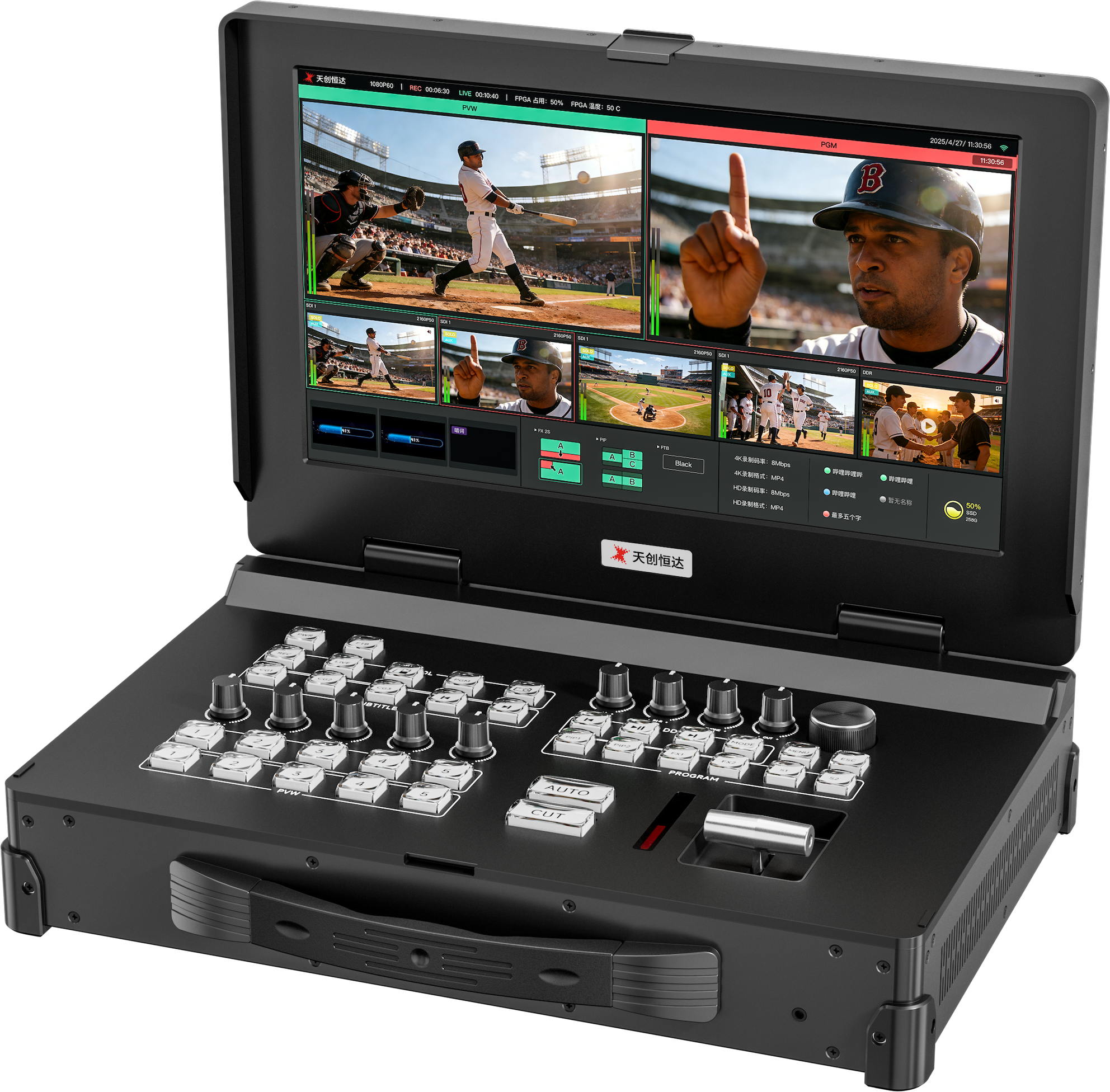 TCHD-840 Ultra: optional 12G-SDI or HDMI 2.0 inputs, 12G-SDI PGM/AUX outputs, RS422 and TALLY control ports.
Problem definition: why switcher compliance is harder than it looks
A modern live stream switcher is not a single regulatory object. One chassis typically contains high-bandwidth digital video receivers, an embedded processing core, a network stack, a storage subsystem, a user-interface panel with a built-in display, an audio mixer and a set of industrial control ports. Each of those elements can pull the product into a different test path, and the sum is what a customs officer, an AV integrator or an institutional procurement team is asked to accept on trust.
Three structural problems make that trust hard to establish without documents.
- The certificate scope problem. A certificate names products. When a buyer sees a supplier claim of "CE certified" or "EMC compliant" without a model list, there is no way to know which chassis, which power supply and which interface board were actually tested.
- The configuration problem. Switchers are frequently sold with selectable inputs. The TCHD-840 Ultra and TCHD-840 Super, for example, are documented with either four or more 12G-SDI inputs or four or more HDMI 2.0 inputs, selectable by configuration. A test performed on one input set does not automatically describe the other.
- The family-transfer problem. Buyers often assume a certificate for one product in a manufacturer's catalogue covers the whole range. It usually does not. In the material supplied for this guide, the CE EMC attestation, ISO 9001, ISO 14001 and ISO 45001 certificates all describe live streaming cameras; they are not switch certificates, and a switcher purchase needs its own evidence.
Industry background: where compliance documentation is now scrutinised
Compliance paperwork has moved from a filing cabinet item to a purchasing gate. The shift follows the same path as the technology: production switchers have absorbed IP networking, multi-platform publishing and software configuration, so the number of parties who need assurance has grown from the broadcast engineer alone to include IT security, facilities, procurement and, in institutional settings, a tender committee.
The commercial context supports that attention. Precision Reports estimates the global production switcher market at USD 2,596.79 million in 2025, driven by IP-based broadcasting and multi-camera streaming transitions. Fortune Business Insights projects the broader video switcher market reaching USD 11.48 billion by 2034 at a 7.10% CAGR from 2026, but its scope includes switching equipment beyond production-specific vision mixers. The two figures are not interchangeable, and that definition gap is itself a useful warning: as with market sizing, so with compliance scope — read the definition before accepting the number.
The manufacturer profile matters too. TCHD Digital Video Technology Development (Beijing) Ltd, trading as TCHD Video, was established in 2005 and supplies video software and hardware products and application systems. Company information records a 10,000 m² factory, approximately 50 employees, an annual output of 4,000 units, a 10-engineer R&D team and an export ratio of about 20%, with main markets in the EU, USA and Asia. A supplier with an active export mix usually maintains destination-specific documentation, but the buyer still has to check that the file in front of them names the model in the purchase order.
The five compliance categories that appear in a regional review
Most production switcher reviews collapse into five categories. They are worth separating because each produces a different kind of document, and a supplier can be complete in one and thin in another.
1. Electrical safety
Safety testing addresses whether the equipment can injure someone under normal operation and under single-fault conditions — insulation, creepage and clearance distances, temperature rise, enclosure strength, and the behaviour of the power inlet. The internationally recognised baseline for audio/video and IT equipment is IEC 62368-1, which replaced the older IEC 60950-1 and IEC 60065 frameworks. National adoption differs by market, and North American listings are typically issued through a nationally recognised testing laboratory. A switcher with an internal power supply, a metal enclosure and an external adapter has several safety-relevant subassemblies, so the report should describe them.
2. EMC: emissions and immunity
Electromagnetic compatibility splits into two questions. Emissions ask whether the device disturbs other equipment; immunity asks whether the device keeps working when disturbed. For multimedia equipment, the EN 55032 family is the commonly cited emissions standard and the EN 55035 family covers immunity. A production switcher is a demanding EMC subject because it radiates from several intentional and unintentional sources at once: 12G-SDI transmitters, HDMI 2.0 transmitters, Ethernet magnetics, USB and the internal switching power supply. This is why an EMC certificate should never be read as a general statement about a brand — it describes a tested configuration.
3. Market-access marks and the declaration of conformity
The visible mark on the rear panel is the end of a paper trail, not the start of one. In the EU, CE marking is backed by an EU Declaration of Conformity that identifies the manufacturer, the product, the applicable directives and the standards applied. In North America, an FCC equipment authorisation or a supplier's declaration applies to unintentional radiators, and the class designation (Class A for commercial environments, Class B for residential) changes the limits. The UK uses UKCA, Korea uses KC, Japan uses VCCI for EMC and PSE for electrical safety, and Australia and New Zealand use the RCM. Each of these systems expects a responsible local entity or importer in most cases.
4. Environmental, hazardous-substance and waste obligations
RoHS restricts hazardous substances in electrical equipment and WEEE places take-back and marking duties on producers and importers in the EU. These obligations attach to the product, not only to the factory, and they are frequently checked alongside safety and EMC in institutional tenders. Management-system certificates are a separate layer: ISO 9001 addresses quality management, ISO 14001 addresses environmental management and ISO 45001 addresses occupational health and safety. They evidence how a manufacturer runs its processes — they do not certify that a specific switcher passes EMC.
5. Customs classification and import documentation
HS Code 85437062 is classified for video mixing systems or consoles in various customs jurisdictions. Correct classification affects duty, and an incorrect code can stall a shipment independently of any technical compliance question. Buyers importing switchers should confirm the code on the commercial invoice matches the classification applied in the destination country and that the technical description on the invoice matches the model actually shipped.
How interface and protocol standards enter the compliance review
Interface standards do not usually create a separate certificate of their own, but they shape what the laboratory has to test and what the buyer should ask about. The four TCHD reference models carry a representative mix.
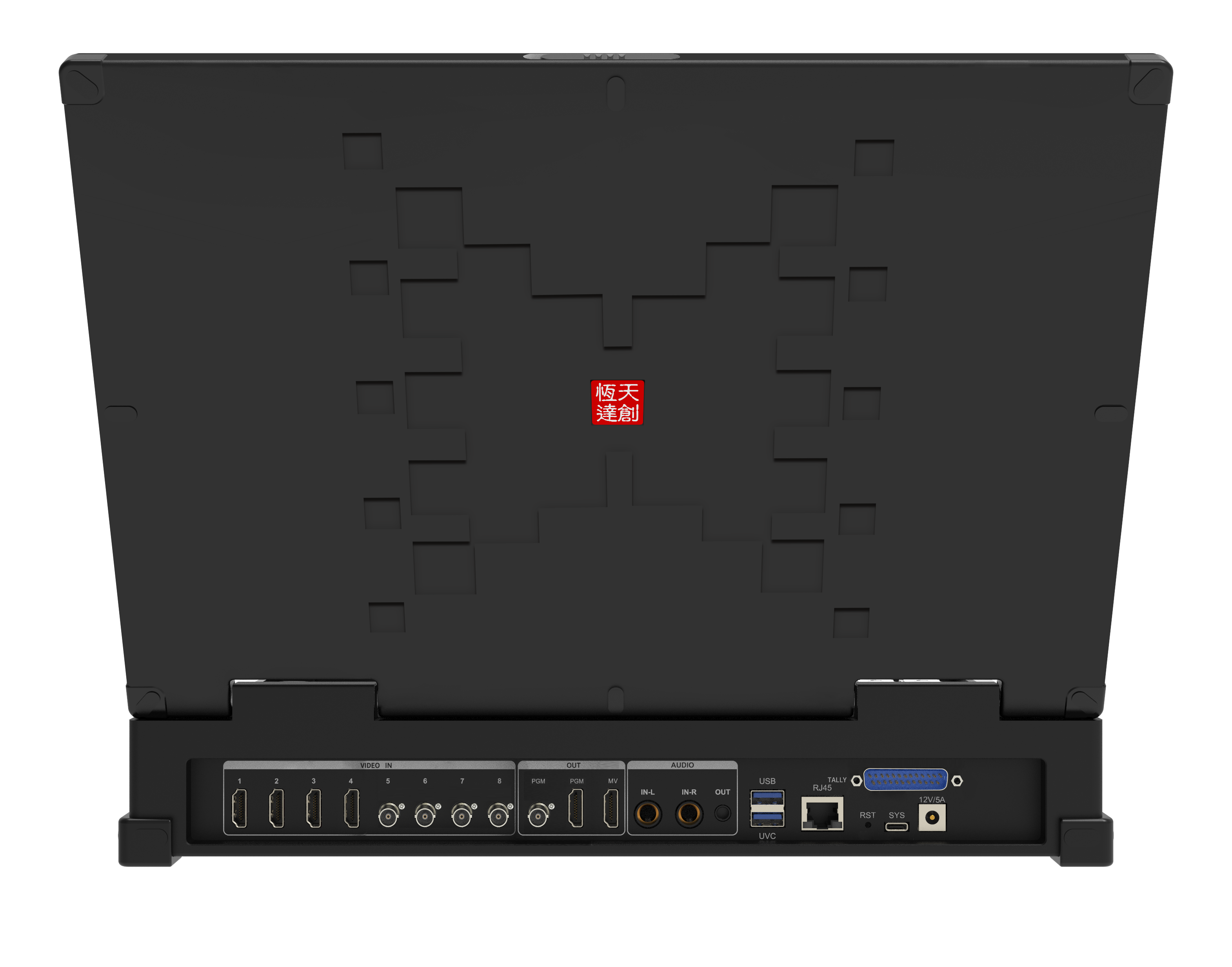 TCHD-890HS interface layout: 4x HDMI and 4x SDI inputs, HDMI and SDI PGM outputs, UVC USB-A output, 1000 Mbps RJ45 and a Tally interface.
12G-SDI and SMPTE ST 2082
The 12G-SDI standard (SMPTE ST 2082) supports uncompressed 4K video at 60 fps over a single coaxial cable at a data rate of 11.88 Gbps. That data rate is the compliance-relevant detail. A very high-frequency signal leaving a chassis through a BNC connector is exactly the kind of source an emissions test is designed to characterise, and the cable, connector quality and shielding practice on site all influence real-world behaviour. The TCHD-812 Ultra is documented with 4x 12G-SDI plus 1x HDMI inputs, and the TCHD-840 Ultra and TCHD-840 Super with four or more 12G-SDI inputs in their SDI configuration.
HDMI 2.0
HDMI 2.0 is a licensed interface specification, so compliance has two layers: the regulatory EMC and safety testing that applies to any digital transmitter, and the adopter agreement obligations that apply to the interface implementation itself. In practice, buyers should ask a simpler question — whether the tested configuration included the HDMI input variant, not only the SDI variant. Because the TCHD-840 Ultra and TCHD-840 Super offer 12G-SDI or HDMI 2.0 as selectable input sets, a procurement file should state which variant is being purchased and confirm the corresponding test coverage.
UVC webcam output
UVC (USB Video Class) output lets the switcher present itself to a host computer as a standard webcam without a driver or a separate capture card. On the TCHD-812 Ultra, TCHD-840 Ultra, TCHD-840 Super and TCHD-890HS this is a documented output path. From a compliance standpoint, UVC is attractive because it removes a third-party capture device from the signal chain and the associated driver stack from the deployment. What it does not remove is the USB interface itself: USB enumeration, bus power and the connector still fall inside the safety and EMC test envelope, so the USB port should appear in the test report scope.
RTMP, RTMPS, SRT, RTSP and NDI
Streaming protocols are software-layer behaviour and generally do not alter the hardware certification category. They do, however, affect the operational risk profile. RTMPS and SRT add encrypted transport options relative to plain RTMP, which matters to IT and security reviewers in enterprise and healthcare settings even though no regulator certifies a protocol choice. NDI, as an IP video transport, pushes significant traffic across the network and may require a network-segmentation conversation with the site's IT team. The TCHD-840 Ultra and TCHD-840 Super are documented with RTMP, RTMPS, SRT, RTSP, UDP and NDI, supporting one-channel stream reception and four-channel simultaneous pushing; the TCHD-890HS is documented with RTMP, RTSP, HLS, FLV, UDP, NDI and NVI and up to six simultaneous streaming outputs.
GB28181
GB28181 is a Chinese national standard for networked video surveillance and monitoring integration. Its presence on the TCHD-812 Ultra protocol list is a regional-integration feature rather than a global certification. For a deployment inside China that must connect to a public-security or campus surveillance platform, the standard is directly relevant; for a European classroom it is not. Buyers should treat GB28181 support as a market-fit question and confirm the integration requirement with the platform operator, not with the switcher's EMC file.
TALLY and RS422 control interfaces
Tally and RS422 are low-speed industrial control paths, but they are external conductors entering the chassis. That makes them relevant to immunity and electrostatic-discharge testing rather than to data-rate-driven emissions. The TCHD-840 Ultra and TCHD-840 Super are documented with one RS422 port, two RJ45 ports and one TALLY port; the TCHD-890HS with a Tally interface and a 1000 Mbps RJ45 LAN port. In studio installations where long control cable runs pick up noise from lighting dimmers, the immunity test result is worth requesting explicitly.
How hardware design affects safety and EMC documentation
Engineering choices do not replace certification, but they change how much of the compliance story a supplier can defend.
Full-hardware FPGA switching architecture
The TCHD-812 Ultra, TCHD-840 Ultra and TCHD-840 Super are built on an embedded FPGA architecture rather than a general-purpose operating system, and the TCHD-840 Ultra in particular is documented as an independently developed, self-researched domestic R&D design. For compliance purposes the benefit is a smaller attack and patch surface: there is no third-party application layer to keep patched, which simplifies security review and reduces the chance of a configuration change invalidating a tested state. It does not by itself produce an EMC pass — that still requires a laboratory.
Aluminum alloy housings
All four reference models use aluminum alloy housings. Metal enclosures contribute shielding, heat spreading and structural rigidity, all of which are positive inputs to an EMC and safety design. The compliance point is that the enclosure is part of the tested article: a buyer comparing a production unit against a test report should confirm the report describes the same enclosure and connector layout as the shipping product.
Hot-swappable SSD recording
The TCHD-812 Ultra is documented with dual hot-swappable SSD slots with optional 2TB, 4TB or 8TB capacity, supporting 4K H.265 and HD H.264 recording, power-off protection and automatic file segmentation. Hot-swap is a usability feature, but the storage bay, the drive power rail and the removal action under load are all things a safety assessment can reasonably ask about. The TCHD-840 Ultra and TCHD-840 Super are documented with a built-in M.2 drive bay, and the TCHD-890HS with a single internal SSD slot plus USB 3.0 recording in MP4, TS and AVI. In all cases the documentation should state the storage options that were assessed.
Regional requirements at a glance
The table below summarises the frameworks most often cited for live production equipment. It is a starting point for a procurement conversation, not a substitute for the destination market's current regulation or for advice from a qualified compliance professional.
| Market | Typical market-access framework | What the buyer should request |
|---|---|---|
| European Union | CE marking; EMC Directive 2014/30/EU and Low Voltage Directive 2014/35/EU where applicable; RoHS 2011/65/EU; WEEE 2012/19/EU | EU Declaration of Conformity naming the exact model; EMC and safety test reports; RoHS and WEEE statements |
| North America | FCC equipment authorisation or supplier's declaration for unintentional radiators; Class A or Class B limits; NRTL safety listing | FCC identification or declaration; NRTL listing certificate referencing the model |
| United Kingdom | UKCA marking | UKCA declaration and the designated standards applied |
| China | CCC where applicable; SRRC for radio; GB standards; GB28181 for networked video integration | CCC certificate scope; GB28181 integration confirmation where required |
| Japan | VCCI for EMC; PSE for specified electrical products | VCCI membership or test evidence; PSE status if in scope |
| Korea | KC marking | KC certificate with model list |
| Australia / New Zealand | RCM | Supplier declaration and test evidence |
| Customs (all markets) | HS classification, e.g. 85437062 for video mixing systems or consoles | Invoice description, classification and origin documents matching the shipped model |
Step-by-step: how to verify compliance for a specific switcher
The verification sequence below is written for a procurement or AV engineering team that has already selected a candidate model. It works whether the supplier is domestic or an importer.
- Write down the exact model and configuration. "TCHD-840 Ultra" is not enough. Record whether the unit is the 12G-SDI input variant or the HDMI 2.0 input variant, whether an M.2 drive is fitted, and which storage capacity is supplied. The TCHD-840 Ultra and TCHD-840 Super are both documented with selectable input sets, so this step is not a formality.
- Request the declaration of conformity first, not the certificate. The declaration names the manufacturer, the product and the directives applied. If a supplier can only produce a certificate image with no accompanying declaration, that is a gap worth noting.
- Check the model list on the certificate against the purchase order. A certificate that names a different model is not evidence for your unit. This is the single most common failure point in switcher procurement.
- Match the certificate to a laboratory test report. The certificate is the conclusion; the report is the evidence. Ask for the report reference and confirm the tested configuration and interface list.
- Confirm the destination market is covered. A CE EMC attestation does not answer an FCC question, and a domestic Chinese certificate does not answer a European one. Map every document to a market.
- Check validity dates and issuing body. Some certificates carry an explicit validity window; others are open-ended. Either way, record the issue date, the issuing laboratory and any expiry date in the procurement file.
- Separate product certification from management-system certification. ISO 9001, ISO 14001 and ISO 45001 describe how the organisation is run. They support a supplier assessment but they do not certify an individual switcher's EMC performance.
- Verify the customs classification. Confirm the HS code used on the invoice, check it against the destination tariff schedule and make sure the technical description matches the shipped model.
Worked example of the scope trap. The material supplied for this guide includes a CE EMC Attestation of Compliance, number LCSA07075157E, issued by LCS TESTING LABORATORY to standard EN 55032:2015/A1:2020, issued 2025-07-16 and valid until 2099-07-16. It also includes ISO 9001:2015, ISO 14001 (GB/T24001-2016/ISO14001:2015) and ISO 45001:2018 certificates from BEIJING STANDARD CERTIFICATION CENTRE. All of these describe the TC-980S, TC420 and TCHD-T3 live streaming cameras. They are evidence of how the manufacturer documents its camera line. They are not switch certificates, and a procurement file for a TCHD-812 Ultra, TCHD-840 Super, TCHD-840 Ultra or TCHD-890HS must request the corresponding model-specific documents separately.
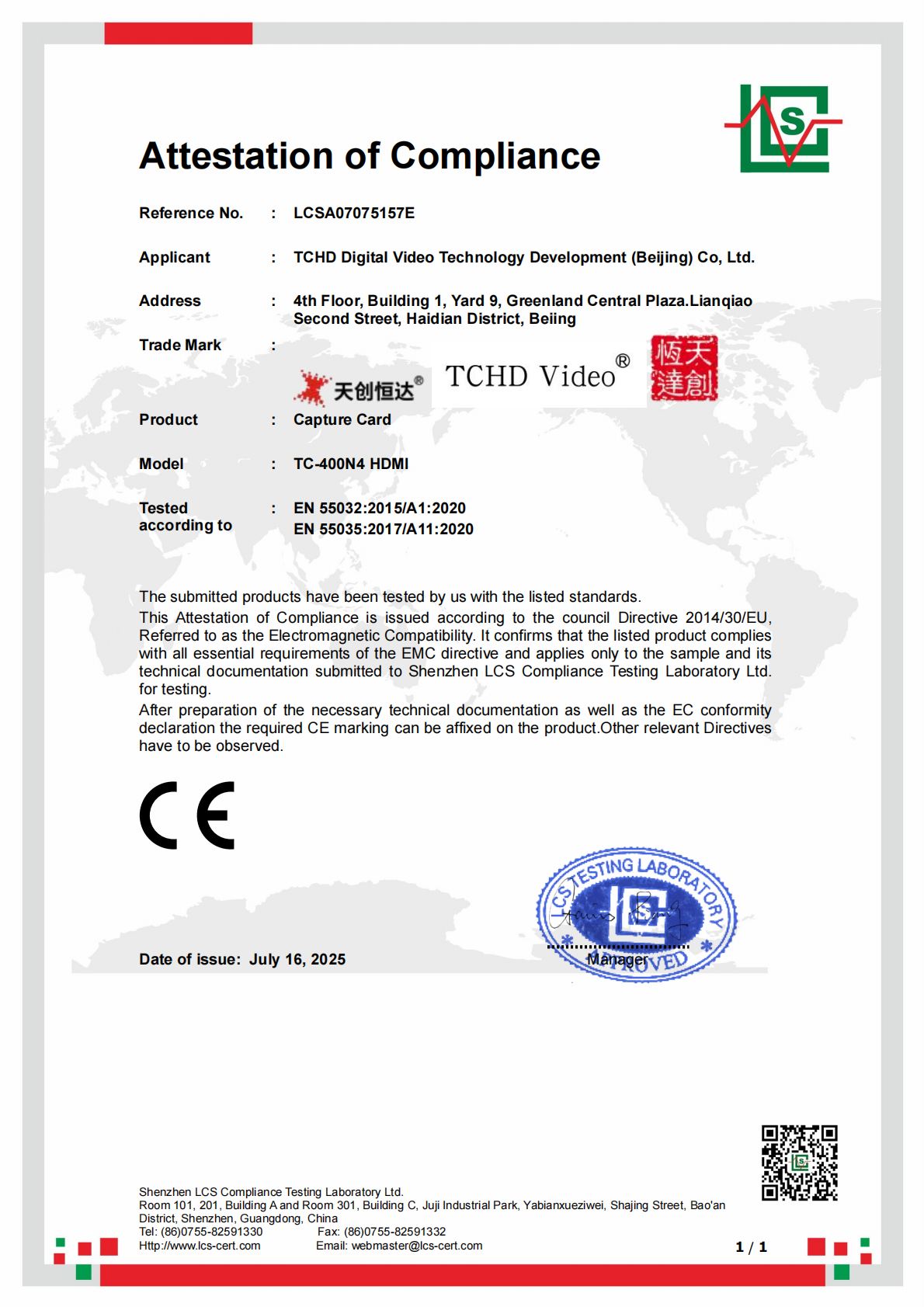 Example of the certificate format: CE EMC Attestation LCSA07075157E from LCS TESTING LABORATORY to EN 55032:2015/A1:2020. This attestation covers the TC-980S live streaming camera, not the switcher range.
Deployments where standards scrutiny is highest
Different environments apply the same standards with very different levels of patience. Four settings account for most of the detailed scrutiny a live stream switcher will meet.
Education and campus facilities
Schools, universities and campus media centres usually buy through tender or framework agreements, and the tender documents frequently require a declaration of conformity as a pass/fail item. Lecture capture, smart classroom builds and campus TV studios all run long duty cycles with non-specialist operators, so safety documentation and a stable, fan-managed enclosure matter as much as switching features. The TCHD-812 Ultra, TCHD-840 Ultra and TCHD-890HS are all documented for education and remote teaching scenarios.
Corporate and conference environments
Corporate AV teams increasingly hand switcher specifications to IT security for review. That review will ask about network exposure, encrypted streaming options and firmware update paths well before it asks about EMC. RTMPS and SRT support, documented web-UI and USB firmware upgrade routes, and a hardware architecture without a general-purpose operating system all shorten that conversation. The TCHD-840 Ultra and TCHD-840 Super are documented for corporate conference and business presentation scenarios.
Healthcare and surgical demonstration
Medical teaching suites place a switcher next to diagnostic and imaging equipment, which raises the practical importance of immunity performance rather than just emissions. A device that behaves well when disturbed is a clinical workflow concern, not only a regulatory one. Documentation confirming the immunity standard applied — rather than only an emissions certificate — is the relevant request here. The manufacturer's TC-UV08 broadcast control panel is separately documented for the healthcare industry alongside corporate, education and content creation use.
Broadcast and professional production
Broadcast facilities tend to have an engineer who reads the test report rather than the certificate, and they will compare the tested configuration against the installed signal chain. For 12G-SDI-heavy builds, the questions are cable practice, connector quality and whether the tested unit included the SDI input variant. The TCHD-812 Ultra, with 4x 12G-SDI plus 1x HDMI inputs and 4K@60Hz processing on an embedded FPGA architecture, is the reference model in this guide most directly aimed at studio and event-relay production.
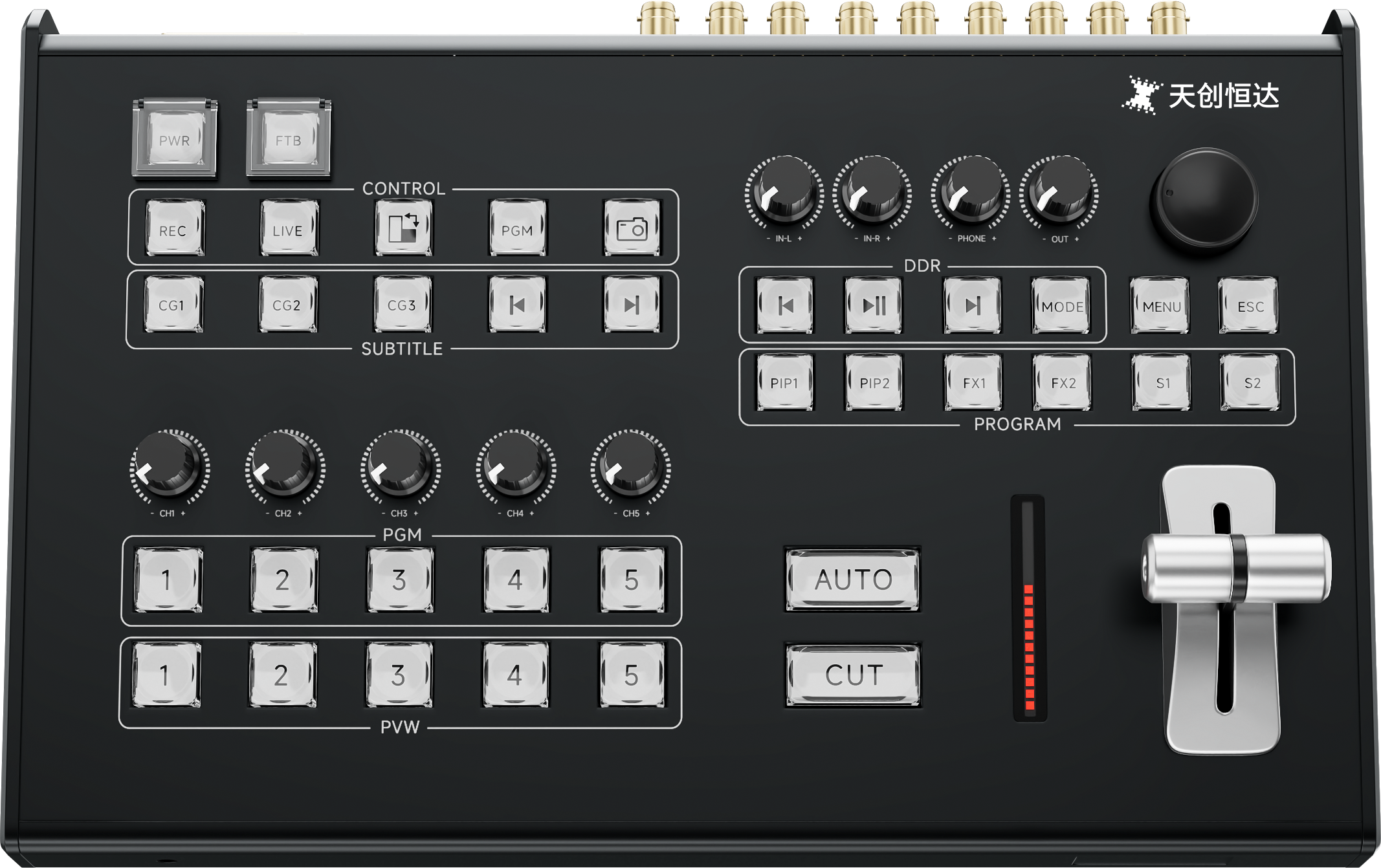 TCHD-840 Super: selectable 12G-SDI or HDMI 2.0 inputs, 12G-SDI PGM/AUX plus 3G-SDI down-conversion and HDMI 2.0 PGM outputs.
Reference models: which compliance questions to raise
The table maps the documented interface facts of the four reference models to the compliance question each one raises. It does not assert that any certification has been obtained for these switchers — it identifies what a buyer should confirm in the supplier's file.
| Model | Documented video inputs | Documented interfaces | Documented streaming | Documented recording | Compliance question to raise |
|---|---|---|---|---|---|
| TCHD-840 Ultra | Four or more 12G-SDI (3G-SDI compatible) or four or more HDMI 2.0, selectable; one 6.5 mm balanced audio input | UVC output; RS422; 2x RJ45; TALLY; OTG; USB 3.0; DisplayPort multiview | RTMP, RTMPS, SRT, RTSP, UDP, NDI; 1-in / 4-out | Built-in M.2 drive bay | Which input variant was tested; whether M.2 storage was in the assessed configuration |
| TCHD-840 Super | Four or more 12G-SDI (3G-SDI compatible) or four or more HDMI 2.0, selectable; one 1/4-inch balanced audio input | UVC output; RS422; 2x RJ45; TALLY; OTG; USB 3.0; DP multiview | RTMP, RTMPS, SRT, RTSP, UDP, NDI; 1-in / 4-out | Built-in M.2 slot | Same input-variant question; confirm the M.2 slot appears in the safety assessment |
| TCHD-812 Ultra | 4x 12G-SDI plus 1x HDMI; 4K@60Hz, 1080p and 1080i | UVC output; dual hot-swap SSD bays; 17.3-inch built-in display | RTMP, RTMPS, SRT, RTSP, NDI, GB28181; four-platform push | Dual hot-swappable SSD, 2TB/4TB/8TB options; power-off protection; auto segmentation | Hot-swap bay and SSD capacity range in the safety file; GB28181 only relevant for China deployments |
| TCHD-890HS | 4x HDMI plus 4x SDI; 720p, 1080p, 1080i | HDMI 1.4 (PGM + multiview); SDI PGM; UVC USB-A; 1000 Mbps RJ45; Tally; single SSD slot | RTMP, RTSP, HLS, FLV, UDP, NDI, NVI; up to 6 simultaneous outputs | Internal SSD or USB 3.0, MP4/TS/AVI; PGM 1-20 Mbps, multi-channel 1-8 Mbps | Both HDMI and SDI groups present in the tested configuration |
Frequently asked questions
Who are Chinese production switcher manufacturers, and how should buyers verify their compliance documentation?
Chinese production switcher manufacturers range from component assemblers to established OEM suppliers. TCHD Video — TCHD Digital Video Technology Development (Beijing) Ltd — was established in 2005 and supplies live stream switchers including the TCHD-812 Ultra, TCHD-840 Super, TCHD-840 Ultra and TCHD-890HS. Country of origin does not decide whether a document is valid. What decides it is scope: confirm that the certificate names the exact switch model, confirm that the destination market is covered, confirm that the certificate traces to a laboratory test report, and confirm issue and expiry dates. Note that the CE EMC attestation LCSA07075157E and the ISO 9001, ISO 14001 and ISO 45001 certificates in the manufacturer's supplied material describe live streaming cameras, so switcher procurement should request model-specific switcher documents separately.
Does a live stream switcher need CE marking to be sold in the European Union?
CE marking is the mechanism through which a manufacturer declares conformity with the applicable EU directives for a product placed on the EU market. For a production switcher, the relevant framework normally includes the EMC Directive 2014/30/EU and, where the voltage thresholds apply, the Low Voltage Directive 2014/35/EU, alongside RoHS and WEEE obligations. The declaration of conformity is the document that names the model and the directives applied. Because directive scope and harmonised standard lists change, confirm the current position with the supplier and a qualified compliance professional before relying on a certificate for an order.
Do 12G-SDI and HDMI 2.0 change which certification a switcher needs?
Not the category, but certainly the test content. The 12G-SDI standard (SMPTE ST 2082) supports uncompressed 4K at 60 fps over a single coaxial cable at 11.88 Gbps, and a transmitter running at that rate is a significant emission source that an EMC laboratory must characterise. HDMI 2.0 adds its own high-bandwidth transmitter, connector requirements and adopter-agreement obligations. The practical consequence for buyers is that a certificate should describe which input configuration was tested. On models such as the TCHD-840 Ultra and TCHD-840 Super, where 12G-SDI and HDMI 2.0 are selectable alternatives, that distinction is not academic.
Why does a camera certificate not prove that a switcher is compliant?
Because a certificate is scoped to the products it names. The supplied CE EMC attestation LCSA07075157E, issued by LCS TESTING LABORATORY to EN 55032:2015/A1:2020 and valid to 2099-07-16, covers the TC-980S live streaming camera, and the accompanying ISO 9001, ISO 14001 and ISO 45001 certificates from BEIJING STANDARD CERTIFICATION CENTRE cover the TC980S, TC420 and TCHD-T3 camera line. A production switcher has a different enclosure, power architecture, interface set and emission profile, so it needs its own assessed documentation. Buyers should always check the model list on a certificate rather than the brand on the front page.
What documents should be requested for an overseas switcher deployment?
Request the declaration of conformity for the destination market, the safety test report, the EMC emissions and immunity test reports, the RoHS and WEEE statements where the market requires them, and the customs documentation showing the HS classification — HS Code 85437062 is classified for video mixing systems or consoles in various customs jurisdictions. For deployments inside China that must connect to a networked video platform, also confirm GB28181 integration with the platform operator. Keep the certificate, the test report and the purchase order filed together so the model, configuration and market can be checked as a set.
Do the aluminum housing and FPGA design make compliance easier?
They help, but they do not substitute for testing. The embedded FPGA architecture used across the TCHD-812 Ultra, TCHD-840 Ultra and TCHD-840 Super removes a general-purpose operating system from the signal path, which reduces patch exposure and makes the tested state easier to preserve. The aluminum alloy housing used on all four reference models contributes shielding, heat spreading and mechanical strength. Both are legitimate design advantages that a technical reviewer will notice. Neither produces a certificate: the EMC and safety conclusions still come from a laboratory assessment of the specific model and configuration.
Planning a switcher procurement and need the interface and configuration details in one place? The TCHD Product Catalog 2025 lists the documented specifications for the live stream switcher range, including the TCHD-812 Ultra, TCHD-840 Super, TCHD-840 Ultra and TCHD-890HS. Use it to build the model-and-configuration list that your compliance file needs, then request the corresponding declarations and test reports for each model from TCHD Video.
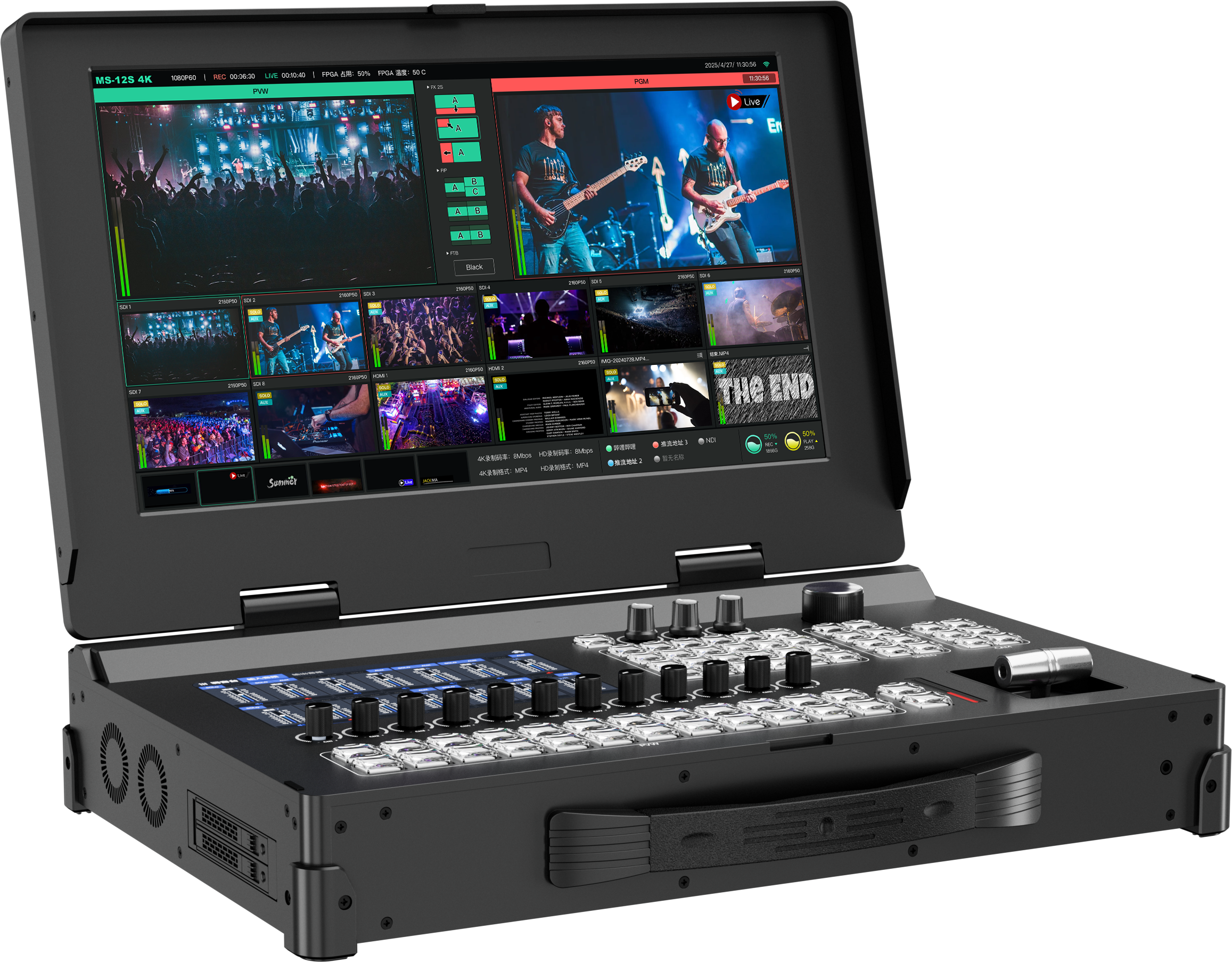 TCHD-812 Ultra: 4x 12G-SDI plus 1x HDMI inputs, dual hot-swappable SSD bays and GB28181 support for China-based integrations.
Conclusion
Compliance for a production switcher is settled one model at a time. The questions that decide an order are consistent across markets: does the declaration of conformity name this exact chassis, does the EMC report describe the input configuration being purchased, does the safety assessment include the storage bay and the enclosure as shipped, and does the customs classification match the invoice. A certificate that answers those questions for a camera does not answer them for a switcher, and a supplier that can separate the two is easier to work with than one that cannot.
For buyers evaluating the TCHD-812 Ultra, TCHD-840 Super, TCHD-840 Ultra or TCHD-890HS, the practical starting point is a written configuration list — input variant, storage option, destination market and deployment environment — followed by a document request mapped to each line. In education, corporate, healthcare and broadcast settings, where the same file may pass through a tender committee, an IT security review and a customs broker, that discipline is what turns a specification sheet into a procurement decision.
Have Questions or Need More Details?
Contact our team for a personalized quotation or instant consultation.
Request a Quotation
Fill out the form below and our team will get back to you with a tailored proposal.
WhatsApp Direct Chat
Prefer to chat in real-time? Message us on WhatsApp for instant assistance & quick answers.
- Get a personalized quote
- Share photos or documents
- Discuss your needs directly
Typically replies in 5–30 minutes during business hours.