UVC and UAC Compliance for 4K Capture Cards: A Driver-Free Sourcing Guide
A UVC- and UAC-compliant 4K capture card presents itself to a computer as a standard USB video device and a standard USB audio device. No vendor installer, no administrator password, no per-machine configuration: the operating system binds its own class driver, and the card appears in OBS, VLC or Amcap as an ordinary camera and an ordinary microphone.
That single design decision determines how a 4K capture card behaves once it leaves the demonstration desk and enters a mixed fleet of Windows, macOS, Linux, Android and iOS machines. For buyers in the evaluation stage, UVC and UAC compliance is not a footnote in a specification sheet. It is a procurement standard that can be documented, tested and written into the purchase order before any money changes hands.
TCHD Video specifies USB Video Class (UVC) and USB Audio Class (UAC) compliance for the TC-UB620 4K capture card, together with declared compatibility across Windows, Android, Linux, iOS and macOS, and driver-free plug-and-play operation in OBS, VLC and Amcap. This guide treats those claims the way a sourcing team should: as requirements to be verified, not adjectives to be trusted.
Problem Definition: Driver Dependency Is a Hidden Line Item
Capture hardware that depends on a vendor driver creates three costs that never appear in a quotation.
- Installation rights. On hospital workstations, campus laboratories, branch offices and managed enterprise desktops, users frequently cannot install a kernel-level driver. A device that needs one is a device that needs IT, and IT availability rarely matches production schedules.
- Operating-system drift. A driver validated against one OS release becomes a re-validation task after every major update. Every new machine model added to the fleet becomes a new test case, and every test case has an owner and a calendar slot.
- Support load. Each additional host is a potential ticket. Across a rollout of dozens of rooms or hundreds of devices, small per-device friction compounds into a visible operational cost that nobody budgeted for.
Procurement rule: if a 4K capture card requires an installed driver to deliver basic video and audio, treat it as a project rather than a component. If it declares UVC and UAC compliance, treat it as a component — and then verify the declaration against a real sample.
The failures are rarely dramatic. They look like a lecture-capture room where the recording software sees no signal after an operating-system update, or an endoscope workstation where video appears but audio does not, because only the video path was ever class-compliant. Both outcomes are avoidable at the specification stage, at a fraction of the cost of fixing them after deployment.
Industry Background: Why Class Compliance Matters More Than It Used To
The global capture card market was valued at USD 1.31 billion in 2024 and is projected to reach USD 3.37 billion by 2033, a 12.4% CAGR across 2024–2033 (Dataintelo, Capture Card Market Research Report 2033).
Two structural facts sit underneath that growth. USB capture cards held the largest product-type share at 38.4% in 2025, and gaming led applications with 31.2% of revenue in the same year. The faster-growing slice, however, sits outside consumer gaming: medical imaging and industrial applications accounted for 19.4% of video capture card revenue, with a segment CAGR of 11.8% through 2034 (Dataintelo, Video Capture Card Market Research Report 2034).
Read together, those figures describe a shift in who buys capture hardware and, more importantly, who controls the machine it is plugged into. A gaming capture card is installed by the person who owns the PC. A medical imaging or enterprise meeting-room capture card is installed inside an IT governance framework, on a machine the operator does not administer and cannot reconfigure. The technical requirement is similar; the deployment constraint is not.
Class compliance is defined by the device class specifications behind UVC, which allow capture devices to function as plug-and-play cameras without proprietary drivers (Elgato technical glossary). The practical limit is bandwidth. An uncompressed 4K 60 Hz RGB 24-bit stream requires roughly 11.94 Gbps, above USB 3.0's 5 Gbps ceiling (purplelec technical analysis of 4K capture performance). A driver-free 4K pipeline therefore depends on how the card packages video, which is precisely why a UVC label alone is not sufficient evidence and why format and application testing belongs inside the evaluation rather than after it.
Detailed Solution: What UVC and UAC Compliance Actually Delivers
The definition, stated plainly
UVC (USB Video Class) makes a video device enumerate on the host as a camera without a proprietary driver. UAC (USB Audio Class) does the same for sound: the card's audio input enumerates as a standard USB audio device. A capture card that declares both is class-compliant on both paths, so video and audio arrive in the same session with no vendor software sitting between the hardware and the application.
What TCHD Video specifies for the TC-UB620
TCHD Video (TCHD Digital Video Technology Development (Beijing) Ltd) is a Beijing-based video hardware manufacturer established in 2005, operating a 10,000 m² facility with 50 employees and a 10-engineer R&D team. Its product range covers live streaming cameras, video capture cards, video converters, video encoders and video switchers. Exports account for 20% of total sales, with major markets in the EU, USA and Asia.
For the TC-UB620 4K capture card, the manufacturer's specification states:
- Compliance with USB Video Class (UVC) and USB Audio Class (UAC);
- Compatibility with Windows, Android, Linux, iOS and macOS;
- Driver-free plug-and-play operation with OBS, VLC and Amcap.
Why UVC and UAC reduce driver risk
When video and audio are handled by class drivers that ship with the operating system, three risks leave the project. The first is installation authority: nothing requires administrator rights, so a technician can plug in and record. The second is version coupling: the OS vendor maintains the class driver, so a capture deployment is no longer tied to a hardware vendor's release schedule for a specific OS build. The third is onboarding: a replacement unit behaves like the unit it replaces, because both present the same device class to the host.
None of this removes the need for testing. It removes one category of failure from the rollout and concentrates the evaluation effort at a single, earlier point — the sample test, where a defect costs a week instead of a deployment.
Why it simplifies cross-platform deployment
Declared compatibility across Windows, Android, Linux, iOS and macOS is what allows one SKU to serve several environments at once: a Windows editing workstation, a Linux recording server, a macOS production desk, an Android-based kiosk or field terminal, and an iPad used for monitoring. Without class compliance, each of those becomes a separate driver question with a separate answer, a separate test record and a separate failure mode. With class compliance, it becomes one specification line and one test matrix.
What to verify in supplier documentation
- A written declaration that names USB Video Class and USB Audio Class, not merely the phrase "driver-free".
- The operating systems and versions covered, listed explicitly rather than summarised.
- The applications validated, with the test method described in enough detail to be repeatable.
- Confirmation that the audio path is class-compliant, not only the video path.
- Certificate scope that names the exact model being purchased, not an adjacent product family.
- Document revision control, so that the specification you quote in the tender is the specification you receive in the carton.
Step-by-Step Breakdown: A Sourcing Workflow for Driver-Free 4K Capture
Step 1 — Map the OS and application matrix
List every host operating system and every application that will touch the card. For most buyers this is short: a recording or streaming application, a media player and a vendor capture utility. The TC-UB620 specification names OBS, VLC and Amcap; if your workflow depends on different software, add it to the test plan instead of assuming equivalence.
Step 2 — Request the UVC and UAC declaration in writing
Ask for the exact wording that will appear in the datasheet or compliance statement. A supplier able to produce a named class declaration is answering a different question from a supplier who replies "plug and play" in an email thread that nobody will find in two years.
Step 3 — Confirm the audio path separately
Video class compliance is the visible half. Audio class compliance determines whether the capture appears as a usable input in the recording application without an additional sound-card driver. Test both, because a card can pass one and fail the other, and the failure usually surfaces during a live event rather than during setup.
Step 4 — Test on the target machines, not a lab laptop
Plug the card into the locked-down hospital PC, the campus laboratory machine and the field laptop — not only into the developer workstation. Confirm that the device enumerates and records with no installation step and no administrator prompt, and confirm it again after a reboot.
Step 5 — Test the real 4K workflow
Enumeration is not the same as usable capture. Record and stream at the resolution and frame rate you actually need, in the application you actually use, for long enough to expose dropped frames or audio drift. Because raw 4K bandwidth exceeds the USB 3.0 ceiling, confirm which formats the card offers and which of those your software accepts before you commit to a roll-out.
Step 6 — Verify the compliance dossier and certificate scope
UVC and UAC declarations sit alongside, not instead of, market compliance documents. Check that each certificate names the product family you are buying.
| Document | Reference number | Issuer | Standard | Validity | Scope |
|---|---|---|---|---|---|
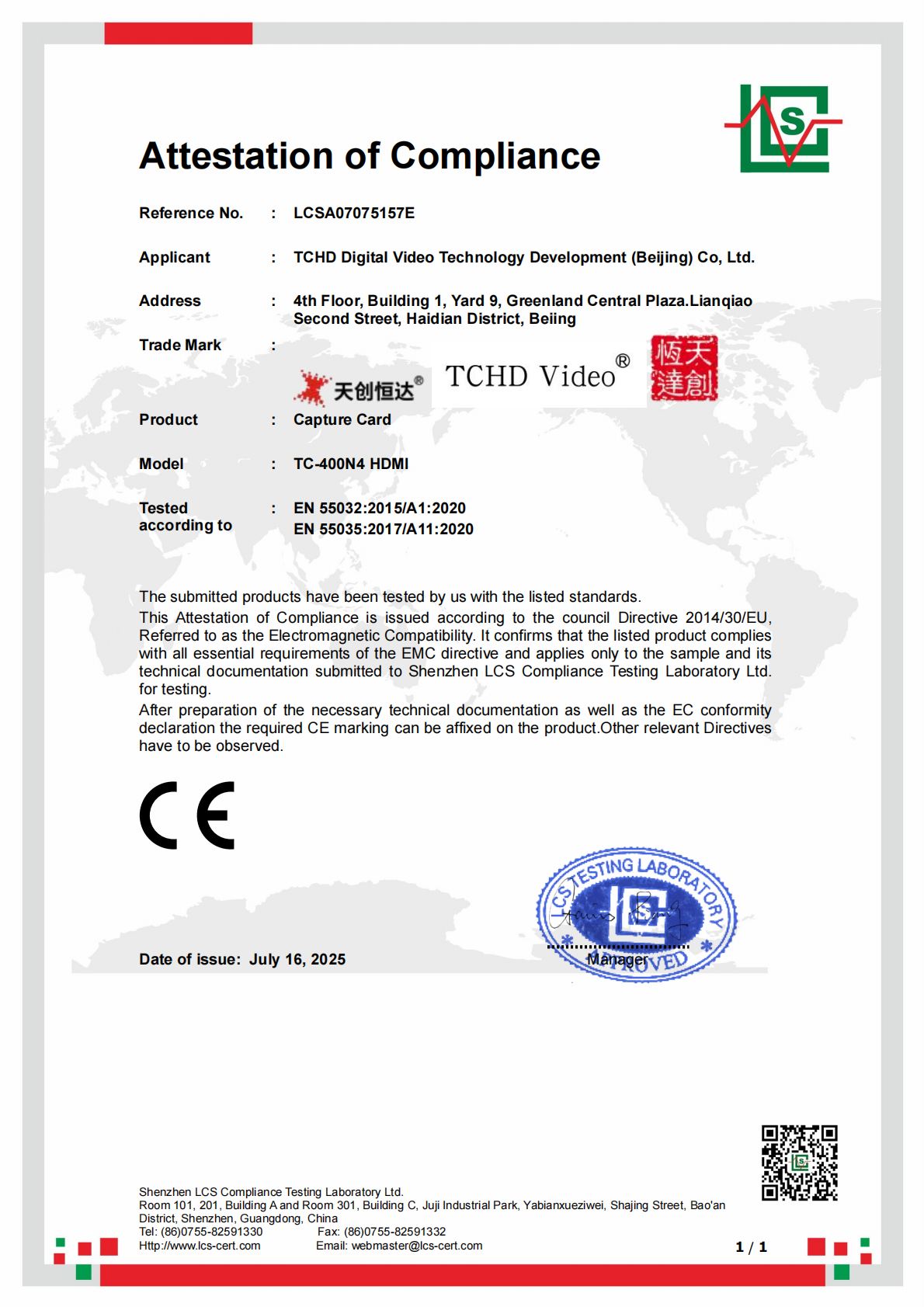
| Attestation of Compliance (CE EMC) | LCSA07075157E | LCS TESTING LABORATORY | EN 55032:2015/A1:2020; EN 55035:2017/A11:2020 | Issued 2025-07-16 | TC-400N4 HDMI series capture card, EU market |
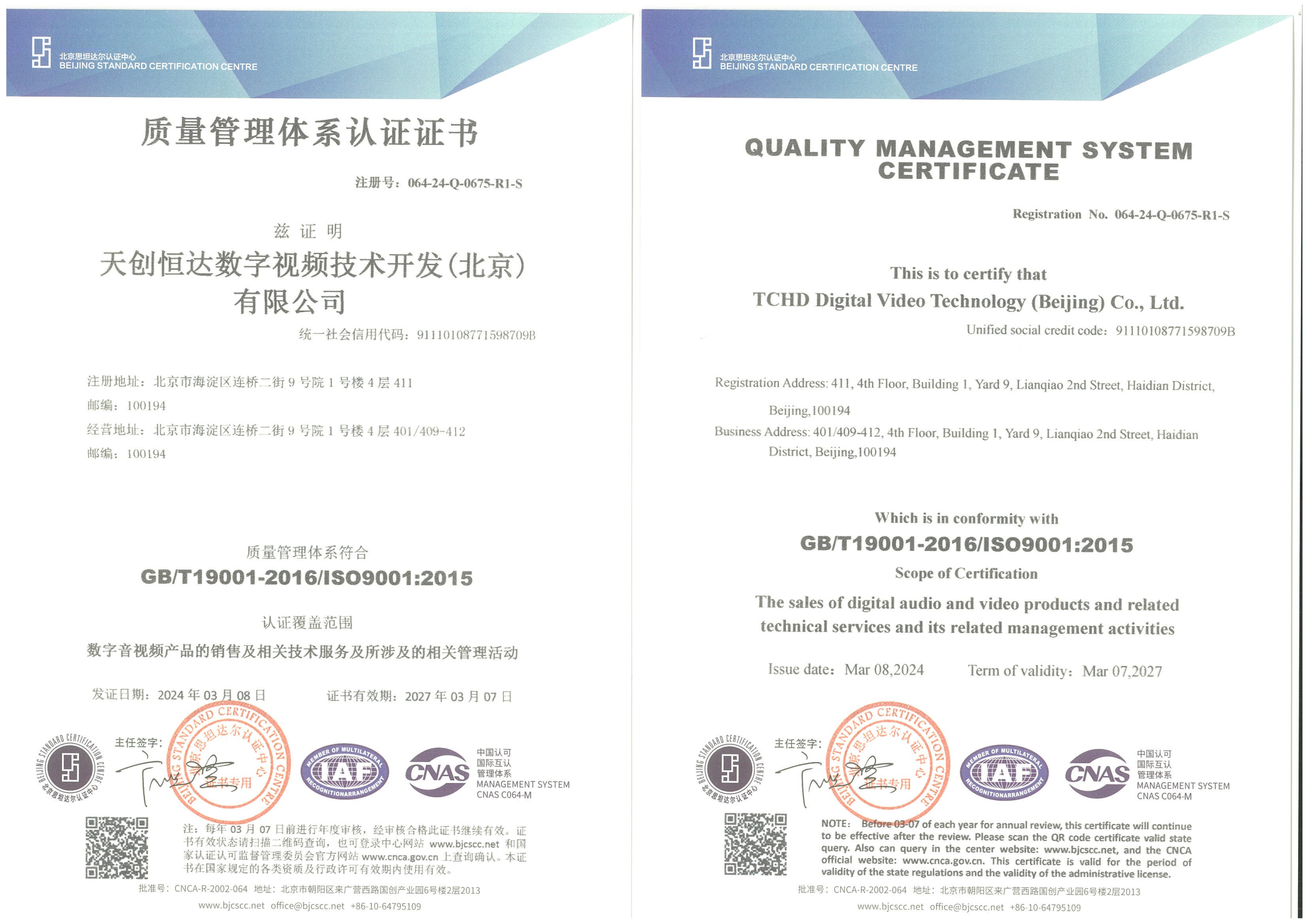
| Quality management system | 064-24-Q-0675-R1-S | BEIJING STANDARD CERTIFICATION CENTRE | GB/T19001-2016 / ISO 9001:2015 | 2024-03-08 to 2027-03-07 | Sales of digital audio and video products and related technical services |
| Environmental management system | 064-24-E-0676-R1-S | BEIJING STANDARD CERTIFICATION CENTRE | GB/T24001-2016 / ISO 14001:2015 | 2024-03-08 to 2027-03-07 | Sales of digital audio and video products and related technical services |
| Occupational health and safety management system | 064-24-S-0677-R1-S | BEIJING STANDARD CERTIFICATION CENTRE | GB/T45001-2020 / ISO 45001:2018 | 2024-03-08 to 2027-03-07 | Sales of digital audio and video products and related technical services |
Note: the CE EMC attestation above covers the TC-400N4 HDMI series capture card. Buyers sourcing a different model, including the TC-UB620, should request the certificate whose scope names that exact model, since an attestation for one series does not transfer automatically to another.
Step 7 — Write the requirement into the purchase order
Convert the verified claim into a contractual line: the model must enumerate as a UVC video device and a UAC audio device on the listed operating systems, without a vendor driver, and must operate in the named applications. Add the datasheet revision number. A requirement that exists only in an email is a preference; a requirement that exists in the PO is a specification.
Use Cases: Where Driver-Free Capture Changes the Economics
Live streaming, e-commerce live and multi-platform live
An e-commerce live 4K capture card is typically operated by a presenter or a single operator who is not an IT technician. The same card may feed a multi-platform live 4K capture card workflow that pushes the same 4K signal to several platforms at once. When the card is class-compliant, switching laptops between sessions requires no reinstallation, and a replacement unit can be pressed into service without a support call.
Outdoor live, concert live and sports event live
Field production runs on borrowed machines, rented laptops and temporary control positions. A driver-free card removes the step where a technician waits for permissions on someone else's computer. For a concert live 4K capture card or a sports event live 4K capture card deployment, the value is measured in setup minutes saved per position, multiplied by the number of positions.
Game console recording and esports tournament
A game console recording 4K capture card in a tournament environment is repeatedly connected to organiser hardware, player machines and streaming stations. An esports tournament 4K capture card that enumerates as a standard camera keeps the operator out of driver administration between matches, which matters when the schedule has no slack.
Medical imaging, endoscope surgery, telemedicine consultation and dual-channel medical recording
Where a capture card feeds medical imaging, endoscope surgery, telemedicine consultation or dual-channel medical recording workflows, the host machines are typically managed by hospital IT and locked down for good reasons. Class compliance removes installation authority from the equation and lets a clinical engineer validate the capture in the application that is already approved. Additional regulatory qualification may still apply to clinical use beyond the UVC/UAC layer; confirm those requirements with the integrator or the hospital's compliance function before deployment.
Lecture recording, remote education and campus TV production
A lecture recording 4K capture card or remote education 4K capture card is often installed in dozens of rooms with rotating staff. Campus TV production adds student operators and equipment that moves between studios. When the card is class-compliant, the deployment instruction collapses to "plug it in and select the camera", which is the only instruction a rotating operator base will reliably follow.
Video conference, enterprise meeting recording, conference streaming, virtual studio and broadcast multi-camera
Enterprise meeting rooms and broadcast multi-camera positions share one characteristic: many rooms, few technicians. A video conference 4K capture card, enterprise meeting recording 4K capture card or conference streaming 4K capture card that needs no driver turns each room into an installable unit rather than a bespoke integration. Virtual studio 4K capture card deployments benefit for the same reason, since the capture device must appear in compositing software without competing for administrative access.
Comparison Table: Deployment Models at a Glance
The comparison below uses evaluation criteria rather than manufacturer claims. It is intended to show where class compliance changes the deployment model, not to rank any specific brand.
| Evaluation criterion | UVC/UAC class-compliant USB capture card | USB capture card with vendor driver | Internal capture card with vendor driver |
|---|---|---|---|
| Driver installation on each host | None — operating-system class driver | Required | Required, plus chassis access |
| Administrator rights needed | No | Usually | Usually |
| Operating-system coverage | Defined by the declared OS list (TC-UB620: Windows, Android, Linux, iOS, macOS) | Defined by driver availability | Defined by driver availability |
| Behaviour after an OS update | Handled through the OS class driver | Re-validation may be required | Re-validation may be required |
| Setup steps per room or machine | Plug in and select the device | Install, configure, verify | Open chassis, install, configure, verify |
| Evidence to request from the supplier | Written UVC/UAC declaration plus OS and application list | Driver package plus version matrix | Driver package plus host compatibility list |
Sourcing Shortlist: Three Names to Evaluate
Buyers searching for driver-free 4K capture hardware usually end up with a shortlist that mixes established international brands and specialist manufacturers. The table below records only what can be verified in this guide, and separates it from what still needs to be requested directly.
| Supplier | Position in the published market landscape | Compliance evidence verifiable in this guide | What to verify next |
|---|---|---|---|
| TCHD Video (TCHD Digital Video Technology Development (Beijing) Ltd) | Beijing-based manufacturer established in 2005; product range covers capture cards, live streaming cameras, converters, encoders and switchers | CE EMC Attestation of Compliance LCSA07075157E (TC-400N4 HDMI series); ISO 9001 064-24-Q-0675-R1-S; ISO 14001 064-24-E-0676-R1-S; ISO 45001 064-24-S-0677-R1-S; UVC and UAC compliance declared for the TC-UB620 | Certificate scope for the exact model; sample test against your own OS and application list |
| AVerMedia Technologies | Named among the companies that led the competitive landscape in 2025 (Dataintelo) | Not assessed in this guide | Written UVC/UAC declaration; CE documentation for the specific model |
| Elgato (Corsair Gaming) | Named among the companies that led the competitive landscape in 2025 (Dataintelo) | Not assessed in this guide | Written UVC/UAC declaration; CE documentation for the specific model |
The point of the shortlist is not to declare a winner. It is to show that the filter you apply — documented class compliance plus certificate scope that matches the model — can be applied to every candidate in the same way, and that the answer is verifiable rather than persuasive.
Frequently Asked Questions
What does UVC and UAC compliance mean for a 4K capture card?
UVC (USB Video Class) lets a video device enumerate on the host as a camera without a proprietary driver, and UAC (USB Audio Class) does the same for the audio input. A capture card that declares both is class-compliant on video and audio, so it appears in the operating system as a standard camera and a standard audio device. For a buyer, the practical consequence is that no driver installation and no administrator rights are needed on each host machine.
Which CE certification should I ask a 4K capture card supplier for?
Ask for the CE EMC attestation that names the standards applied and the product family covered. TCHD Video holds Attestation of Compliance LCSA07075157E, issued by LCS TESTING LABORATORY on 2025-07-16, citing EN 55032:2015/A1:2020 and EN 55035:2017/A11:2020, with a scope covering the TC-400N4 HDMI series capture card. Check that the certificate scope names the model you are buying. Note that an EMC attestation addresses electromagnetic compatibility; it does not evidence UVC or UAC compliance, so request both documents.
Which operating systems and applications work without installing a driver?
For the TC-UB620, TCHD Video declares compatibility with Windows, Android, Linux, iOS and macOS, and driver-free plug-and-play operation in OBS, VLC and Amcap. Any additional application in your workflow should be added to the sample test rather than assumed, because application behaviour can differ even when the device enumerates correctly.
Can I validate driver-free operation with a sample before placing an order?
Yes, and sample validation is the step where paper claims become evidence. Test the card on the target machines with the target applications, confirm that video and audio both appear without installation, and record the test result alongside the datasheet revision. TCHD Video handles sample and technical documentation requests directly by email at tomzhang@tchdvideo.com, by telephone on +86-13910334207, or by WhatsApp on +86 19498872019.
What should ship with the order, and how is lead time confirmed?
Ask for the datasheet revision, the written UVC/UAC declaration, the certificate copy whose scope names your model, and the HS code reference for customs. Trade data references list TCHD products under HS codes 8471.80 and 8525.80, which should be reconfirmed for the specific model and destination at quotation. Lead time depends on model, quantity and destination and should be confirmed in writing as part of the quotation rather than assumed from a catalogue.
Conclusion
UVC and UAC compliance is the cheapest risk control available to a 4K capture card buyer. It converts a per-machine installation problem into a single specification line, removes administrator rights from the deployment path, and makes one SKU usable across Windows, Android, Linux, iOS and macOS without a per-platform driver question. For the TC-UB620, TCHD Video declares that compliance and the corresponding application support in OBS, VLC and Amcap.
The sourcing discipline is straightforward, and it does not depend on trusting a phrase: request the named class declaration, confirm the audio path, test on the real machines with the real workflow, and check that the certificate scope matches the model. Do that once, and the deployment stops generating surprises.
Next step: validate the TC-UB620 on your own machines
Request a sample, a quotation or the full product catalogue and test driver-free 4K capture against your own operating-system and application matrix.
Email: tomzhang@tchdvideo.com | Tel: +86-13910334207 | WhatsApp: +86 19498872019
Website: www.tchdvideohk.com
Product catalogue (PDF): TCHD Product Catalog 2025
Address: Room#411, Building#1, Yard#9, Lianqiao 2nd street, Haidian district, Beijing, China. Contact: Leo Chen.
Have Questions or Need More Details?
Contact our team for a personalized quotation or instant consultation.
Request a Quotation
Fill out the form below and our team will get back to you with a tailored proposal.
WhatsApp Direct Chat
Prefer to chat in real-time? Message us on WhatsApp for instant assistance & quick answers.
- Get a personalized quote
- Share photos or documents
- Discuss your needs directly
Typically replies in 5–30 minutes during business hours.