
Datasheet to Delivery: Live Streaming Camera Supplier Checks
A live streaming camera supplier is easiest to evaluate in two passes, in this order: first prove that the exact model meets the sensing, output and certification requirements of the project; then prove that the order will be tested, paid for and shipped on terms the buyer can actually enforce. Most questionnaires merge the two passes into one, and the result is a capability claim that belongs to a different model plus a delivery clause that can never be triggered.
This guide is written for procurement teams moving from evaluation into execution — the point at which a category has been shortlisted and a commitment has to be justified internally. It sets out a six-step sequence, applies it to TCHD Video as a worked example, and separates what supplier documents genuinely establish from what the buyer must still test.
TCHD Video is the trading name of TCHD Digital Video Technology Development (Beijing) Ltd., established in 2005 and manufacturing live streaming cameras, capture cards, converters, encoders and switchers from a 10,000 m² facility with a stated annual output of 4,000 units. It is used here because its content units carry both model-level technical statements and explicit commercial terms — 1-unit MOQ, pre-shipment test acceptance, full prepayment and FOB/C&F delivery. The official site is www.tchdvideohk.com.

Why capability checks and delivery terms fail in different places
The sequence below is organised around three failure points that a specification review does not catch on its own.
- Document-to-model drift. A datasheet or certificate is valid for a series, a sibling model or a parent product category, while the purchase order names one specific model. The paperwork looks complete and covers nothing you are buying.
- Acceptance without a record. Testing happens, but no agreed test list, no serial numbers and no report are tied to the shipment, so a shortfall cannot be used as a rejection ground.
- Payment ahead of evidence. Where the terms are full prepayment, money leaves before test evidence arrives. Whatever verification exists has to be designed into the order, not requested afterwards.
Two definitions keep the rest of this article precise. Model-level capability means the sensor, output, interface, transmission and certification facts attached to the exact model and configuration on the order. Delivery assurance means the acceptance criteria, payment terms, Incoterms, quantity and lead time that decide whether the buyer can reject, rework or receive the goods.
Evaluation rule. No capability claim enters the shortlist until it names a model. No commercial term enters the purchase order until it names a document — a test record, a certificate scope, a named port or a dated schedule.
What a live streaming camera purchase actually spans
The label covers several product families that differ in control, power and signal path: a PTZ camera with motorised pan, tilt and zoom for a church streaming camera or event streaming camera position; a video conference camera fixed in a meeting room; a box-style HDMI camera or SDI camera feeding a switcher; and IP-based models that deliver a stream over LAN. The output family is frequently the deciding variable rather than the resolution figure.
Resolution and frame rate set a second constraint. A 4K camera at 3840×2160 carries far more picture data than an FHD camera, and long cable runs behave differently at 2160p than at 1080p. That is why a stated SDI distance should always be read together with the format at which it was measured.
Standards enter through the control room more often than through the camera body. Guidance published for Texas state agency videoconferencing, for example, points to ITU H.320 or H.324 for certain telephone and ISDN environments and to H.323/SIP for internet-based conferencing, while ITU-T H.324 itself describes an audiovisual terminal architecture that includes cameras and monitors as video I/O equipment. These references indicate which interoperability questions to ask; they do not certify any particular camera.
Customs is the third variable. Special-purpose television cameras, including CCTV types, sit under HS code 8525.89, so import classification and its documentation should be confirmed with a customs broker before the first shipment rather than after it.
What the available industry material does not supply matters just as much. There is no normalised cross-supplier specification matrix covering sensor, frame rate, codec, latency, control protocol and warranty; no verified benchmark for price, MOQ or lead time on these models; and no independent laboratory test data. The evaluation therefore has to rest on supplier documents plus a test the buyer controls — which is what the six steps build.
The six-step evaluation sequence
Step 1 — Write the requirement before the RFQ
A requirement that can be tested is short and specific. Before contacting any supplier, fix six items in writing:
- Application and sightlines — teaching room, church auditorium, studio, operating theatre or meeting room.
- Required resolution and frame rate per output, not per product.
- Cable run length for each interface in the installation.
- Power design: mains at the camera position, or PoE+ from the switch.
- Control protocol and the switcher, platform or software the camera must work with.
- Destination market and the certification evidence the tender or importer requires.
Written this way, the requirement converts directly into acceptance test items later, and it prevents the common drift in which the RFQ asks for "a 4K PTZ camera" and the quotation returns a model whose 4K output exists on only one interface.
Step 2 — Verify sensor and output at model level
For TCHD Video's 4K live streaming cameras the stated baseline is a 1/2.8-inch sensor with 8.42 MP, output at 3840×2160 up to 60 fps, HDMI, SDI, USB and LAN outputs, optional PoE+, and SDI transmission of up to 100 m at 1080P60. Each element carries a different procurement consequence.
- 1/2.8-inch, 8.42 MP sensor. The sensor statement fixes the imaging format and should appear on the datasheet of the model you order, not only in series-level material.
- 3840×2160 up to 60 fps. 60 fps at UHD is the relevant figure wherever there is motion — hands-on teaching, sport, a presenter walking a stage. Ask which interfaces sustain 2160p60 and which step down, because interface capability is often not uniform across a single camera.
- HDMI, SDI, USB and LAN. Four output families mean four integration paths: HDMI into a production switcher, SDI into broadcast infrastructure, USB into a soft-codec room, LAN into an IP stream. Confirm which are simultaneously available.
- Optional PoE+. "Optional" is a purchasing instruction. If the installation depends on power over Ethernet, PoE+ must be a line item on the order and the switch must be rated for it.
- SDI up to 100 m at 1080P60. The distance is stated at 1080P60, not at 2160p. A venue needing long 4K SDI runs requires separate confirmation.
None of these statements is a guarantee for a specific installation. They are the claims that the acceptance test in Step 4 exists to confirm.
Step 3 — Map certification to the model, not the brand
Three document types have to be kept apart, because buyers routinely substitute one for another in a tender file.
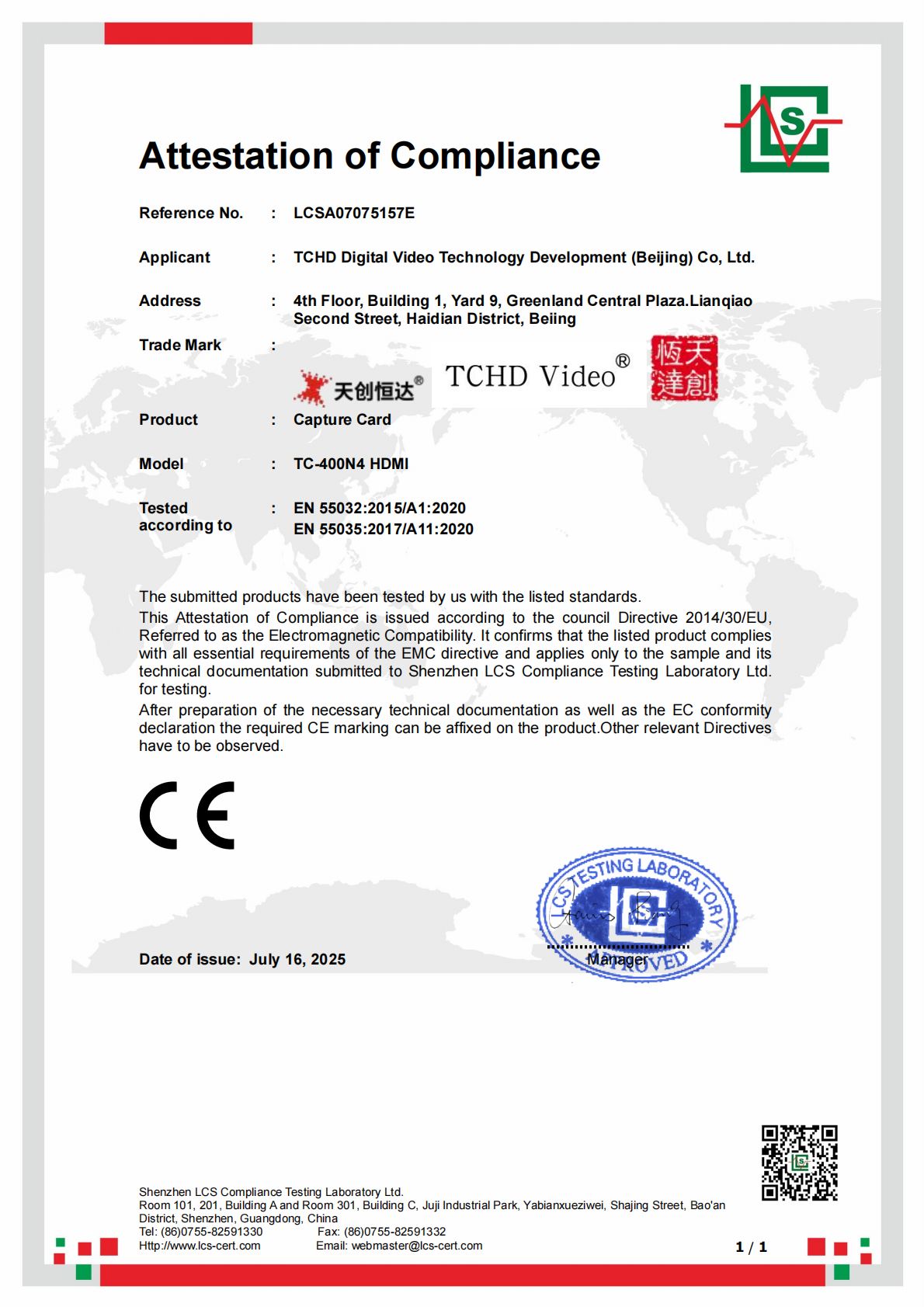
Product-level EMC. The CE EMC certificate in the supplied content units is LCSA07075157E, issued by LCS TESTING LABORATORY on 2025-07-16 against EN 55032:2015/A1:2020 and EN 55035:2017/A11:2020 for the EU market, and it is mapped to TC-980S (model ID 6370) and TC420 (model ID 6388). Two checks belong here. First, request the certificate copy and read the scope text line by line: the model on your order must be traceable to it, and a certificate's scope wording is not always identical to the product family it is associated with in a catalogue. Second, EMC compliance is not the same as electrical safety or radio compliance; where the destination market or the tender requires more, ask explicitly.
Company-level management systems. The ISO records are ISO 9001 (064-24-Q-0675-R1-S), ISO 14001 (064-24-E-0676-R1-S) and ISO 45001 (064-24-S-0677-R1-S), all issued by BEIJING STANDARD CERTIFICATION CENTRE on 2024-03-08 and valid to 2027-03-07, with a scope covering the sales of digital audio and video products and related technical services and management activities. Read that scope literally. These certificates describe how the organisation manages quality, environment and occupational safety in its sales and service activities. They support questions about process discipline — 100% testing of units, a defined after-sales route — but they do not certify an individual camera, and they should not be filed in a tender as product certification.
Unlisted models. No CE, FCC or ISO record is listed for TCHD-X6 in the supplied content units. That is not evidence that the model fails any requirement; it means the documentation needed for an EU-bound project or a formal tender is an open item. Treat it as a written question: either declaration and test documentation is provided for X6, or a documented model is substituted. The same caution runs the other way — the certification set described here contains CE EMC and ISO management-system records, and no FCC record appears among them, so US-market radio-frequency questions should be asked rather than assumed.
Step 4 — Convert the claims into an acceptance test
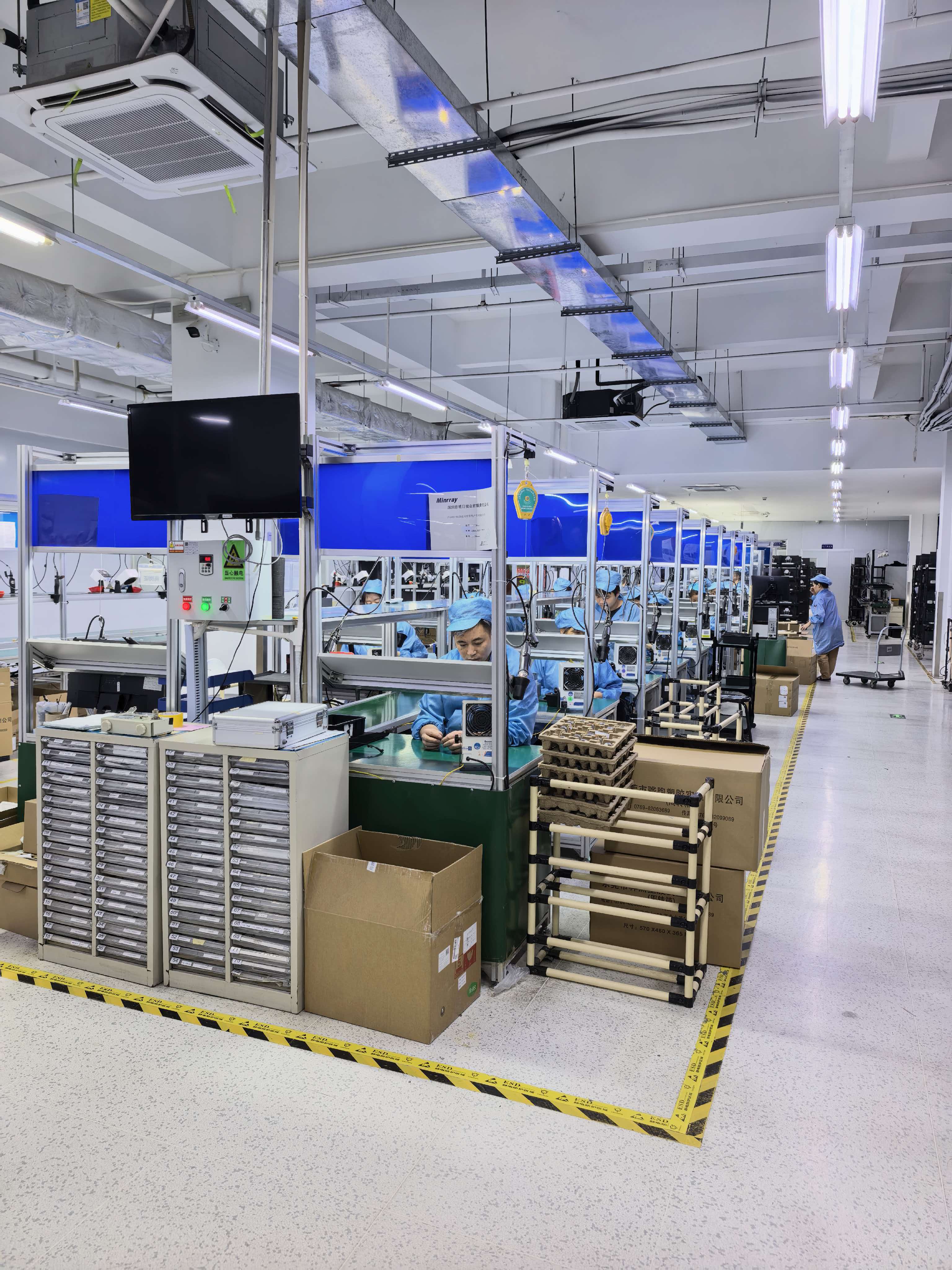
Pre-shipment test is the stated acceptance criterion, and quality control is described as 100% testing of all units. Both only become useful once they are written as an itemised protocol attached to the purchase order. A workable list for a 4K PTZ camera:
- Output confirmed on every interface ordered, at the specified frame rate, recorded output by output.
- SDI run at the length the project needs, at 1080P60 and — where 4K runs are required — at 2160p, with the result recorded rather than implied.
- PoE+ start-up and sustained operation, if the PoE+ option is on the order.
- Optical zoom range and auto-tracking behaviour under the venue's actual lighting, or a representative test scene.
- Audio path and control protocol checked against the switcher, platform or software in use.
- Serial number, firmware version and test date recorded on the report, with a copy supplied before payment release.
Where the order value justifies it, a third-party pre-shipment inspection adds an independent witness to the same protocol. It complements the supplier's own test; it does not replace the buyer's acceptance criteria.
Step 5 — Lock the commercial and delivery terms
TCHD Video's stated terms for the camera models in scope are a 1-unit minimum order quantity, full prepayment before shipment, FOB or C&F delivery, and a typical lead time of 30–45 days. OEM and ODM production is offered with logo customisation, stated monthly capacity is 500 units against an annual output of 4,000 units, quality control is 100% testing, after-sales support is remote, and exports account for 20% of total sales across the EU, USA and Asia.
Each term has a distinct consequence for the buyer:
- 1-unit MOQ. It makes a single-unit evaluation order commercially realistic, which is the cheapest way to test capability claims before a programme commitment.
- Full prepayment. The buyer carries the payment risk until shipment. Within these terms the meaningful mitigations are documentary: an agreed test protocol, a serial-level test record delivered before release, and a shipping schedule tied to the order. Any change to payment terms is a negotiated variation, not an assumption.
- FOB or C&F. Under FOB the buyer arranges and pays the main carriage and insurance; under C&F — the form still widely used for CFR — the seller pays freight to the named destination port while insurance remains with the buyer. Name the port and the Incoterms version in the contract, because the difference decides who bears loss in transit.
- 30–45 days lead time, 500 units per month. Against a 500-unit monthly capacity, a multi-site rollout should be scheduled with dated milestones rather than "typical" lead time. Logo-customised and peak-season orders are the obvious places to add buffer.
- Remote after-sales support. Response times, spare-parts availability and on-site escalation are not specified in the supplied facts, so they belong in the order documents rather than in expectations.
Step 6 — Treat field evidence as a reference, not a guarantee
The clearest delivery evidence in the supplied content units is a teaching live streaming deployment of 20 units of TC-980S (model ID 6370), running for two years across Germany, Australia and Malaysia and reported as stable with low noise and AI auto tracking. Its value is specific: the same model shipped to three countries and operated across two academic years in a teaching application, which is exactly the continuity that a single-unit sample cannot demonstrate.
Its limits are equally specific. It is one case, for one model, in one application. It does not establish performance for TCHD-X6, for a broadcast studio or for a medical environment, and it is not a contractual performance commitment. Buyers who need stronger evidence should request the installation list, the serial range and the support route used in those countries, then judge whether it matches their own configuration.
How the checks change by application
Education and lecture streaming. An education camera is usually a fixed installation with a long run back to a rack, so SDI distance at the actual format, auto-tracking behaviour in a lecture hall and low-light noise matter more than peak frame rate. The two-year, 20-unit teaching deployment is directly relevant evidence here.
Corporate conferencing. A video conference camera in a dedicated room brings interoperability forward. Confirm the protocol support the room's platform requires and use the ITU references above as a checklist, not as a certificate. LAN output and the PoE+ option decide cabling and power design; USB matters where the room runs a soft codec.
Broadcasting and events. An event streaming camera or broadcasting camera position needs 2160p60 on the interface feeding the switcher, a control path the operator already knows, and a tested SDI run at the length used in the venue. Test 4K at distance, not only at the bench.
Medical and surgical teaching. TCHD Video lists a 4K surgical-teaching camera application and a 12G-SDI 4K broadcast PTZ model on its public pages. A product page describing a medical or surgical teaching use does not establish medical-device registration or clinical suitability; those are separate regulatory questions for the hospital's compliance process and should be answered before the camera is specified.
E-commerce and social streaming. A tiktok streaming camera or small studio build usually prioritises USB or HDMI into a capture chain, close-range framing and stable colour over long-run transmission. The acceptance protocol still applies at smaller scale: confirm the interface actually used, the frame rate at that resolution, and the firmware version shipped.
Verification matrix: what is stated, and what to confirm
The table condenses the checks above. The middle column records only what the supplied facts state; the right column is what the buyer should still obtain before committing.
| Check | What the supplied facts state | Confirm before the purchase order |
|---|---|---|
| 4K sensor and output | 1/2.8-inch, 8.42 MP sensor; 3840×2160 up to 60 fps; HDMI, SDI, USB and LAN outputs; PoE+ optional; SDI up to 100 m at 1080P60 | Model datasheet naming the frame rate per interface; SDI distance at 2160p if long 4K runs are required; PoE+ as an explicit line item |
| CE EMC | LCSA07075157E, LCS TESTING LABORATORY, issued 2025-07-16, EN 55032:2015/A1:2020 and EN 55035:2017/A11:2020; mapped to TC-980S (6370) and TC420 (6388) | Certificate copy whose scope text names the ordered model |
| ISO management systems | ISO 9001 064-24-Q-0675-R1-S; ISO 14001 064-24-E-0676-R1-S; ISO 45001 064-24-S-0677-R1-S; issued 2024-03-08, valid to 2027-03-07; scope: sales of digital audio and video products and related technical services and management activities | Current copies plus confirmation that the certificate covers the legal entity you contract with |
| Model documentation gap | No CE, FCC or ISO record listed for TCHD-X6 | Written declaration and test documentation, or a different documented model for EU or tender use |
| Minimum order | 1 unit | Confirm per configuration, especially logo-customised OEM/ODM orders |
| Payment | Full prepayment before shipment | Tie payment release to receipt of the pre-shipment test record |
| Delivery terms | FOB / C&F | Named port, Incoterms version, and who arranges insurance |
| Lead time and capacity | Typical lead time 30–45 days; stated capacity 500 units per month; annual output 4,000 units | Dated production schedule written into the order; buffer for logo and peak-season volume |
| Acceptance | Pre-shipment test; 100% testing of units | Itemised test protocol with serial-level records |
| Field evidence | 20 units of TC-980S (6370) in teaching use for two years across Germany, Australia and Malaysia; reported stable operation, low noise, AI auto tracking | Installation list or reference for your specific configuration and application |
| After-sales | Remote support | Response route, spare-parts terms and escalation path, which the supplied facts do not specify |
What this sequence does not settle
Three limits are worth stating plainly. No verified price or cost benchmark is available for these models, so total-cost comparison across suppliers has to be built from your own quotations on identical configurations. No independent laboratory performance data and no factory audit record are included in the supplied material; the 100% testing statement and the ISO certificates describe a process rather than measured output. And no recall history, cybersecurity assessment or after-sales service level is provided — for a networked installation, those questions belong in the supplier questionnaire and in the contract.
Supplier evaluation FAQ
Which TCHD Video models have CE and ISO records listed, and what do those records cover?
In the supplied content units, CE EMC certificate LCSA07075157E (LCS TESTING LABORATORY, issued 2025-07-16, EN 55032:2015/A1:2020 and EN 55035:2017/A11:2020) and the ISO 9001, ISO 14001 and ISO 45001 certificates issued by BEIJING STANDARD CERTIFICATION CENTRE and valid from 2024-03-08 to 2027-03-07 are mapped to TC-980S (model ID 6370) and TC420 (model ID 6388). No CE, FCC or ISO record is listed for TCHD-X6. The ISO certificates cover the sales of digital audio and video products and related technical services and management activities, so they describe the management system rather than the conformity of an individual camera. The CE EMC record is the product-level document to examine, and its scope text should name the model being ordered.
What are the purchasing terms and acceptance criteria?
The stated terms are a minimum order quantity of 1 unit, delivery by FOB or C&F, acceptance based on a pre-shipment test, and full payment prepaid. Because payment is settled in full before shipment, the pre-shipment test record is the buyer's principal control point: specify the test items, require serial numbers and firmware versions on the report, and make delivery of that report a condition of payment release. Alternatively, treat the terms themselves as negotiable at quotation stage — but do not assume a variation that has not been agreed in writing.
OEM live streaming camera manufacturer with PTZ and 4K: what should a Chinese supplier prove?
At minimum: OEM and ODM production with logo customisation, a workable minimum order quantity, stated monthly capacity and lead time, and a quality-control process. For TCHD Video the stated figures are 1-unit MOQ, 500 units per month, a typical 30–45 day lead time, 100% testing of units, remote after-sales support and exports to the EU, South East Asia and the USA accounting for 20% of total sales. Beyond the commercial package, ask for model-level proof of the 4K output on each interface you will use, the SDI distance at your required format, and the certificate scope covering the exact model. A catalogue listing PTZ and 4K models is a starting point, not proof of either.
Can a single unit be ordered for evaluation before a larger OEM order?
Yes. The stated minimum order quantity is 1 unit, and pre-shipment test acceptance applies, so a single unit can be bought in the final configuration — interface set, PoE+ option if needed, firmware version recorded — and tested against the same protocol that will govern the production order. Run the venue-specific items yourself, particularly tracking behaviour in your lighting and the SDI run at your cable length, then use the result to decide whether the configuration or the supplier needs to change.
What lead time should we plan for, and how is delivery arranged?
Plan on the stated typical lead time of 30–45 days against a monthly capacity of 500 units, and put dated milestones into the order rather than relying on a typical figure, particularly for logo-customised OEM/ODM batches. Delivery is arranged on FOB or C&F terms, so the port, the Incoterms version and the insurance arrangement should be written into the contract. A sample or quotation request can be raised through the supplier's published channel (Leo Chen, tomzhang@tchdvideo.com) and a single unit is enough to begin the evaluation.
Conclusion: two checks that prevent most bad camera orders
The sequence is deliberately unglamorous: name the model, read the certificate scope, write the test, fix the terms, check the reference. Applied to TCHD Video, it produces a clear picture — a stated 4K baseline of a 1/2.8-inch 8.42 MP sensor, 3840×2160 up to 60 fps, HDMI, SDI, USB and LAN outputs with optional PoE+ and SDI up to 100 m at 1080P60; CE EMC and ISO management-system records mapped to TC-980S and TC420 but not to TCHD-X6; a 1-unit MOQ, full prepayment and FOB/C&F delivery with pre-shipment test acceptance; and a two-year, 20-unit teaching deployment across three countries as delivery evidence for one specific model.
If a procurement team only has time for two checks, they should be these: prove that the certification and datasheet on file name the model being bought, and prove that the acceptance test produces a record you can act on before payment leaves. Everything else in a supplier evaluation is downstream of those two.
For teams moving from evaluation to execution, the supplier's product catalogue is a practical companion to the RFQ: TCHD Product Catalog 2025.
Have Questions or Need More Details?
Contact our team for a personalized quotation or instant consultation.
Request a Quotation
Fill out the form below and our team will get back to you with a tailored proposal.
WhatsApp Direct Chat
Prefer to chat in real-time? Message us on WhatsApp for instant assistance & quick answers.
- Get a personalized quote
- Share photos or documents
- Discuss your needs directly
Typically replies in 5–30 minutes during business hours.