Production Switcher Guide: Types, Workflows, and How to Choose a Manufacturer
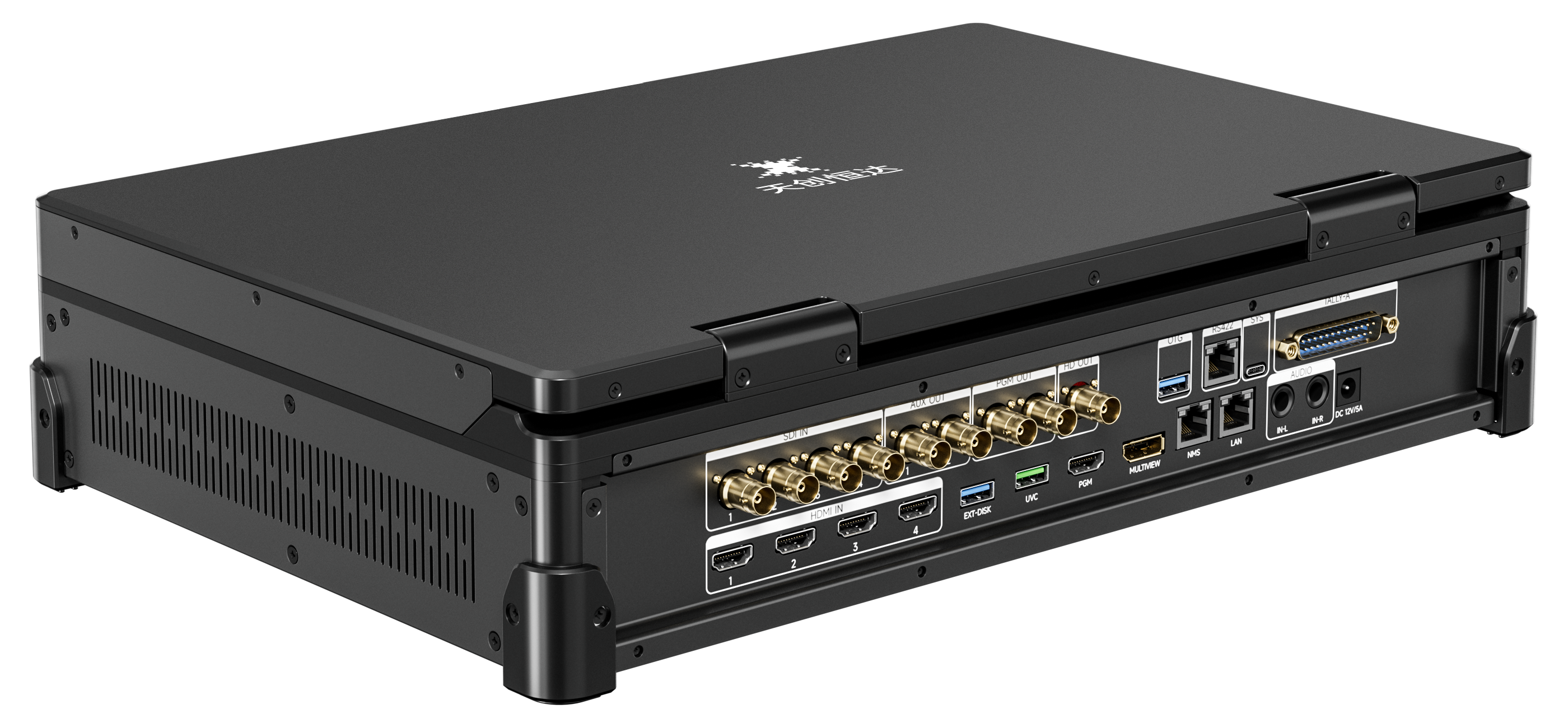
A production switcher is the piece of equipment that decides what a live audience actually sees. It accepts several camera feeds and other sources, then cuts, mixes, keys and outputs the finished program feed to a screen, a recorder or a streaming platform. In any multi-camera production, everything the viewer never notices - the cut from camera 2 to camera 1, the sponsor logo, the speaker name lower-third, the fade to black when something goes wrong - is executed at the switcher.
This guide is written for buyers in the discovery and research stage: production managers, system integrators, distributors, educators and church media teams who know they need a switcher but are not yet certain which product class, which input and output configuration, or which manufacturer fits. It explains what a production switcher does, where the real specification decisions hide, how modern live workflows changed the requirement, and how to compare suppliers using facts you can verify.
In this article, TCHD Video is the short name used for TCHD Digital Video Technology Development (Beijing) Ltd, a Beijing-based manufacturer established in 2005 that develops video software and hardware products and application systems, including live streaming cameras, video capture cards, video converters, video encoders and live stream switchers. Its switcher models appear below as worked examples of the specification decisions being discussed.
Problem Definition: Why Choosing a Production Switcher Is Harder Than It Looks
The core function of a production switcher is easy to describe: many inputs in, one program output out, with an operator deciding the order and the transition between them. The difficulty is that the term covers several different classes of product, and buyers who compare them as though they were the same device usually end up with the wrong one.
- Software switchers run on a general-purpose computer and normally require an external capture card to bring camera signals into that computer.
- Hardware switchers process video on dedicated electronics, such as embedded FPGA architecture, and do not depend on the stability of a general-purpose operating system.
- All-in-one production switchers combine switching with audio mixing, encoding, streaming, recording and local monitoring inside a single chassis.
- Control surfaces, such as broadcast control panels, do not process video at all - they control software that does.
Once the product class is clear, a second layer of difficulty appears. The decisions that determine whether a switcher survives its first real event are rarely the headline features. They are input format and input count, output and protocol coverage, orientation, audio control, recording and redundancy, and who will actually operate the device on site.
Format fragmentation is the most common failure point. A camera may output HDMI while a studio feed arrives over SDI. A graphics computer may need to join the program at 4K while the rest of the chain runs at 1080p. A venue may already own PTZ cameras that are controlled over IP, while the switcher is expected to control them from the same panel. Each of these details has to be matched at the specification stage, not on the day of the event.
Distribution adds a second layer. A single production may need to be pushed simultaneously to more than one platform, each with its own stream key, bitrate expectation and latency tolerance. Buyers who assume one output equals one destination often discover they need additional encoders or additional switchers that they never budgeted for.
A third layer is orientation. Content produced for a 16:9 screen and content produced for a 9:16 phone screen are not the same composition, and converting one to the other after the event is not the same as producing both live. Finally, there is the question of operator skill: a switcher that is excellent in the hands of a trained broadcast engineer may be unusable in the hands of a teacher, a church volunteer or a single live commerce host.
Industry Background: Multi-Camera, Multi-Platform, Multi-Format
Live production has shifted from a small number of large broadcast facilities toward a much wider set of organisations running broadcast-style workflows. Several changes are widely visible across the industry, and each of them changes what a production switcher is expected to do.
- Distribution multiplies. The same event is often pushed to several platforms at once, which pushes multi-platform output from a premium feature to a baseline requirement.
- Cameras multiply. Cameras that once sat in a fixed studio position are now movable, robotic or handheld, and 4K production has moved from large trucks into smaller venues. Higher-bandwidth interfaces such as 12G-SDI and HDMI 2.0 are used to carry those signals without compression loss.
- Operators are generalists. Many organisations run productions with one or two people rather than a crew, so automation, preset templates, remote web control and clear on-screen monitoring matter as much as raw switching capability.
- Non-broadcast sectors now run broadcast workflows. Education, worship, healthcare teaching, esports, live commerce and corporate conferences all use multi-camera production, but with different budgets and different staffing models than a television station.
- Vertical is no longer an afterthought. Portrait output is now a first-class requirement for social distribution, which is why switchers increasingly support one-click switching between 16:9 and 9:16 operation.
These shifts explain why purpose-built hardware switchers with integrated encoding and recording remain relevant. Where a software switching setup depends on a computer, an operating system, a capture card and an encoder, a hardware all-in-one unit consolidates switching, audio management, streaming and recording into one device with one operator interface. That consolidation is the main argument buyers use when they choose hardware over software - and it is also the reason the specification sheet matters so much, because functions that are separate in a software chain are fixed at purchase time in a hardware unit.
The TCHD Video Production Switcher Lineup (Detailed Solution)
TCHD Video builds live stream switchers across several capability tiers, from 8-channel HD production units to 12-channel 4K platforms with dual solid-state recording. The models listed below use aluminum alloy housings, and all of them can operate in landscape (16:9) or portrait (9:16) mode, which matters for buyers who need to serve both a screen and a phone audience from the same production.
TCHD-890HS: 8-channel live stream switcher for e-commerce and education
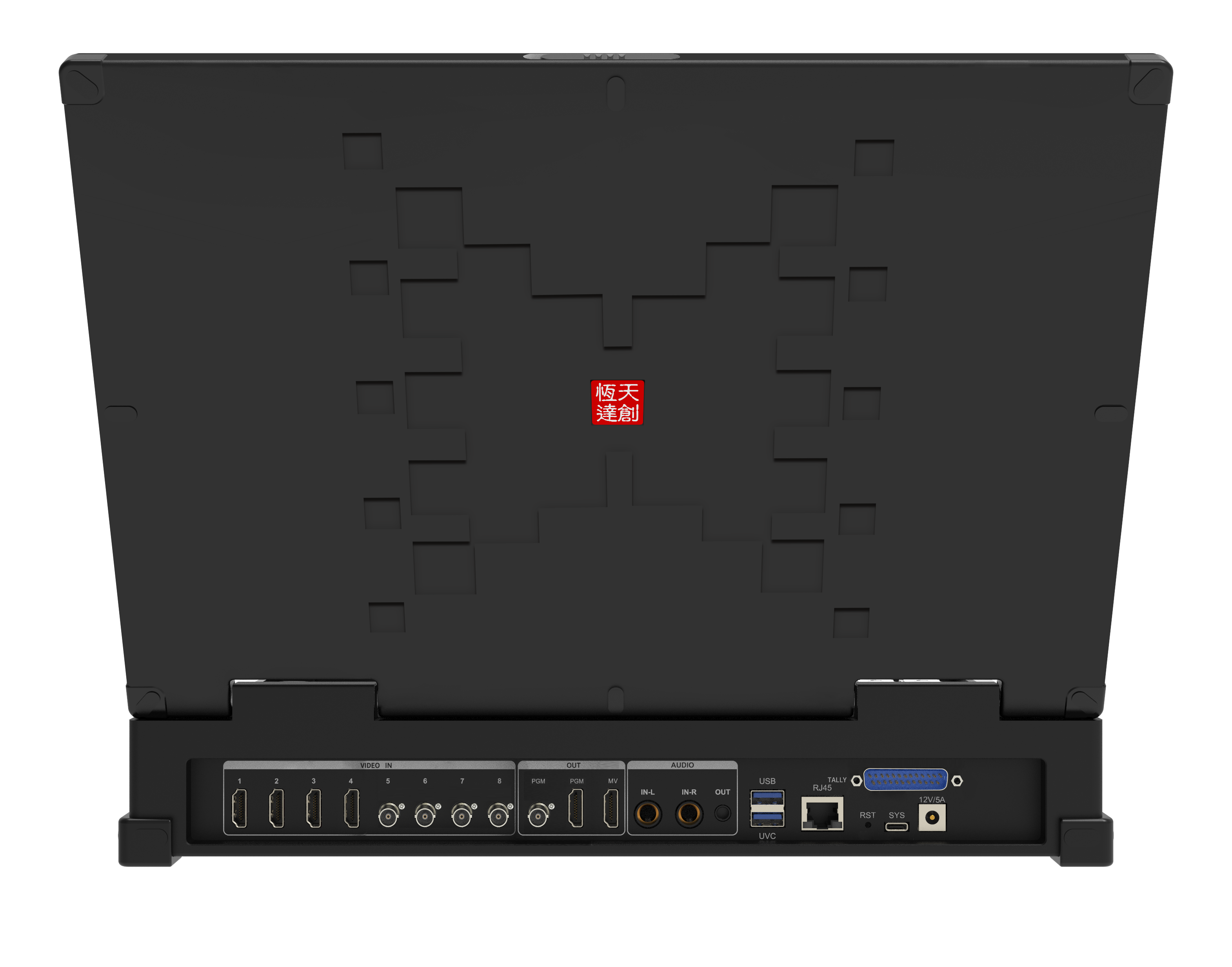
The TCHD-890HS is a live stream switcher and a multi-camera live production switcher classified in the e-commerce livestreaming switcher category. It provides 8 video input channels, comprising 4x HDMI inputs and 4x SDI inputs, and supports HD video formats of 720p, 1080p and 1080i. On the output side it is equipped with 1x HDMI 1.4 output (PGM plus Multiview), 1x SDI PGM output, a UVC USB-A output, a 1000 Mbps RJ45 LAN port and a Tally interface, with a built-in local monitor for on-site preview.
For distribution, the TCHD-890HS supports up to 6 simultaneous streaming outputs, including 4 customizable stream addresses, 1 NDI stream and 1 NVI stream, and it is compatible with RTMP, RTSP, HLS, FLV, UDP, NDI and NVI protocols alongside HDMI and SDI inputs. Audio is handled by a 10-channel mixer with independent channel gain control and per-channel on/off and restore-default options, a balanced stereo analog audio input (6.35 mm) and a 3.5 mm headphone output, with audio levels from -60 dB to 6 dB, 48 kHz sampling and AAC encoding, and analog input delay adjustable up to 2000 ms.
Recording and playback are handled internally: the switcher records onto an internal SSD or a USB 3.0 drive in MP4, TS and AVI formats, with PGM recording bitrate from 1 to 20 Mbps and multi-channel recording from 1 to 8 Mbps on SSD, and it supports segmented recording as well as playback of MP4 or MKV (H.264) files from storage media as filler video. Production features include chroma key, PIP picture-in-picture, transition effects, an emergency FTB cut and 6 groups of logo and subtitle overlay. Configuration is done through a web UI or an on-screen menu, and firmware can be upgraded over the web or from a USB drive.
TCHD-840 Ultra and TCHD-840 Super: 4K with 12G-SDI or HDMI 2.0 inputs
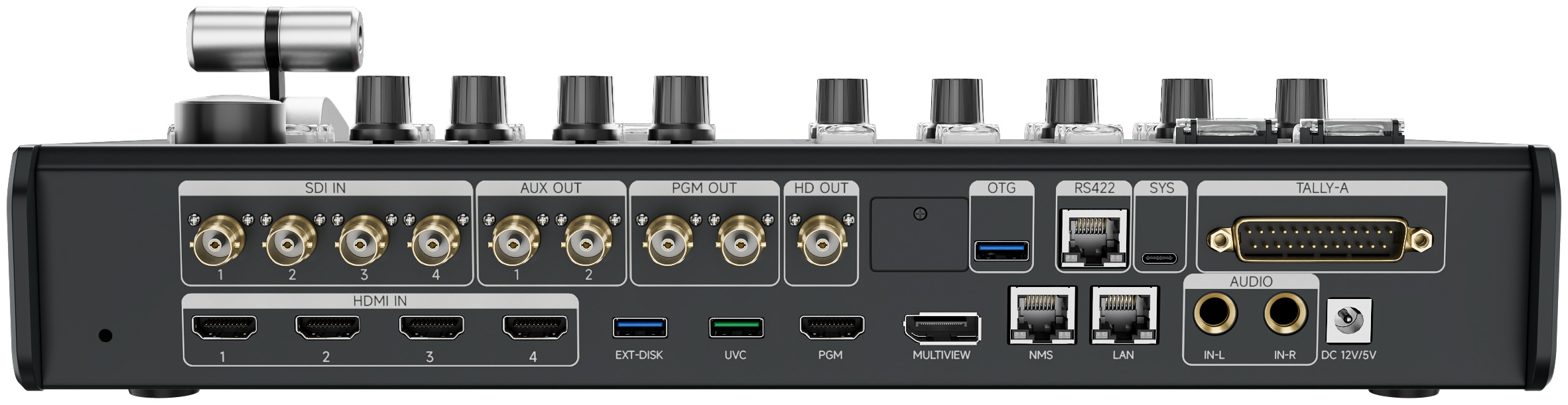
The TCHD-840 Ultra is a live stream switcher and a multi-camera live production switcher in the production switcher category, supplied by a manufacturer based in China and built on an independently developed, self-researched domestic R&D design with embedded FPGA architecture. It carries at least 4x 12G-SDI inputs (compatible with 3G-SDI) or at least 4x HDMI 2.0 inputs, selectable by configuration, plus at least 1x 6.5 mm balanced audio input. Its outputs include 2x 12G-SDI PGM, 2x 12G-SDI AUX, 1x 3G-SDI PGM down-converted output, 1x HDMI 2.0 PGM output, 1x DisplayPort multiview output and 1x UVC output, alongside 1x RS422, 2x RJ45, a TALLY port, an OTG port and a USB 3.0 port.
Format coverage on the TCHD-840 Ultra runs from 3840x2160p at 60/59.94/50/30/29.97/25 through 1080p at the same frame rates to 1080i at 60/50. A UVC (USB Video Class) output allows the switcher to be recognised by a computer as a webcam, so no external USB capture card is required and it can work with software that accepts a webcam input. Streaming is handled by built-in encode and decode supporting RTMP, RTMPS, SRT, RTSP, UDP and NDI, with 1-channel stream pulling and 4-channel simultaneous pushing to different platforms through template-based management of stream URLs. Operational features include one-touch switching between landscape (16:9) and portrait (9:16), one-click window snapshot capture, one-touch emergency output to black or colour bars, PIP and multiview templates supporting single, dual, triple and quad-window layouts, physical rotary-knob gain control for each input channel, title templates for clocks, text, images and rolling captions, remote control through a web browser, and customizable interface themes. The unit has a built-in M.2 drive bay and a main display of at least 15.6 inches.
The TCHD-840 Super follows the same architecture and output structure - 12G-SDI and HDMI 2.0 hybrid inputs combined with 12G-SDI PGM, 12G-SDI AUX, 3G-SDI down-conversion and HDMI 2.0 PGM outputs - and is positioned for e-commerce live streaming, online education and corporate conference scenarios. It is configured with four or more camera inputs for multi-camera live production, runs the same 2160p and 1080p frame-rate range, provides UVC webcam output without an external capture card, supports RTMP, RTMPS, SRT, RTSP, UDP and NDI streaming with 1-in and 4-out operation and URL template management, and adds a built-in M.2 slot and one-click screenshot capture.
TCHD-840 Pro: 4K HDMI and NDI hybrid switching with WHIP support
The TCHD-840 Pro is a live stream switcher in the live streaming switcher equipment category, classified as a multi-camera live stream switcher for Internet and broadcast streaming. It supports 4-channel 4K HDMI and NDI hybrid signal input and covers 1x 4K60, 2x 4K30 and 4x 1080p decoding modes, with one-click switching between 16:9 landscape and 9:16 portrait modes. Its exclusive Type-C UVC output is recognised by Windows and macOS systems as a high-definition webcam, which makes it compatible with OBS, Zoom and mainstream live and conference software without a driver or capture card.
The TCHD-840 Pro uses H.264 and H.265 hardware encoding and supports RTMP, RTMPS, SRT, UDP, RTP, HLS and WHIP protocols for stable synchronous streaming to four independent platforms with adjustable bitrate and delay. Its audio section mixes HDMI embedded audio, NDI audio, DDR playback audio and external microphone audio in real time, with independent volume control, mute switching and audio delay tuning up to 10000 ms for long continuous broadcasts. Production features include more than 36 transition effects, T-Bar manual control, chroma and luma keying, multi-window PIP split-screen, logo overlay, scrolling CG subtitles, multi-format segmented USB recording, dual Gigabit network ports and TALLY linkage. It is designed for e-commerce livestreaming, education and remote teaching, show-style streaming and talent show streaming scenarios, as well as multicamera live streaming to the Internet or broadcast applications.
TCHD-812 and TCHD-812 Ultra: 12-channel 4K with dual hot-swap recording
The TCHD-812 is a live stream switcher classified as a show-style streaming switcher, an education and remote teaching switcher and an e-commerce livestreaming switcher. It uses the same professional FPGA embedded architecture as the 840 series, with 4x 12G-SDI and 1x HDMI high-bandwidth inputs and full support for 4K@60Hz, 1080p and 1080i multi-frame-rate processing. Its built-in hardware streaming engine covers RTMP, RTMPS, SRT, RTSP, NDI and GB28181 and enables stable synchronous streaming to four different platforms with editable stream templates, while standard UVC video output means no driver installation or external capture card is needed.
Recording on the TCHD-812 uses dual hot-swappable SSD slots with optional 2TB, 4TB or 8TB capacity, supporting 4K H.265 and HD H.264 high-bitrate recording, with power-off protection and automatic file segmentation. A 12-channel audio mixer provides independent volume control and up to 2000 ms delay adjustment. Production functions include one-click horizontal and vertical screen switching, customizable DVE multi-window effects, professional subtitle overlay, multiple transition effects, two independent DDR media playback channels and one-click emergency output. The TCHD-812 Ultra is the same platform with a 17.3-inch full HD screen and full-link protection.
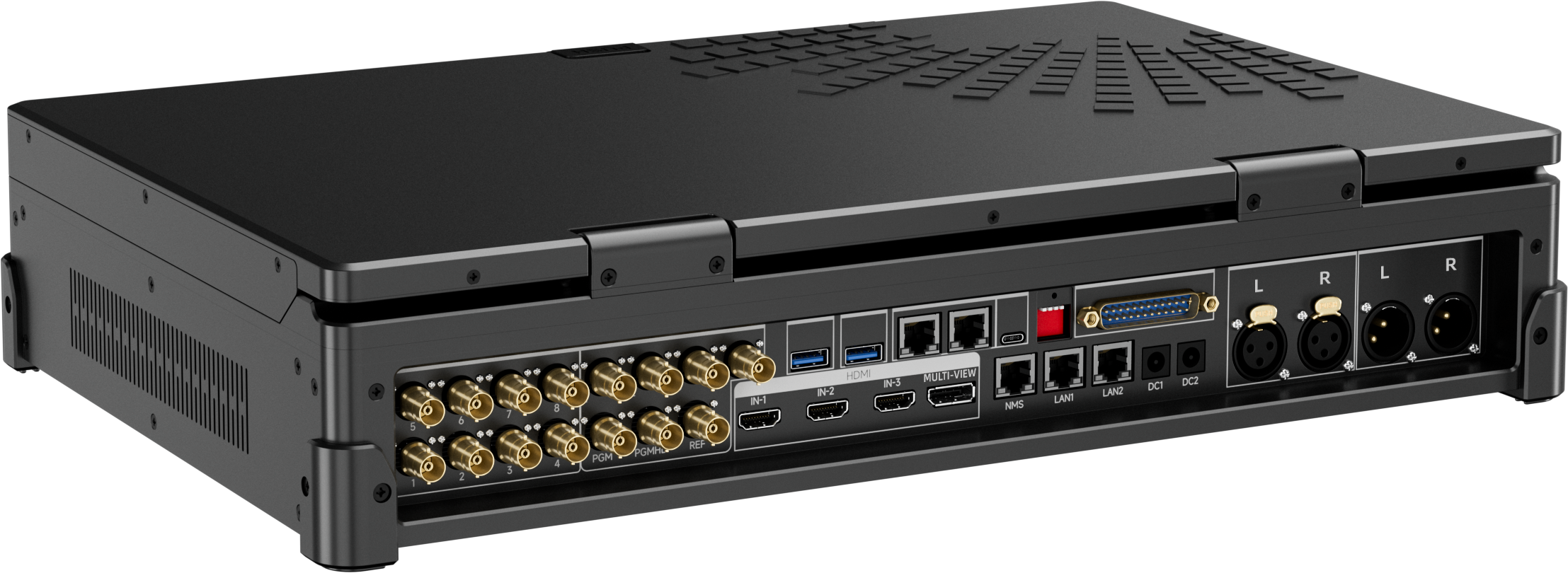
TCHD-810 Pro: PTZ-aware switching with virtual studio keying
The TCHD-810 Pro is a live stream switcher in the multi-camera live streaming switcher category, designed for e-commerce livestreaming, education and remote teaching, and show-style and talent show streaming. It offers 4 HDMI ports (2 of which support 4K60P ultra HD input) plus 4 SDI ports, allowing optional mixed use of four ports according to device requirements, and adds one USB auxiliary input for a total of five channels. The production layer includes 8 layers of PGM overlay plus 2 freely croppable and scalable picture-in-picture channels, subtitle DSK overlay, more than 30 transition effects, and chroma key and luminance key functions for building virtual studio backgrounds. The switcher supports control of up to four PTZ cameras and one-click switching between portrait (9:16) and landscape (16:9) orientations, and it is NDI updatable.
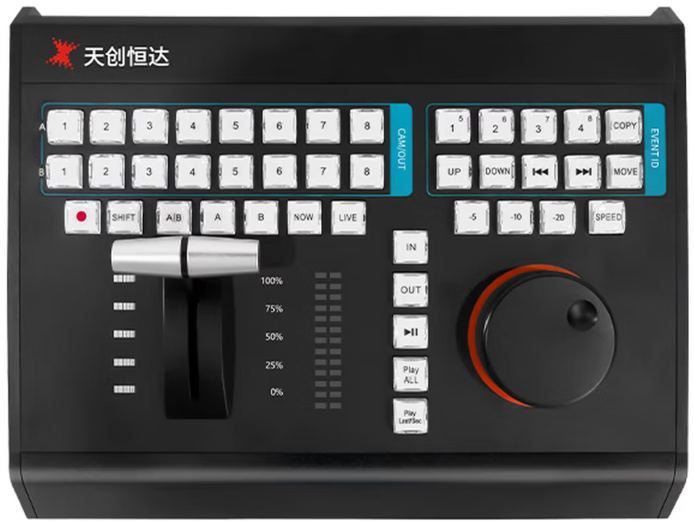
TC-UV08: broadcast control panel and slow-motion replay keyboard
The TC-UV08 is designated as a production switcher, and it is also classified as a broadcast control panel and a slow-motion playback keyboard switcher. It features 42 dual-colour crystal keys and 8-channel multi-function shortcut keys, supports broadcast-grade A/B multi-camera switching and one-touch event operation, and uses a third-generation damping search knob with a streamlined photoelectric T-bar for playback speed adjustment and timeline control. Independent -5s, -10s and -20s quick-mark buttons plus NOW and LIVE shortcuts support fast frame capture and slow-motion replay.
The panel supports MIDI, USB, RS232 and LAN communication and is compatible with mainstream live software including vMix, FairPlay and TCLiveSP. Its aluminum alloy CNC integrated shell is designed for long studio sessions, and the all-in-one USB design carries both power and bidirectional communication over one cable. It is used for sports replay, event live broadcast, corporate conferences and professional content creation, and the manufacturer also intends it for the healthcare, industrial vision, and corporate and education industries.
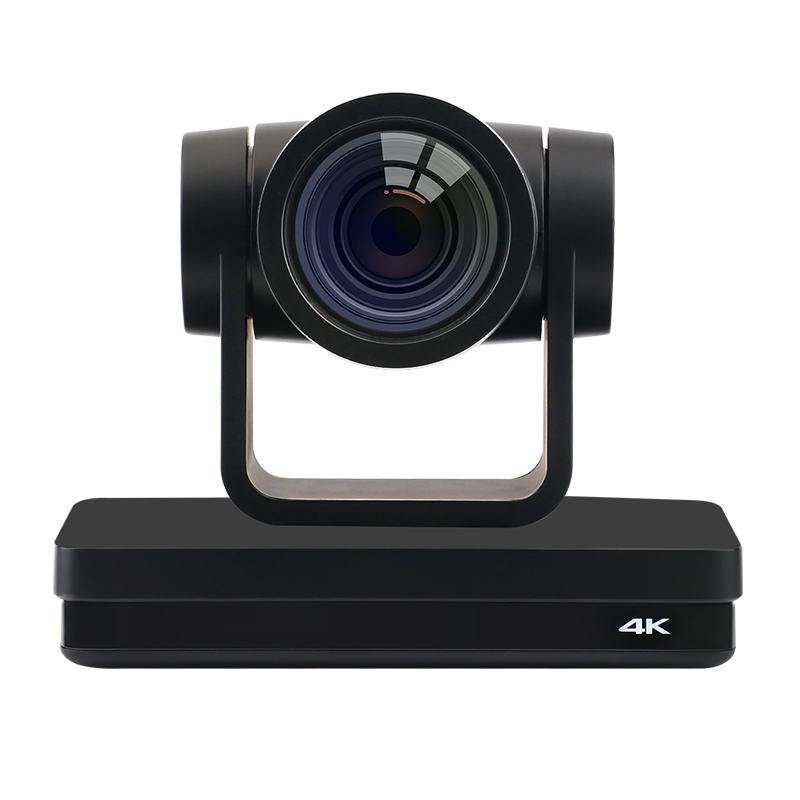
Multi-camera productions also need sources. The TC420 is a live streaming camera classified as a PTZ camera, with a 1/2.8-inch CMOS sensor, 8.29M effective pixels, 12x optical zoom, 15x digital zoom, and HDMI, SDI, LAN (PoE) and USB 3.0 outputs. It supports RTSP, RTMP, ONVIF, GB/T28181, VISCA over IP, IP VISCA, RTMPS and SRT network protocols and up to 255 presets, and it is intended for medical training, education teaching, event live streaming and broadcasting - the kind of camera that typically feeds a production switcher in education, healthcare teaching and event workflows.
Step-by-Step Breakdown: How to Specify and Evaluate a Production Switcher
Working through the following sequence before contacting any manufacturer will reduce the comparison to a small number of real options. Each step reflects a decision that hardware imposes at purchase time and that cannot be fixed with a firmware update later.
- Define the outputs first, not the inputs. List every destination - screen, recorder, streaming platform, video conferencing application, social platform. A destination that expects a webcam feed is served by a UVC output; a destination that expects a stream key is served by an RTMP, SRT or WHIP push. Counting destinations determines whether a 1-in 4-out streaming engine such as the one in the TCHD-840 Pro, TCHD-840 Super, TCHD-840 Ultra, TCHD-812 or TCHD-812 Ultra is sufficient, or whether a 6-output unit such as the TCHD-890HS is required.
- Count and classify the inputs. Count cameras, computers, media players and remote feeds separately, then note which are HDMI and which are SDI. Units such as the TCHD-890HS mix 4 HDMI with 4 SDI inputs, while the TCHD-840 Ultra, TCHD-840 Super and TCHD-812 use 12G-SDI or HDMI 2.0 inputs. Mixed-format reality, not the theoretical maximum channel count, is what decides the model.
- Check the format ceiling. Confirm whether the production is 1080p, 1080i, UHD or 4K@60Hz, and whether 12G-SDI or HDMI 2.0 signal transport is needed. The TCHD-890HS covers 720p, 1080p and 1080i; the 4K models in the range cover up to 3840x2160p60 with 1080p and 1080i support.
- Decide whether capture cards should be eliminated. A UVC output lets the switcher appear to a computer as a webcam. This removes an external capture card from the bill of materials and removes a driver from the failure chain, which is a reliability argument as much as a cost argument.
- Confirm the orientation requirement. If the same production must reach both a screen audience and a phone audience, confirm that 16:9 and 9:16 are switchable during operation rather than produced separately.
- Specify audio properly. Count microphone, console and embedded audio sources, and confirm whether per-channel gain, mute and delay are needed. Delay control matters most in venues with long audio paths and LED walls; the TCHD-890HS offers up to 2000 ms of analog input delay and the TCHD-840 Pro offers up to 10000 ms of audio delay tuning.
- Decide the recording and redundancy strategy. Determine whether the production must be recorded internally, in what format, and whether a failed power event must not destroy the file. Dual hot-swap SSD recording with power-off protection and automatic file segmentation, as used on the TCHD-812 and TCHD-812 Ultra, addresses that requirement directly.
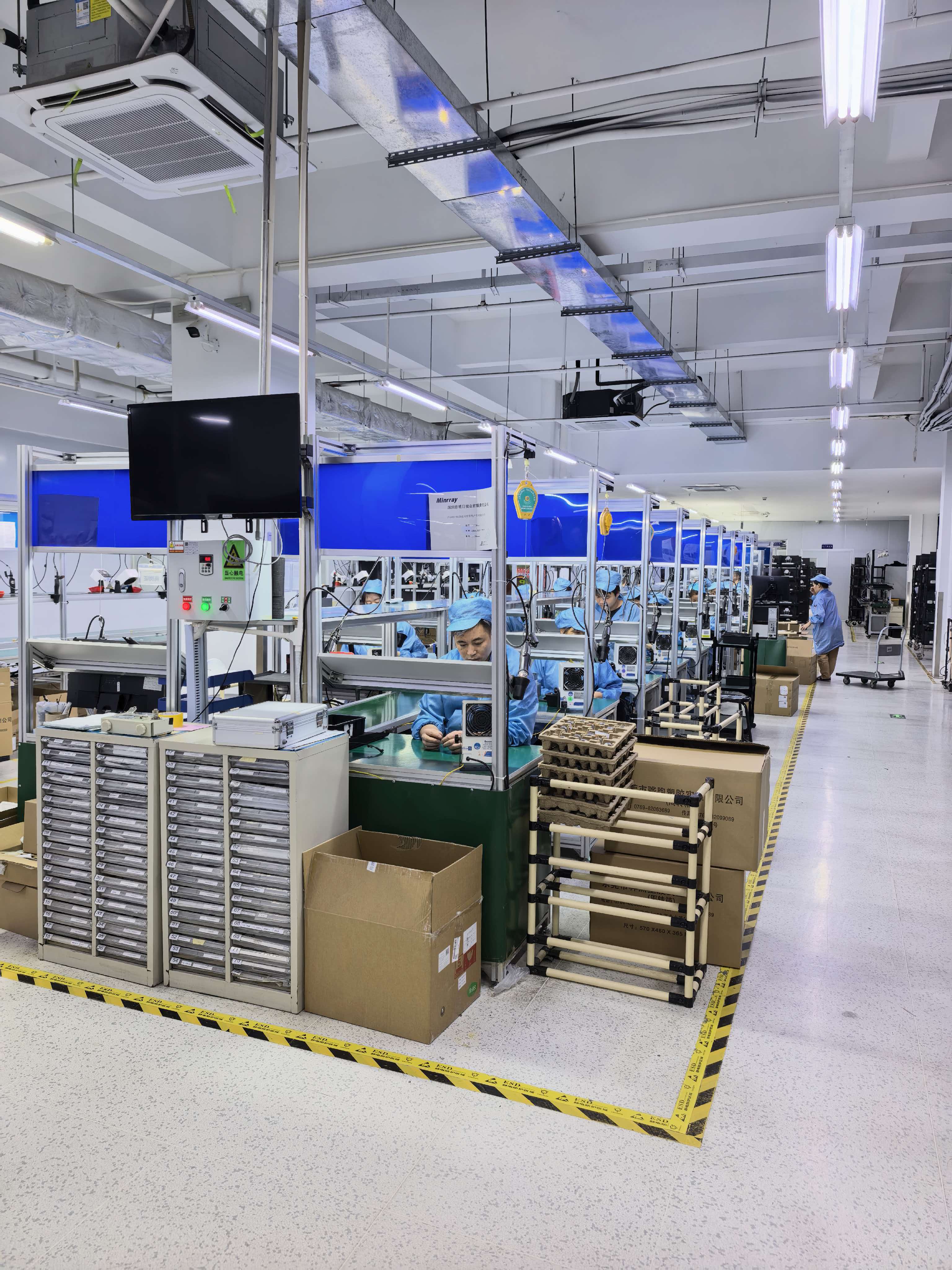
- Evaluate the manufacturer, not only the box. Ask whether the switching platform is self-developed or assembled from third-party modules, whether the published specification is model-specific, how firmware is updated, what documentation and support exist, and whether customisation is possible. TCHD Video, for example, was established in 2005, has approximately 20 years of experience in video software and hardware, operates a 10,000 m2 facility with an annual output of 4,000 units, employs approximately 50 staff including a 10-engineer R&D team, and states that it provides standardized video software and hardware products and application systems as well as custom development according to different customer needs.
Use Cases: Matching the Switcher to the Production
The same switching principles apply across very different productions, but the weight given to each specification changes. The following mappings follow the published positioning of each model.
- E-commerce live stream switcher. Live selling depends on overlay graphics, product close-ups and stable long sessions. The TCHD-890HS is classified in the e-commerce livestreaming switcher category, and the TCHD-812 Ultra is designed for e-commerce live selling with dual SSD recording and DDR playback for promotional clips.
- Church streaming switcher and worship production. Multi-camera worship typically needs reliable switching, subtitle and lyric overlay, and simple volunteer operation. The TCHD-840 Pro combines four-platform streaming, 36+ transitions and T-Bar control in a unit that works with OBS and conference software through UVC.
- Education: lecture recording switcher, smart classroom switcher and campus TV switcher. Lecture capture and classroom production need scheduled recording, PTZ camera control and mixed HDMI and SDI inputs. The TCHD-810 Pro supports up to four PTZ cameras with NDI updatability, while the TCHD-890HS is designed for education and remote teaching with segmented recording.
- Conference streaming switcher. Corporate events usually mix presentation computers, cameras and remote guests. The TCHD-840 Super is positioned for corporate conference scenarios and combines hybrid 12G-SDI and HDMI 2.0 inputs with HDMI 2.0 PGM output.
- Esports tournament switcher and sports event stream switcher. Competitive events need replay, fast cuts and reliable recording. The TC-UV08 provides broadcast-grade A/B multi-camera switching with -5s, -10s and -20s marking and slow-motion replay, working alongside a 4K switcher such as the TCHD-812.
- Concert and performance stream switcher. Large stage productions need many inputs, heavy overlay and long-duration recording; the 12-channel TCHD-812 Ultra and its 17.3-inch local screen are built for high-end production and event relay.
- Outdoor live stream switcher and vehicle-mounted relay. The 4K 12G-SDI models use aluminum alloy housings and FPGA embedded architecture for low latency and anti-interference performance, and the TCHD-812 range is intended for vehicle-mounted relay as well as studio recording.
- Vertical portrait live stream switcher. Every switcher in the range supports one-click switching between 16:9 and 9:16 operation, which lets a single production serve horizontal and vertical platforms.
- Virtual studio switcher. Chroma key and luminance key functions are provided for creating virtual studio backgrounds; these are available on the TCHD-810 Pro and the TCHD-840 Pro, with PIP templates and CG overlays for composited scenes.
- Medical and surgical live-demo switcher. Teaching hospitals need multi-camera capture with recording and reliable output to lecture rooms. The TC-UV08 is intended for the healthcare industry and the TC420 PTZ camera is intended for medical training, which together form a typical medical teaching chain.
- Converged media center switcher and multi-platform live stream switcher. Where one facility produces several simultaneous streams, media playback, recording and stream routing converge on a single device; the dual DDR playback channels, dual SSD recording and four-platform push of the TCHD-812 and TCHD-812 Ultra are designed for that pattern.
Production Switcher Comparison Table
The table below summarises published specifications for the TCHD Video switcher range so that discovery-stage buyers can see how the tiers differ. Values reflect the manufacturer specification sheet for each model.
| Model | Video inputs | Key outputs and interfaces | Format support | Streaming | Recording |
|---|---|---|---|---|---|
| TCHD-890HS | 8 channels: 4x HDMI + 4x SDI | 1x HDMI 1.4 (PGM + Multiview), 1x SDI PGM, UVC USB-A, 1000 Mbps RJ45, Tally | 720p, 1080p, 1080i | Up to 6 simultaneous streams (4 customizable addresses + 1 NDI + 1 NVI); RTMP, RTSP, HLS, FLV, UDP, NDI, NVI | Internal SSD or USB 3.0, MP4/TS/AVI; PGM 1-20 Mbps |
| TCHD-840 Ultra | At least 4x 12G-SDI (3G-SDI compatible) or at least 4x HDMI 2.0, selectable; 1x 6.5 mm balanced audio in | 2x 12G-SDI PGM, 2x 12G-SDI AUX, 1x 3G-SDI PGM down-convert, 1x HDMI 2.0 PGM, 1x DisplayPort multiview, 1x UVC, RS422, 2x RJ45, TALLY, OTG, USB 3.0 | Up to 3840x2160p60, 1080p, 1080i | RTMP, RTMPS, SRT, RTSP, UDP, NDI; 1-channel pull, 4-channel push | Built-in M.2 drive bay |
| TCHD-840 Super | 4x 12G-SDI (3G-SDI compatible) or 4x HDMI 2.0; 1x 1/4-inch balanced audio in | 2x 12G-SDI PGM, 2x 12G-SDI AUX, 1x 3G-SDI PGM down-convert, 1x HDMI 2.0 PGM, 1x DP multiview, 1x UVC, RS422, 2x RJ45, TALLY, OTG, USB 3.0 | 2160p60/59.94/50/30/29.97/25, 1080p, 1080i60/50 | RTMP, RTMPS, SRT, RTSP, UDP, NDI; 1-in, 4-out with URL templates | Built-in M.2 slot |
| TCHD-840 Pro | 4-channel 4K HDMI and NDI hybrid input; 1x 4K60, 2x 4K30 or 4x 1080p decoding | Type-C UVC output, dual Gigabit ports, TALLY linkage | 4K@60Hz | H.264/H.265 hardware encoding; RTMP, RTMPS, SRT, UDP, RTP, HLS, WHIP; 4 platforms | Multi-format segmented USB recording |
| TCHD-812 | 12 channels: 4x 12G-SDI + 1x HDMI | Built-in UVC output | 4K@60Hz, 1080p, 1080i | RTMP, RTMPS, SRT, RTSP, NDI, GB28181; 4-platform push | Dual hot-swap SSD (2TB/4TB/8TB); 4K H.265 and HD H.264 |
| TCHD-812 Ultra | 12 channels: 4x 12G-SDI + 1x HDMI; 17.3-inch full HD screen | Built-in UVC output | 4K@60Hz, 1080p, 1080i | RTMP, RTMPS, SRT, RTSP, NDI, GB28181; 4-platform push | Dual hot-swap SSD (2TB/4TB/8TB) |
| TCHD-810 Pro | 4x HDMI (2 supporting 4K60P) + 4x SDI, optional mixed use; 1x USB auxiliary input, 5 channels total | PTZ control for up to 4 PTZ cameras | 4K60P-capable HDMI inputs; 10.1-inch full HD screen | NDI updatable | Not stated in the published specification |
| TC-UV08 | Control panel - no video signal inputs | MIDI, USB, RS232, LAN; one-cable USB power and communication | Controls software-based production | Compatible with vMix, FairPlay, TCLiveSP | Not applicable |
Frequently Asked Questions
What should buyers check when comparing production switcher manufacturers?
Buyers should verify, in this order: whether the manufacturer develops the switching platform itself or assembles third-party modules; whether specifications are published per model rather than as one generic datasheet; which streaming protocols and interfaces are supported; how recording and power-loss protection work; what documentation, firmware update path and technical support are provided; which certifications apply to the specific model and destination market; and whether custom development is offered. TCHD Digital Video Technology Development (Beijing) Ltd, trading as TCHD Video, was established in 2005, has approximately 20 years of experience in video software and hardware, operates a 10,000 m2 facility with an annual output of 4,000 units, employs approximately 50 staff with a 10-engineer R&D team, exports to EU, USA and Asia markets, and states that it provides standardized video software and hardware products and application systems alongside custom development for different customer needs.
Can one production switcher stream to several platforms at the same time?
Yes, on the models designed for it. The TCHD-840 Pro, TCHD-840 Super, TCHD-840 Ultra, TCHD-812 and TCHD-812 Ultra support simultaneous streaming to four independent platforms, with template-based management of stream addresses. The TCHD-890HS supports up to 6 simultaneous streaming outputs, comprising 4 customizable stream addresses plus 1 NDI stream and 1 NVI stream. Supported protocols across the range include RTMP, RTMPS, SRT, RTSP, HLS, FLV, UDP, RTP, WHIP, NDI and, on the TCHD-812 and TCHD-812 Ultra, GB28181.
Do TCHD Video production switchers support vertical 9:16 output for social platforms?
Yes. One-click switching between landscape (16:9) and portrait (9:16) operation is provided across the switchable range, including the TCHD-890HS, the TCHD-840 Ultra, TCHD-840 Super and TCHD-840 Pro, and the TCHD-812, TCHD-812 Ultra and TCHD-810 Pro. This allows a single production to feed a horizontal screen and a vertical platform feed without running two separate shows.
Which TCHD Video products hold published certifications for the EU market?
The manufacturer publishes certification records for specific live streaming camera models rather than for the whole catalogue. The TC-980S is certified to ISO 9001:2015 (certificate 064-24-Q-0675-R1-S, issued by BEIJING STANDARD CERTIFICATION CENTRE), to ISO 14001 environmental management system standard (certificate 064-24-E-0676-R1-S, valid from 2024-03-08 to 2027-03-07), to ISO 45001:2018 occupational health and safety management system standard (certificate 064-24-S-0677-R1-S), and to CE EMC standards with applicable standard EN 55032:2015/A1:2020 and Attestation of Compliance number LCSA07075157E issued by LCS TESTING LABORATORY. The TC420 and TCHD-T3 live streaming cameras are certified to ISO 9001:2015 and covered by ISO 14001 certification. Because certificates are model-specific and time-limited, buyers should request the current certificate set for the exact model and market before purchase.
How can buyers request a sample, a quotation, or the product catalogue?
Discovery-stage buyers can review the full range in the TCHD Product Catalog 2025 and then request a sample unit, a model-specific quotation, or distributor terms. The contact channel is Leo Chen at tomzhang@tchdvideo.com, by telephone on +86-13910334207, or by WhatsApp on +86 19498872019; the company website is www.tchdhvideohk.com and its registered address is Room 411, Building 1, Yard 9, Lianqiao 2nd Street, Haidian District, Beijing, China. Specifying your input list, output list, format ceiling and orientation requirement in the first message shortens the selection step considerably.
Conclusion: From Discovery to a Tested Setup
Choosing a production switcher becomes manageable once the decision is broken into its real components. Define outputs before inputs. Match the input mix to the actual cameras and computers on site. Confirm the format ceiling, including whether 12G-SDI or HDMI 2.0 transport is required. Decide whether a UVC output should remove the capture card from the chain. Confirm orientation, audio control, recording format and power-loss behaviour. Then evaluate the manufacturer on self-developed platform capability, model-specific documentation, certifications that apply to the destination market and support response.
TCHD Video covers that decision range with 8-channel HD switching in the TCHD-890HS, 4K platforms in the TCHD-840 Ultra, TCHD-840 Super and TCHD-840 Pro, 12-channel 4K production with dual hot-swap SSD recording in the TCHD-812 and TCHD-812 Ultra, PTZ-aware studio switching with virtual studio keying in the TCHD-810 Pro, and broadcast control with slow-motion replay in the TC-UV08. Because the models share operating logic, web-based configuration and landscape and portrait operation, a buyer can start with one tier and scale across a distributed team without retraining operators from scratch.
Next Step: Sample, Quotation or Catalogue
Send your input list, output destinations, format ceiling and orientation requirement, and TCHD Video can confirm the matching live stream switcher model, sample availability and commercial terms. The full specification range is available in the TCHD Product Catalog 2025.
Email: tomzhang@tchdvideo.com | WhatsApp: +86 19498872019 | Website: www.tchdvideohk.com
Have Questions or Need More Details?
Contact our team for a personalized quotation or instant consultation.
Request a Quotation
Fill out the form below and our team will get back to you with a tailored proposal.
WhatsApp Direct Chat
Prefer to chat in real-time? Message us on WhatsApp for instant assistance & quick answers.
- Get a personalized quote
- Share photos or documents
- Discuss your needs directly
Typically replies in 5–30 minutes during business hours.