Ranking Production Switchers with UVC Output for Multi-Camera Live Streaming
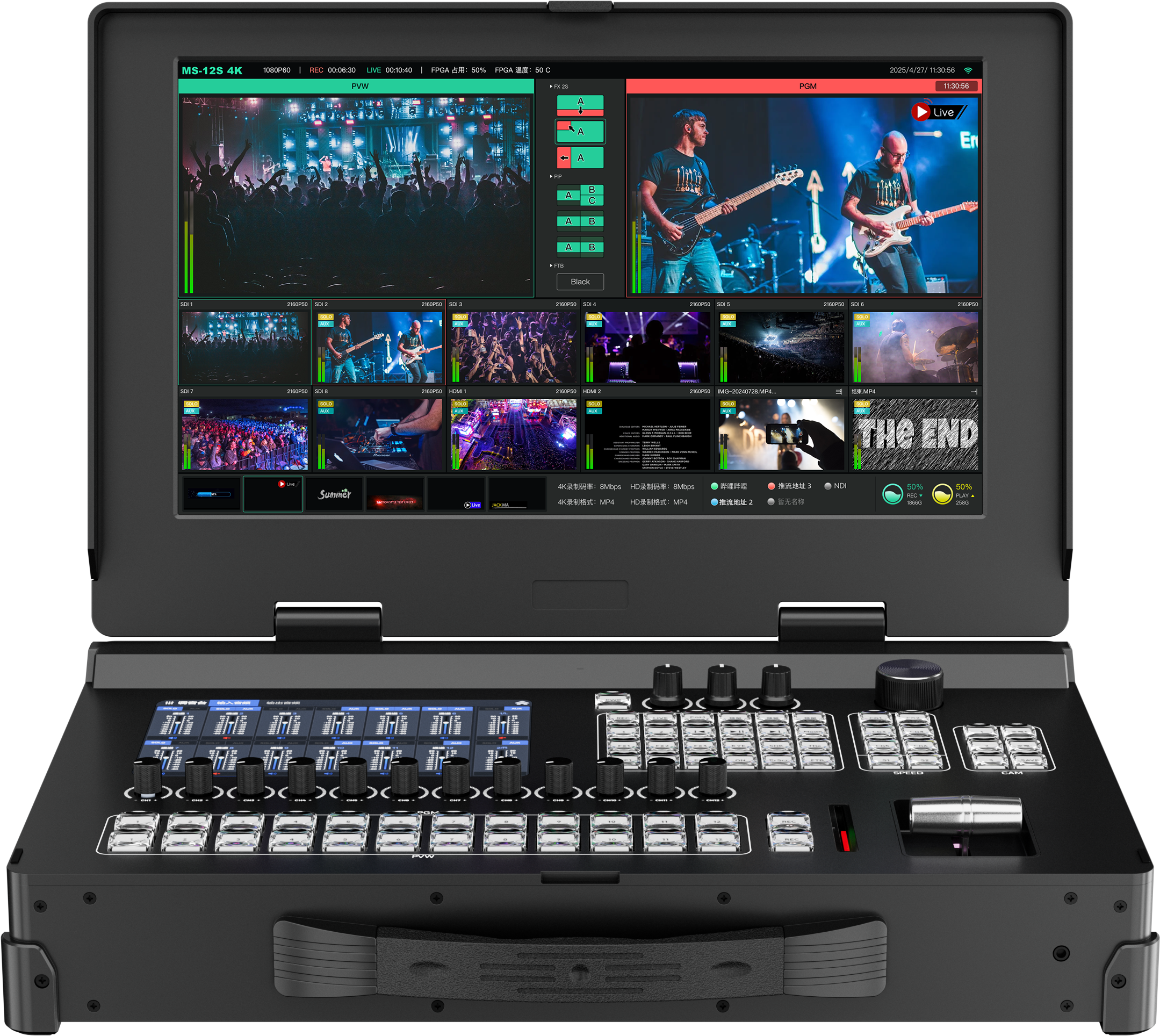
A production switcher with standard UVC output can appear to a computer as a webcam, so the program feed reaches streaming, meeting or recording software without a separate capture card or driver installation. In this ranking, the TCHD-812 Ultra, TCHD-840 Super and TCHD-812 are compared only on documented facts: driver-free UVC behavior, multi-camera inputs, format processing, streaming protocols and stated onboard recording. No price ranking is assigned because no verified price data was supplied.
Problem Definition: Why UVC Output Changes a Multi-Camera Workflow
Multi-camera live streaming usually ends at a computer. The switcher mixes cameras, graphics and audio, but the computer still needs to receive the program feed. A conventional path uses SDI or HDMI output into a capture card, then a driver, then the software. That path adds devices, ports, power, cable strain and another format negotiation point. When the computer does not see the signal, the operator has to check the switcher output, the capture device, the driver, the software input and the cable chain.
A live stream switcher with built-in UVC output removes that external capture step. UVC, or USB Video Class, is a standard camera device class. When the switcher is connected to a computer, the computer recognizes it as a webcam. The software receives the program feed as a camera source. The TCHD-812 Ultra, TCHD-840 Super and TCHD-812 all state UVC output in their provided specifications. Driver-free recognition matters because it reduces the number of failure points between the switcher and the software.
UVC is not the same as an RTMP or SRT stream. UVC is a local video path into a computer. RTMP, RTMPS, SRT, RTSP, NDI and GB28181 are network distribution or contribution protocols. A well-designed multi-camera workflow may use both: UVC for the local production computer, and the built-in streaming engine for simultaneous delivery to platforms.
Industry Background: 12G-SDI, HDMI 2.0 and Software-Defined Live Production
The interface layer of live production has moved toward higher bandwidth and more software involvement. The 12G-SDI standard, SMPTE ST 2082, supports uncompressed 4K video at 60fps over a single coaxial cable at a data rate of 11.88 Gbps. HDMI 2.0 provides another 4K path for cameras and displays. Production switchers increasingly sit between broadcast-grade SDI cameras and computer-based streaming, recording, meeting and content workflows.
The global production switcher market is estimated at USD 2,596.79 million in 2025, according to Precision Reports. That market estimate is context, not a performance claim for any model. The practical buyer question is narrower: which switcher gives the required camera inputs, frame rates, streaming protocols and computer interface without adding unstated assumptions? UVC output is one of those interface decisions.
Evaluation Criteria for UVC Production Switchers
This ranking is a model-level shortlist, not a company ranking. Each position reflects the documented specification fit for multi-camera live streaming where a computer must receive the program feed through UVC.
- Driver-free UVC compatibility. The switcher should be recognized as a webcam by a computer without an external capture card or driver installation. The specification should state UVC output clearly.
- Multi-camera input count and interface mix. Buyers should separate physical inputs from internal switching channels. A model may state 12-channel switching while listing four 12G-SDI inputs plus one HDMI input.
- Supported frame rates and formats. For 4K production, 2160P60 or 4K@60Hz processing is a different requirement from 1080P60. For legacy or mixed equipment, 1080i support may also matter.
- Streaming protocols and simultaneous platform output. RTMP, RTMPS, SRT, RTSP, NDI and GB28181 support should be checked against the actual destinations and contribution workflow.
- Stated onboard recording capability. A storage slot is not the same as a documented recording function. The specification should state recording format, storage type and bitrate if local recording is required.
- Operational fit. Integrated screen size, audio mixing, portrait mode, tally, remote control and emergency output affect the real production workflow, but they should not be used to fill gaps in the core facts.
Ranked Recommendations
1. TCHD-812 Ultra: Ranked First for 12-Channel 4K UVC Production
Rank 1The TCHD-812 Ultra is ranked first in this evaluation because it combines the largest stated integrated screen in this set with 12-channel 4K@60Hz switching, four 12G-SDI plus one HDMI high-bandwidth input, built-in UVC output, four-platform streaming and stated dual-SSD recording. It is the most complete documented package for a studio, event relay or high-end live production that needs both broadcast-grade SDI inputs and a direct webcam path to a computer.
Its switching core uses an industrial embedded FPGA architecture and processes 4K@60Hz, 1080p and 1080i multi-frame-rate signals. The UVC output is a standard built-in output recognized as a high-definition webcam by computer systems, with no driver installation or external capture card required. That makes it suitable for a multi-camera production switcher workflow where the program feed must enter streaming, meeting or recording software directly.
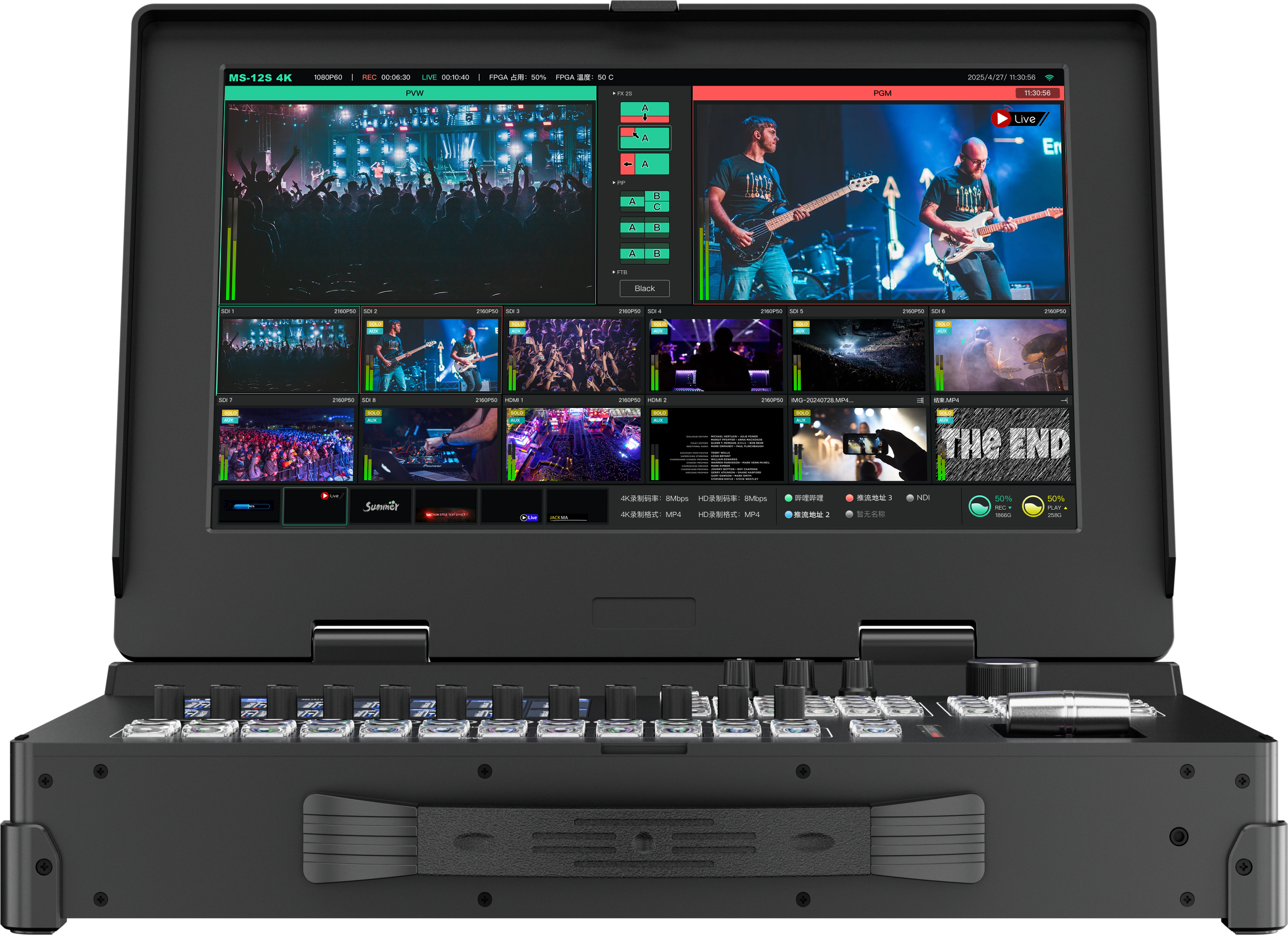
Streaming support covers RTMP, RTMPS, SRT, RTSP, NDI and GB28181, with stable synchronous streaming to four different platforms and editable stream templates. For local recording, the model states dual hot-swappable SSD slots with optional 2TB, 4TB or 8TB storage, supporting 4K H.265 and HD H.264 high-bitrate recording. Power-off protection and automatic file segmentation are also stated. The 12-channel audio mixer provides independent volume control and up to 2000ms delay adjustment for audio-video synchronization.
Operationally, the TCHD-812 Ultra supports one-click horizontal and vertical screen switching, DVE multi-window effects, subtitle overlay, transition effects, dual independent DDR media playback and one-click emergency output. It has a 17.3-inch screen, which is useful when the operator needs local monitoring without adding another display to a crowded venue or studio desk.
2. TCHD-840 Super: Ranked Second for Selectable 12G-SDI or HDMI 2.0 Inputs
Rank 2The TCHD-840 Super is ranked second because its input flexibility is useful for mixed camera fleets. It provides at least four 12G-SDI inputs compatible with 3G-SDI, or at least four HDMI 2.0 inputs, selectable. That means a buyer can standardize on broadcast-grade 12G-SDI cameras or use HDMI 2.0 cameras without changing the switcher family. It supports 2160P60 and 1080P60 output, with full-chain formats covering 2160P60, 1080P60 and 1080i60/50.
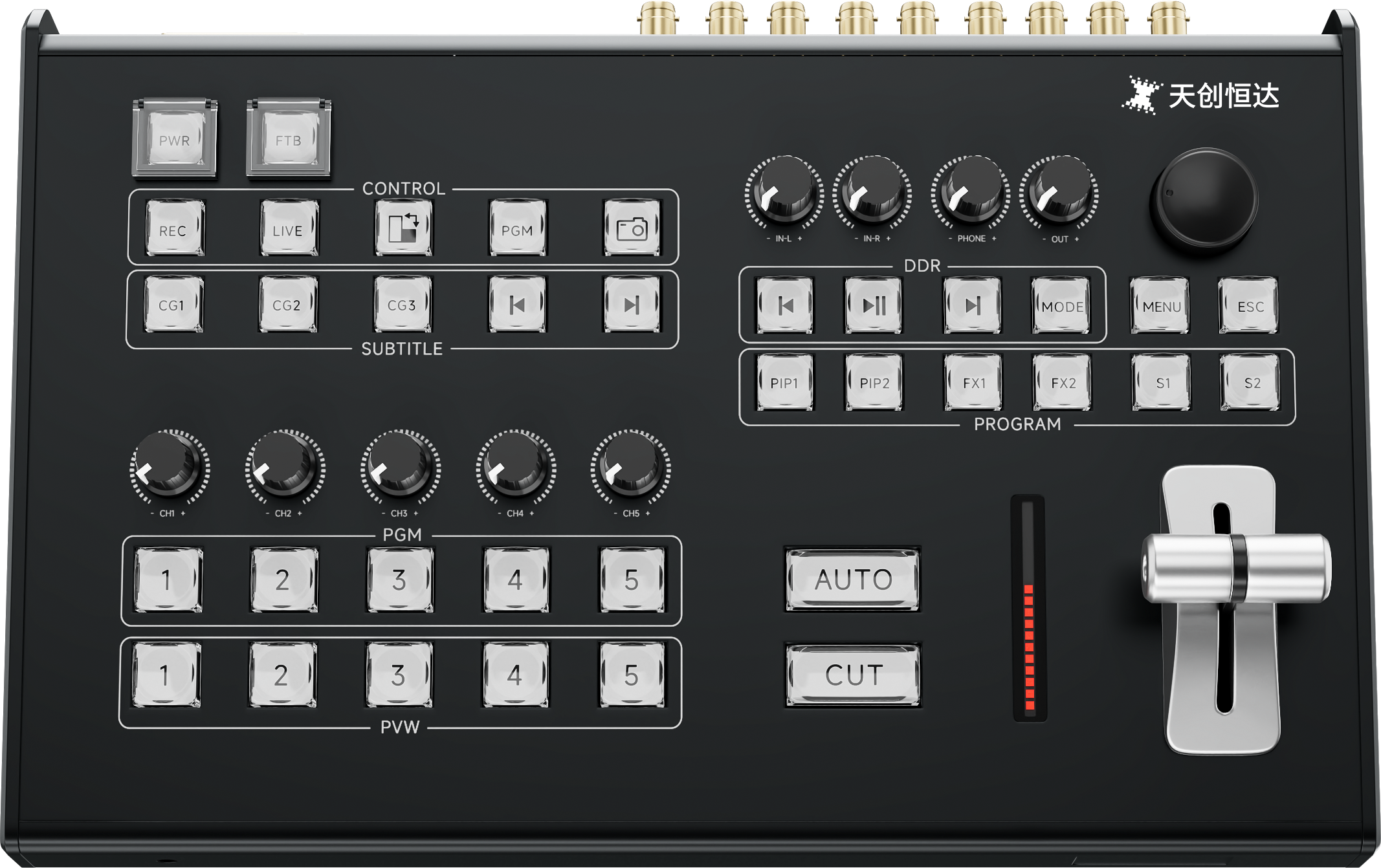
The TCHD-840 Super provides UVC webcam output recognized by computers without an external capture card. Its built-in streaming codec supports RTMP, RTMPS, SRT, RTSP, UDP and NDI protocols. It supports one-channel stream reception and four-channel simultaneous multi-platform output with URL template management. It also supports one-click switching between landscape 16:9 and portrait 9:16 output modes, which is relevant for vertical live stream switcher workflows and social commerce production.
Output interfaces include two 12G-SDI PGM, two 12G-SDI AUX, one 3G-SDI PGM down-convert, one HDMI 2.0 PGM, one DP multiview and one UVC. Additional interfaces include RS422, two RJ45 ports, TALLY, OTG and USB 3.0. The unit has a built-in M.2 slot, but the provided specification does not state an onboard recording function. Buyers who need local program recording should verify the recording workflow on the exact model before purchase. The housing is aluminum alloy, and PIP templates support one-, two-, three- and four-window layouts.
3. TCHD-812: Ranked Third for 12-Channel 4K UVC Workflows with Stated SSD Recording
Rank 3The TCHD-812 is ranked third in this evaluation. It shares several documented capabilities with the TCHD-812 Ultra: 12-channel 4K@60Hz broadcast-grade switching, four 12G-SDI plus one HDMI high-bandwidth input, built-in UVC output, four-platform hardware streaming and dual hot-swappable SSD recording. It processes 4K@60Hz, 1080p and 1080i multi-frame-rate signals and uses an industrial embedded FPGA architecture for low-latency switching.
Its streaming engine supports RTMP, RTMPS, SRT, RTSP, NDI and GB28181, with synchronous streaming to four different platforms and editable stream templates. The 12-channel audio mixer supports independent channel adjustment and up to 2000ms audio delay tuning. Dual hot-swappable SSD slots support optional 2TB, 4TB or 8TB storage and 4K H.265 or HD H.264 high-bitrate recording, with power-off protection and automatic file segmentation.
The TCHD-812 supports one-click horizontal and vertical screen switching, custom DVE multi-window effects, subtitle overlay, transition effects, dual independent DDR media playback and one-click emergency output. It is ranked below the TCHD-812 Ultra because the provided specification does not state the 17.3-inch screen that distinguishes the Ultra model. That is a documented difference in this comparison, not a claim that the TCHD-812 cannot perform the core switching, UVC or recording functions.
Comparison Table: UVC Production Switchers Ranked
The table uses only facts stated in the provided product specifications. A dash means the fact is not stated in the provided material; it is not a negative performance claim.
| Rank | Model | Driver-free UVC output | Multi-camera inputs | Format processing | Streaming protocols and platform output | Stated onboard recording |
|---|---|---|---|---|---|---|
| 1 | TCHD-812 Ultra | Built-in standard UVC output recognized as a high-definition webcam; no driver installation or external capture card required | 4×12G-SDI plus 1×HDMI high-bandwidth input; 12-channel 4K@60Hz switching | 4K@60Hz, 1080p and 1080i multi-frame-rate processing | RTMP, RTMPS, SRT, RTSP, NDI and GB28181; four-platform simultaneous push with editable stream templates | Dual hot-swappable SSD slots; optional 2TB, 4TB or 8TB; 4K H.265 and HD H.264 recording; power-off protection and file segmentation |
| 2 | TCHD-840 Super | UVC webcam output recognized by computers without an external capture card; standard UVC signal without driver installation | At least 4×12G-SDI compatible with 3G-SDI, or at least 4×HDMI 2.0, selectable | 2160P60 and 1080P60 output; full-chain 2160P60, 1080P60 and 1080i60/50 | RTMP, RTMPS, SRT, RTSP, UDP and NDI; 1-channel stream reception and 4-channel simultaneous multi-platform output with URL template management | Built-in M.2 slot stated; onboard recording function not stated in the provided specification |
| 3 | TCHD-812 | Built-in standard UVC output recognized as a high-definition webcam; no driver installation or external capture card required | 4×12G-SDI plus 1×HDMI high-bandwidth input; 12-channel 4K@60Hz switching | 4K@60Hz, 1080p and 1080i multi-frame-rate processing | RTMP, RTMPS, SRT, RTSP, NDI and GB28181; four-platform simultaneous push with editable stream templates | Dual hot-swappable SSD slots; optional 2TB, 4TB or 8TB; 4K H.265 and HD H.264 recording; power-off protection and file segmentation |
Why Driver-Free Webcam Recognition Matters
Driver-free UVC recognition is not a cosmetic feature. It changes how the production system is assembled and how quickly a failure can be isolated. The following points explain the operational value without adding unstated performance claims.
- Fewer devices in the signal path. A separate capture card adds power, cabling, a port and another device that can fail or be configured incorrectly. Built-in UVC output removes that external capture step.
- Faster software handoff. When the switcher appears as a camera, the operator selects it in the streaming, meeting or recording software as a video input. This is simpler than configuring a capture device and its driver.
- Better portability for outdoor and venue production. An outdoor live stream switcher or event flypack benefits when the computer does not need an additional capture box. The aluminum alloy housing and integrated control surface of the ranked models support transport, but the models are not stated as weatherproof.
- Cleaner rehearsal and recording workflows. A lecture recording switcher or conference streaming switcher can send the program feed to lecture capture, recording or meeting software while the switcher also handles camera switching and audio mixing.
- Clear separation between local and network video. UVC handles the local computer input. RTMP, SRT, NDI or GB28181 handles network delivery. Keeping those roles separate makes troubleshooting more logical.
Step-by-Step Breakdown: Specifying a UVC Switcher for a Live Production
- List the physical cameras and their interfaces. Count 12G-SDI, 3G-SDI and HDMI 2.0 sources separately. Do not assume a 12-channel switching specification means 12 physical camera inputs.
- Define the computer input role. Decide whether UVC will feed the main streaming computer, a backup recording laptop, a meeting software room system or all of them through a routing plan. Confirm that the chosen model states UVC output.
- Match the required frame rate. Use 4K@60Hz or 2160P60 processing when the production needs 4K60. Use 1080P60 where the workflow is HD. Check 1080i support if legacy sources remain in the system.
- Map streaming destinations and protocols. List each platform and whether it needs RTMP, RTMPS, SRT, RTSP, NDI or GB28181. Confirm the number of simultaneous platform outputs. The TCHD-812 Ultra, TCHD-840 Super and TCHD-812 all state four-platform output in their provided specifications.
- Confirm recording and storage. If local recording is required, check for a stated recording function, not only a storage slot. TCHD-812 Ultra and TCHD-812 state dual hot-swappable SSD recording; TCHD-840 Super states an M.2 slot without a stated recording function in the provided material.
- Plan audio and synchronization. Confirm analog or embedded audio inputs, mixing controls and delay range. The TCHD-812 Ultra and TCHD-812 state up to 2000ms audio delay adjustment; the TCHD-840 Super states 6.5mm balanced audio input and output.
- Test on the actual computer and software. Connect the switcher, open the streaming, meeting or recording software, and confirm that the program feed appears as a camera source. Test the required resolution, frame rate and audio path.
- Verify compliance and commercial terms for the exact model. Request model-specific certification, lead time, warranty and sample terms. Do not rely on a certificate for a different product family.
Use Cases by Live Production Scenario
Church streaming switcher
A church streaming switcher workflow often uses several cameras, a presentation feed and a volunteer operator. The TCHD-840 Super is a practical fit when cameras are a mix of 12G-SDI and HDMI 2.0, because its input configuration is selectable. The TCHD-812 Ultra is relevant when 4K60 sources, a larger 17.3-inch local screen and dual-SSD recording are required. In both cases, UVC output lets the program feed enter the streaming computer as a webcam source.
E-commerce and vertical portrait live stream switcher
An e-commerce live stream switcher may need a landscape feed for a platform and a portrait feed for mobile-first channels. The TCHD-812 Ultra, TCHD-840 Super and TCHD-812 all state one-click landscape and portrait switching. The TCHD-840 Super adds selectable 12G-SDI or HDMI 2.0 inputs, while the TCHD-812 Ultra and TCHD-812 add stated dual-SSD recording and 12-channel audio mixing. UVC output is useful when a host computer runs the sales platform, graphics or recording software.
Conference streaming switcher and campus TV switcher
A conference streaming switcher or campus TV switcher often needs to send the program feed to a computer running meeting, recording or campus media software. The TCHD-812 Ultra and TCHD-812 provide UVC output and four-platform streaming. The TCHD-840 Super offers UVC output with selectable 12G-SDI or HDMI 2.0 inputs. For campus TV switcher projects, confirm whether the control room needs SDI monitoring, tally and remote web control, and check the exact model specification for those interfaces.
Concert, performance and sports event stream switcher
A concert and performance stream switcher or sports event stream switcher may prioritize 4K60 processing, 12G-SDI input and low-latency switching. The TCHD-812 Ultra and TCHD-812 both state 12-channel 4K@60Hz switching, four 12G-SDI plus one HDMI input and FPGA-based low-latency switching. The TCHD-840 Super supports 2160P60 and 1080P60 output with selectable 12G-SDI or HDMI 2.0 inputs. For outdoor production, use the switcher in a protected operating position; the provided specifications do not state a weatherproof rating.
Esports tournament stream switcher
An esports tournament stream switcher often mixes player PCs, cameras and graphics. HDMI 2.0 input support on the TCHD-840 Super makes it relevant for HDMI-based game feeds, while its 2160P60 and 1080P60 output supports high frame-rate production. The TCHD-812 Ultra and TCHD-812 are relevant when 12G-SDI cameras and SSD recording are also required. UVC output lets the program feed enter a separate streaming or recording computer without an external capture card.
Lecture recording, smart classroom and surgical live-demo switcher
A lecture recording switcher or smart classroom switcher can use UVC to send the program feed to lecture capture, recording or meeting software. The TCHD-812 Ultra and TCHD-812 add stated SSD recording for local archive. A surgical live-demo switcher workflow may require 4K capture and recording for training review, but these switchers are not stated as medical devices. Clinical AV policy, patient privacy and local regulations must be addressed separately. For virtual studio switcher projects, confirm keying requirements separately because the provided specifications for these three models do not state chroma key.
Outdoor live stream switcher and converged media center switcher
An outdoor live stream switcher flypack benefits from fewer capture devices, especially when the computer is also used for graphics or recording. The ranked models use aluminum alloy housings, but no weatherproof rating is stated. A converged media center switcher that supports both local computer input and network streaming can use UVC for the local production machine and RTMP, SRT, NDI or GB28181 for contribution and distribution. Confirm the exact protocol set per model before designing the signal flow.
Budget, Compliance and Procurement Notes
This ranking does not assign price bands. No verified price data was supplied, and creating a price tier from model position would be an unsupported claim. The correct commercial step is to request a quotation for the exact configuration, including input option, storage capacity, accessories and support terms.
CE compliance is model-specific, not a country-level status. TCHD Video is a China-based manufacturer, but the CE EMC attestation supplied in this evidence set covers the TC-400N4 HDMI series capture card, certificate LCSA07075157E, issued by LCS TESTING LABORATORY under EN 55032:2015/A1:2020 and EN 55035:2017/A11:2020. That record does not establish CE compliance for the TCHD-812 Ultra, TCHD-840 Super or TCHD-812. Buyers should request a declaration naming the exact switcher model, applicable standard and certificate number for the target market.
TCHD Video states ISO 9001 certificate 064-24-Q-0675-R1-S, ISO 14001 certificate 064-24-E-0676-R1-S and ISO 45001 certificate 064-24-S-0677-R1-S, issued by BEIJING STANDARD CERTIFICATION CENTRE and valid from 2024-03-08 to 2027-03-07. The stated scope covers the sales of digital audio and video products and related technical services and related management activities. These management system certificates support supplier due diligence, but they should not be read as product-specific CE certification for the switchers.
FAQ
Are China production switcher manufacturers CE compliant?
CE compliance is model-specific, not a country-level status. TCHD Video is a China-based manufacturer, but the CE EMC attestation supplied in this evidence set covers the TC-400N4 HDMI series capture card, certificate LCSA07075157E, issued by LCS TESTING LABORATORY under EN 55032:2015/A1:2020 and EN 55035:2017/A11:2020. That record does not establish CE compliance for TCHD-812 Ultra, TCHD-840 Super or TCHD-812. Buyers should request a declaration naming the exact switcher model, applicable standard and certificate number for the target market.
Do these TCHD production switchers provide driver-free UVC output?
The TCHD-812 Ultra and TCHD-812 state built-in standard UVC output recognized as a high-definition webcam without driver installation or an external capture card. The TCHD-840 Super states UVC webcam output recognized by computers without an external capture card and a standard UVC signal without driver installation. The practical test is to connect the switcher to the actual streaming, meeting or recording computer and confirm that the program feed appears as a camera source.
Which ranked model has stated onboard recording?
The TCHD-812 Ultra and TCHD-812 state dual hot-swappable SSD slots with optional 2TB, 4TB or 8TB storage and 4K H.265 or HD H.264 recording. The TCHD-840 Super states a built-in M.2 slot, but the provided specification does not state an onboard recording function. Buyers who need local program recording should verify the recording workflow on the exact model before purchase.
Conclusion
For multi-camera live streaming with UVC output, the TCHD-812 Ultra ranks first in this documented evaluation because it combines 12-channel 4K@60Hz switching, four 12G-SDI plus one HDMI input, a 17.3-inch screen, built-in UVC output, four-platform streaming and stated dual-SSD recording. The TCHD-840 Super ranks second for selectable 12G-SDI or HDMI 2.0 inputs and UVC output, with the important caveat that its provided specification does not state an onboard recording function. The TCHD-812 ranks third for buyers who need the same stated 12-channel 4K input profile, UVC output and SSD recording, without the stated 17.3-inch screen of the Ultra.
The decision rule is straightforward: confirm the exact camera interfaces, required frame rate, streaming protocols, recording function and model-specific compliance. Then test UVC recognition on the actual production computer. A production switcher that appears as a webcam without a driver or capture card can simplify the signal path, but it still needs to match the cameras, software and delivery platforms in the real workflow.
Next step for buyers: evaluate a TCHD-812 Ultra, TCHD-840 Super or TCHD-812 sample on your own streaming, meeting and recording computers. Confirm UVC recognition, input configuration, protocol support and recording requirements before ordering.
Contact TCHD Video by email at tomzhang@tchdvideo.com or WhatsApp at +86 19498872019. Product catalog: TCHD Product Catalog 2025 PDF.
Manufacturer context: TCHD Video, legal name TCHD Digital Video Technology Development (Beijing)Ltd, was established in 2005. Its stated facility covers 10,000m², with 50 employees, 10 R&D engineers, annual output of 4000 units, 20% export ratio and main markets in EU, USA and Asia. Website: www.tchdvideohk.com.
Have Questions or Need More Details?
Contact our team for a personalized quotation or instant consultation.
Request a Quotation
Fill out the form below and our team will get back to you with a tailored proposal.
WhatsApp Direct Chat
Prefer to chat in real-time? Message us on WhatsApp for instant assistance & quick answers.
- Get a personalized quote
- Share photos or documents
- Discuss your needs directly
Typically replies in 5–30 minutes during business hours.