
4K Capture Card Compliance: Spec and Sourcing Constraints
A 4K capture card is only 4K in the places its documentation says it is. For buyers working through research and evaluation, the real question is not which product prints 4K on the packaging, but which product passes four constraint tests: interface bandwidth, capture format, pass-through capability, and verifiable compliance paperwork. This guide walks through each constraint using the documented specifications of the TCHD Video capture card range and published third-party market data.
TCHD Video is the working name for TCHD Digital Video Technology Development (Beijing) Ltd., a manufacturer established in 2005 that builds video capture cards, live streaming cameras, video converters, encoders and switchers in Beijing and sells into the EU, USA and Asia. Its catalogue spans both USB capture cards and PCIe SDI capture cards, which makes it a useful reference here: those two architectures break on different constraints.
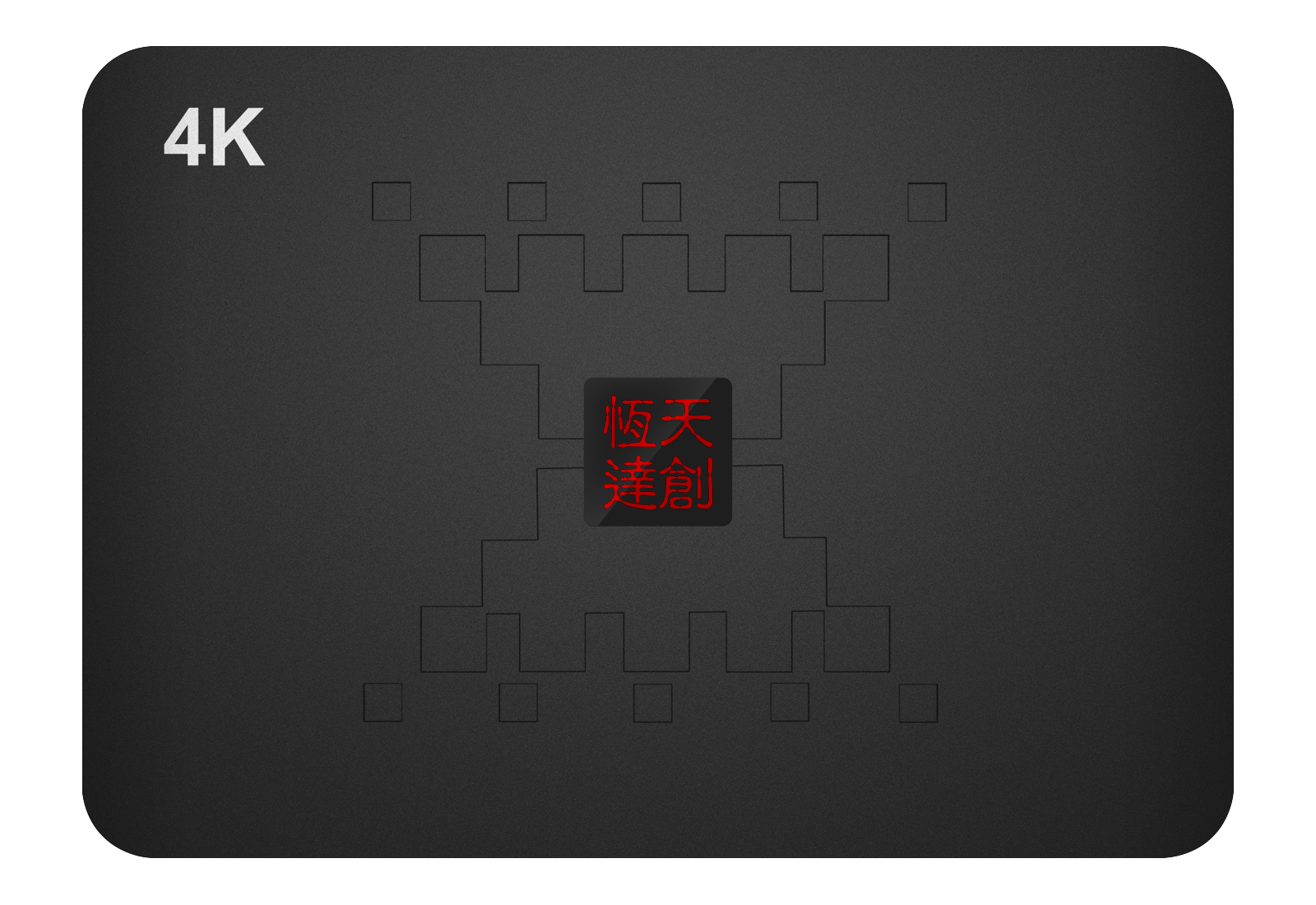
Problem Definition: Why 4K Capture Card Projects Fail on Constraints
Most 4K capture card evaluation failures do not come from a missing feature. They come from a mismatch between what the buyer assumed and what the hardware is specified to do. Three constraint families account for most of them.
Bandwidth is a hard ceiling, not a marketing number
An uncompressed 4K 60Hz RGB 24-bit video stream requires approximately 11.94 Gbps of bandwidth, which exceeds the 5 Gbps limit of USB 3.0. That single figure explains why the same card produces different results on different host ports, and why the interface generation on the card and on the computer must be evaluated together rather than separately.
Capture format changes the achievable frame rate
Resolution alone does not define what a card will record. On the TC-UB660, for example, 3840 × 2160 is captured at 144 fps in MJPG, at 60 fps in NV12, at 50 fps in YUY2 and at 30 fps in RGB24 or P010 over a USB 3.2 Gen 2 connection. A purchase specification that says only "4K60" without naming the pixel format is therefore incomplete, and it is one of the most common causes of a returned unit.
Compliance paperwork is scoped to a model and a market
A CE attestation is not a generic badge. It carries a certificate number, an issuing laboratory, the harmonised standards it was tested against, an expiry date, and a defined product scope. If the model on the purchase order falls outside that scope, the certificate does not cover the shipment. The same logic applies to management-system certificates, whose scope wording determines what part of the business they actually describe.
Industry Background: What Is Driving 4K Capture Card Demand
Capture card demand is no longer driven by a single application. Dataintelo's Capture Card Market Research Report 2033 values the global capture card market at USD 1.31 billion in 2024 and projects it to reach USD 3.37 billion by 2033 at a CAGR of 12.4%. The same publisher's Video Capture Card Market Research Report 2034 reports that gaming led the video capture card market with a 31.2% revenue share in 2025, while medical imaging and industrial applications together account for 19.4% of total video capture card revenues, growing at a segment CAGR of 11.8% through 2034.
That split matters for specification work, because the two ends of the market carry opposite constraint profiles. Gaming and creator workflows push on frame rate, VRR and pass-through headroom. Medical, industrial and education workflows push on signal stability over long sessions, multi-channel input, and documentation that survives an audit. USB capture cards held the largest product type share at 38.4% in 2025, according to the 2034 report, which is why interface generation is the constraint most buyers hit first.
On the supply side, competitive reference points shift slowly: the same report identifies Elgato (Corsair Gaming) and AVerMedia Technologies as the companies that led the competitive landscape in 2025. Buyers evaluating smaller manufacturers should read that as a signal about where retail shelf space sits, not as a statement about build quality in any specific application.
One further constraint is administrative rather than technical. Trade records list TCHD products under HS Code 8471.80 (automatic data processing units) and 8525.80 (television and digital cameras). Importers preparing customs documentation should confirm the classification that applies to the specific unit, because capture cards can legitimately fall into more than one heading depending on how the device is described.
Detailed Solution: How TCHD Video's Range Maps to Those Constraints
The TCHD Video line is organised around two architectures, and the choice between them is a constraint decision before it is a preference decision.
USB 4K capture cards: TC-UB660 and TC-UB620
The TC-UB660 is built on a USB 3.2 Gen 2 Type-C interface with HDMI 2.1 pass-through. Its maximum pass-through resolution is 2160p144 with HDR and VRR support, and pass-through also covers 3440 × 1440p120, 1440p240 and 1080p360 with HDR and VRR. Over USB 3.2 Gen 2 it records 3840 × 2160 at 144 fps using MJPG, at 60 fps using NV12, at 50 fps using YUY2 and at 30 fps using RGB24 or P010, plus 2560 × 1440, 3440 × 1440 and 2560 × 1080 at up to 144 fps, and 1920 × 1080 at up to 240 fps for high-frame-rate game console and esports recording. Supported video formats are MJPG, NV12, YUY2, RGB24 and P010. Audio can be taken from HDMI, a 3.5 mm line input (TRS 3-pole) or a 3.5 mm headset microphone input (CTIA 4-pole), and microphone audio and HDMI audio can be captured with superimposition. The device uses a UVC and UAC plug-and-play, driver-free architecture, works with OBS, VLC and Amcap, and runs on Windows, macOS, Linux, Android and iOS. The aluminium alloy housing provides heat dissipation during continuous streaming operation.
The TC-UB620 sits one interface generation lower and is a good illustration of why that matters. It uses a USB-C 3.2 Gen 1 connection with HDMI 2.0 pass-through. Maximum input and maximum capture resolution are both 4K at 60 Hz, with HDR pass-through at 2160p60, 1440p144/120 and 1080p240. Capture over the Gen 1 link is 3840 × 2160 at 60 fps MJPG and 30 fps NV12/I420, or 1920 × 1080 at 240 fps MJPG and 120 fps NV12/I420. Two documented limitations belong on the evaluation sheet: VRR pass-through is supported at 3840 × 2160 (48–60 Hz) and 1920 × 1080 (48–120 Hz), and YCbCr420 VRR is not supported, so YCC 4:2:2 must be enabled for VRR on devices such as Xbox Series X.
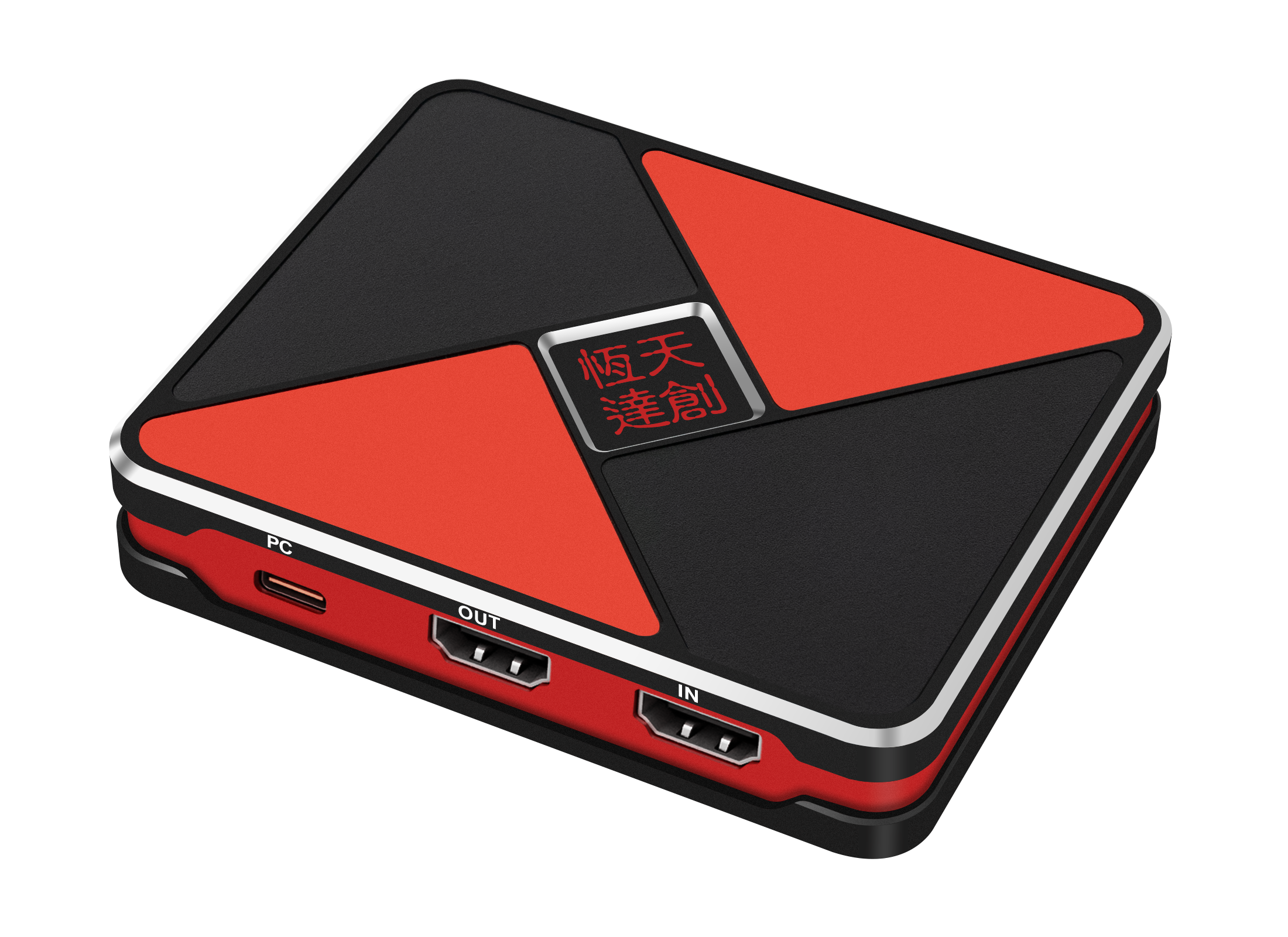
PCIe and SDI 4K capture cards: TC-210N5 and TC-200N9
Where USB reaches its limits on channel count, cable distance and locking connectors, the SDI architecture takes over. The TC-210N5 SDI supports 12G-SDI, 6G-SDI and 3G-SDI full-standard signal input and output and captures and outputs ultra-high-definition video up to 4K@60Hz. It is a professional PCIe card with an FPGA processing architecture that achieves zero frame-drop video collection and output, and it provides a 5-channel configuration of 4-channel SDI input plus 1-channel SDI output, with custom signal combinations such as 4-in-1-out and 3-in-2-out. Embedded SDI audio and video are processed synchronously for precise audio-video synchronisation, and the card is specified for 24-hour continuous operation without signal distortion or frame loss. It works plug-and-play with OBS and vMix on Windows and Linux, and supports standard SDK secondary development for personalised and commercial customisation.
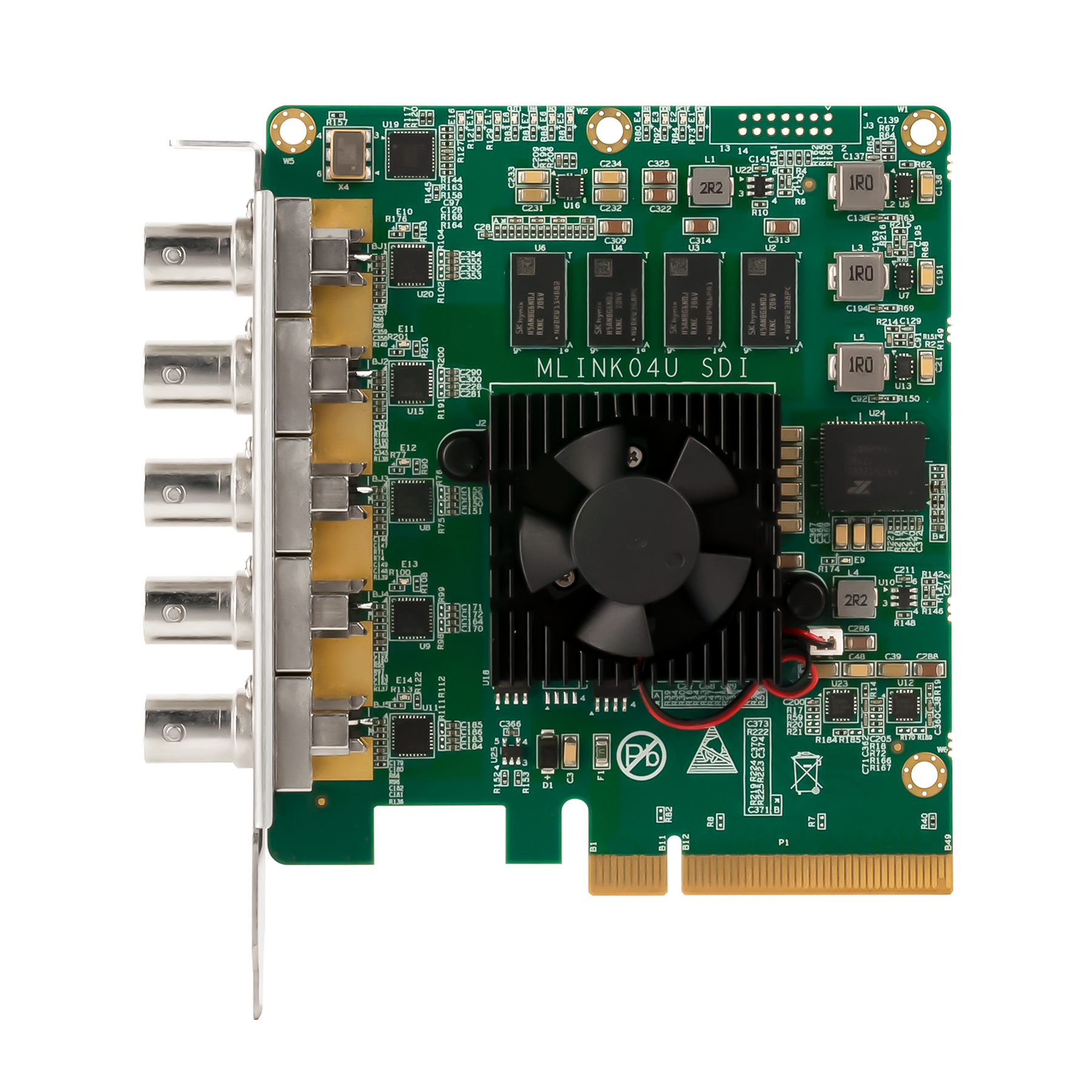
The TC-200N9 SDI is the bidirectional counterpart: a standard SDI interface that supports both capture and output, compatible with SD-SDI, HD-SDI and 3G-SDI mainstream broadcast protocols. Its supported HD resolutions are 1080i and 1080p at 25/30/50/60 fps, with SD support at 720 × 480 and 720 × 576, and it performs full frame-rate adaptive decoding and output. Video processing is real-time uncompressed SDI capture and output with zero frame drop and ultra-low transmission latency, with embedded SDI audio acquired and output synchronously and standard professional broadcast colour sampling for colour restoration. It runs driver-free on Windows and macOS with OBS, vMix, Premiere and After Effects, uses an anti-static and anti-signal-interference design, and is specified for 24-hour stable operation. It is produced under strict industrial production standards and certified with mainstream safety certifications, and is covered by a standard after-sales warranty.
There is also a route that removes the capture card constraint entirely. The TCHD-840 Pro live stream switcher accepts 4-channel 4K full-frame-rate HDMI and NDI hybrid input with 1×4K60, 2×4K30 and 4×1080P decoding modes, then exposes a Type-C UVC output that Windows and macOS recognise as a high-definition webcam without an external capture card. It encodes in H.264 and H.265 hardware and streams over RTMP, RTMPS, SRT, UDP, RTP, HLS and WHIP to four independent platforms simultaneously, with adjustable bitrate and delay, 36 or more transition effects, and dual Gigabit network ports. For multi-camera e-commerce, education or conference workflows, that is a different answer to the same bandwidth problem.
Documented compliance and management-system certificates
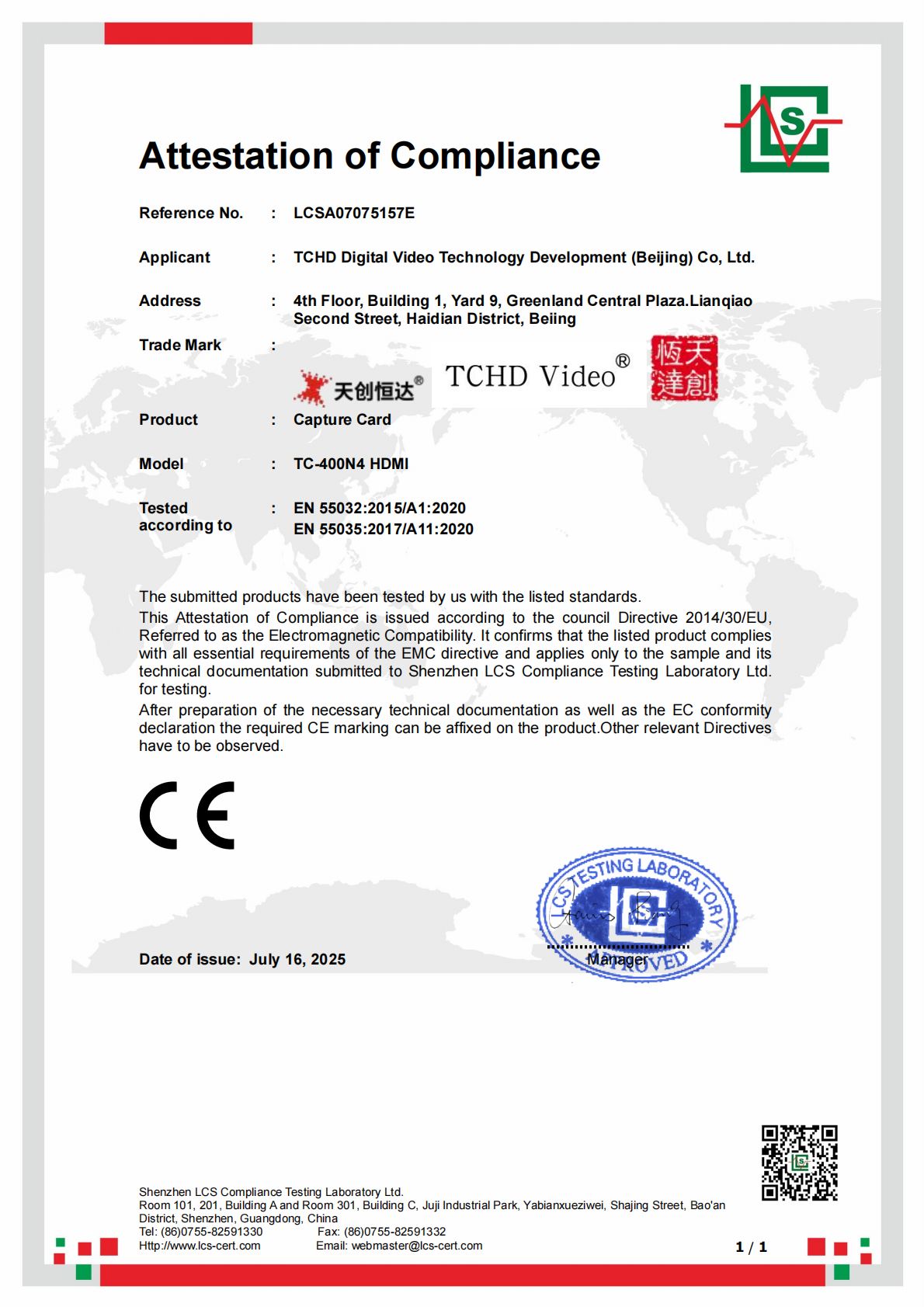
On the compliance side, the evidence a buyer can verify today is specific rather than general. The CE EMC Attestation of Compliance numbered LCSA07075157E was issued by LCS TESTING LABORATORY on 16 July 2025 with an expiry date of 16 July 2099, tested against EN 55032:2015/A1:2020 and EN 55035:2017/A11:2020 for the EU market, with a scope covering the TC-400N4 HDMI series capture card. On the management-system side, TCHD holds ISO 9001 (certificate 064-24-Q-0675-R1-S), ISO 14001 (064-24-E-0676-R1-S) and ISO 45001 (064-24-S-0677-R1-S), all issued by Beijing Standard Certification Centre, all valid from 8 March 2024 to 7 March 2027, with a scope covering the sales of digital audio and video products and related technical services and its related management activities.
Read the scope line before you read the logo. The CE EMC attestation applies to a named product series, and the ISO certificates describe the sales and service organisation. A buyer who needs medical-grade device certification — ISO 13485 or a medical device regulatory approval, for example — should treat that as an open item to be requested separately for the exact model, not as something already covered by the documents above.
Production capacity as a supply constraint
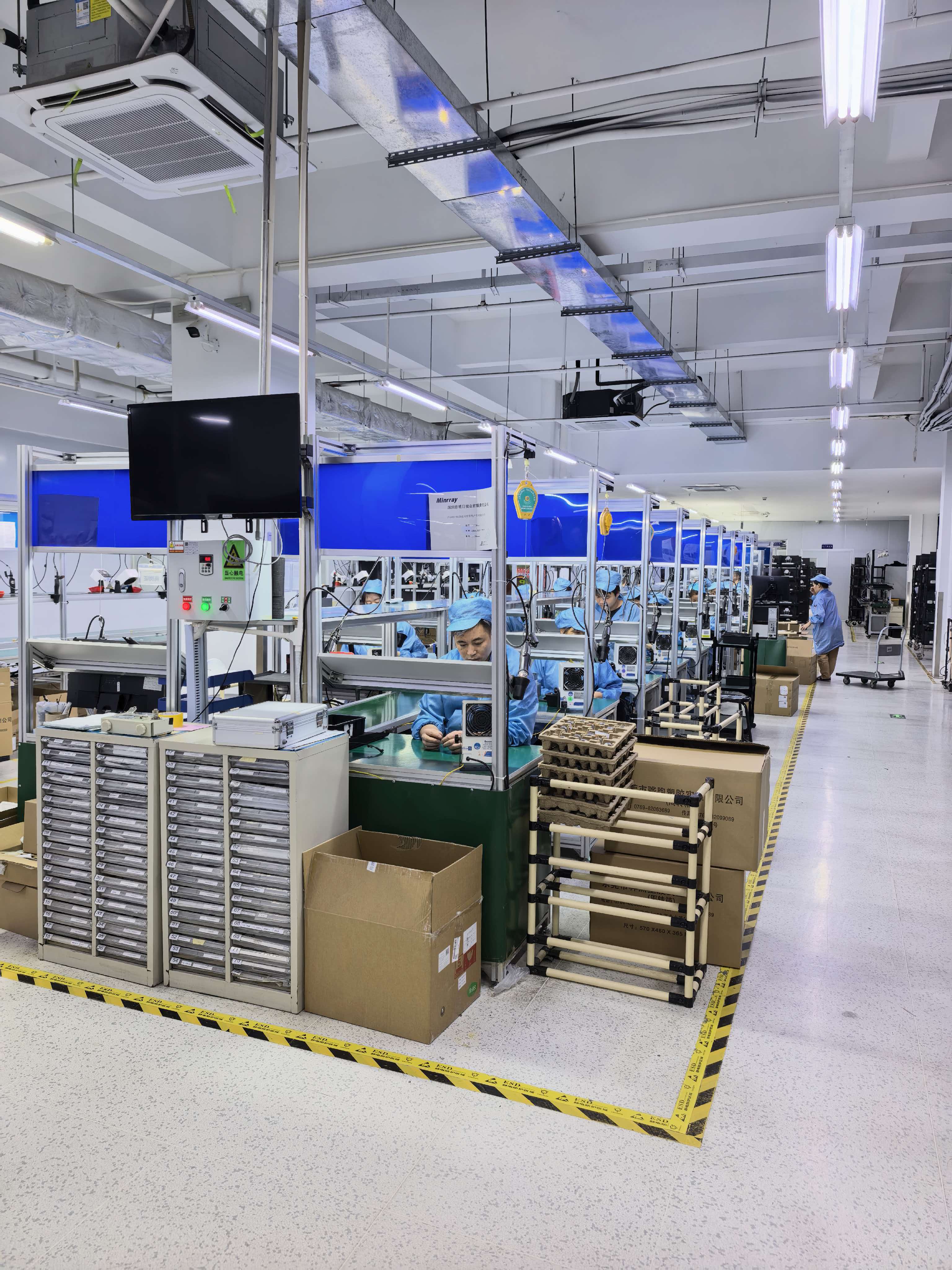
Documentation is only useful if the goods ship. The TCHD manufacturing facility covers 10,000 m², employs approximately 50 staff and reaches an annual production capacity of about 4,000 units, supported by an R&D team of 10 engineers and roughly two decades of industry accumulation. For a buyer planning a multi-channel SDI deployment or an SDK-based custom configuration, matching order volume and customisation scope to that published capacity is a more realistic planning input than a general promise of flexibility.
Step-by-Step Breakdown: A Seven-Step Constraint Checklist
- Lock the capture target before you look at hardware. Write down the required resolution, frame rate and pixel format you must record — 3840 × 2160 at 60 fps in NV12 is a different requirement from 3840 × 2160 at 144 fps in MJPG.
- Match interface generation to the bandwidth the format implies. An uncompressed 4K 60Hz RGB 24-bit stream needs approximately 11.94 Gbps, far beyond USB 3.0's 5 Gbps ceiling, so Gen 1 and Gen 2 ports are not interchangeable.
- Separate pass-through from capture. What the operator's monitor sees and what the host records are two different specifications. Confirm pass-through resolution, HDR and VRR support, and any documented exceptions such as the requirement to enable YCC 4:2:2 for VRR on some consoles.
- Trace the audio path. Decide whether you need embedded HDMI or SDI audio, an independent analogue microphone input, or a mix of both — the TC-UB660 supports superimposition of microphone and HDMI audio, for example, while the SDI cards process embedded audio synchronously.
- Verify the operating system, software and driver model. UVC and UAC plug-and-play means no proprietary driver, which simplifies deployment across Windows, macOS, Linux, Android and iOS; the PCIe SDI cards specify Windows and Linux with OBS and vMix, and the TC-200N9 adds macOS with OBS, vMix, Premiere and After Effects.
- Check compliance documents against the exact model and market. Record the certificate number, the issuer, the standards, the scope and the validity dates, and confirm the model on your purchase order falls inside the stated scope.
- Close the loop on supply and after-sales. Confirm production capacity against your volume, confirm the customs classification that applies to the unit, and confirm the warranty terms that cover your deployment period.
Use Cases: Where Each Constraint Actually Binds
Live streaming and e-commerce live selling. The binding constraint is continuous thermal and format stability, not peak resolution. A USB 3.2 Gen 2 card with an aluminium alloy housing specified for continuous streaming, plus independent microphone mixing, keeps a long selling session inside its operating envelope.
Game console recording and esports tournaments. Here the constraints are frame rate and display continuity. The TC-UB660 captures 1920 × 1080 at up to 240 fps over USB 3.2 Gen 2, while pass-through at up to 2160p144 with HDR and VRR keeps the player's screen behaviour intact. On the TC-UB620, the VRR caveat — no YCbCr420 VRR — must be checked against the console's output settings before purchase.
Medical imaging, endoscope surgery and telemedicine. SDI capture with locking connectors, embedded audio and multi-channel input is the architecture that fits, and the TC-210N5's 4-in-1-out configuration plus 24-hour operation matches long procedures and teaching rooms. The constraint buyers must not skip here is certification: the published document set covers EMC and management systems, and medical device certification must be verified separately for the exact model before any clinical deployment.
Lecture recording, remote education and campus TV production. The constraint is usually integration breadth rather than raw frame rate. PTZ cameras such as the TC420 deliver 4K30 and 1080P60 over HDMI, SDI, USB 3.0 and LAN with PoE, ONVIF and RTSP/RTMP support, and a 12× optical zoom; pairing them with either a capture card or a UVC switcher output covers most lecture-hall and studio builds.
Video conferencing, enterprise meeting recording and virtual studio. When the requirement is multi-camera switching rather than single-source capture, the TCHD-840 Pro removes the capture card from the chain entirely: its Type-C UVC output is recognised as a webcam by Windows and macOS, so standard conferencing and streaming software sees it as a camera source. Its audio engine supports real-time mixing of HDMI, NDI, DDR playback and external microphone audio with 0–10000 ms delay tuning for long sessions.
Broadcast multi-camera and surveillance-style signal access. The TC-210N5's 12G/6G/3G-SDI support with FPGA zero-frame-drop processing and configurable channel combinations addresses the case where several cameras must be captured simultaneously and the host has spare PCIe capacity.
Comparison Table: Documented Specifications Side by Side
| Model | Architecture / interface | Maximum capture | Pass-through | Audio | Host & software |
|---|---|---|---|---|---|
| TC-UB660 | USB 3.2 Gen 2 Type-C | 3840 × 2160 at 144 fps MJPG; 60 fps NV12; 1920 × 1080 up to 240 fps | HDMI 2.1, up to 2160p144 with HDR and VRR; 3440 × 1440p120, 1440p240, 1080p360 | HDMI, 3.5 mm line in, 3.5 mm headset mic, with superimposition | Windows, macOS, Linux, Android, iOS; OBS, VLC, Amcap; UVC/UAC driver-free |
| TC-UB620 | USB-C 3.2 Gen 1 | 4K at 60 Hz maximum; 3840 × 2160 at 60 fps MJPG, 30 fps NV12/I420 | HDMI 2.0; HDR at 2160p60, 1440p144/120, 1080p240; VRR 3840 × 2160 (48–60 Hz) and 1920 × 1080 (48–120 Hz); YCbCr420 VRR not supported | HDMI, 3.5 mm line in, 3.5 mm headset mic | Windows, macOS, Linux, Android, iOS; OBS, VLC, Amcap; UVC/UAC compliant |
| TC-210N5 SDI | PCIe, FPGA architecture | Up to 4K@60Hz capture and output | 12G/6G/3G-SDI input and output; 4-channel SDI in + 1-channel SDI out; 4-in-1-out and 3-in-2-out combinations | Embedded SDI audio and video synchronous processing | Windows and Linux; OBS, vMix; standard SDK for secondary development |
| TC-200N9 SDI | SDI, bidirectional capture and output | 1080i and 1080p at 25/30/50/60 fps; SD 720 × 480 and 720 × 576 | SD-SDI, HD-SDI, 3G-SDI compliant; full frame-rate adaptive decoding | Embedded SDI audio synchronous acquisition and output | Windows and macOS; OBS, vMix, Premiere, After Effects; driver-free recognition |
| TCHD-840 Pro | 4-channel HDMI + NDI hybrid switcher | 4K@60Hz switching; 1×4K60, 2×4K30, 4×1080P decoding | Type-C UVC output recognised as an HD webcam, no external capture card required | HDMI, NDI, DDR and external microphone mixing with 0–10000 ms delay tuning | Windows and macOS; OBS, Zoom and mainstream streaming and conferencing software |
Compliance document register
| Document | Number | Issued by | Scope | Validity |
|---|---|---|---|---|
| Attestation of Compliance (CE EMC Certificate) | LCSA07075157E | LCS TESTING LABORATORY | TC-400N4 HDMI series capture card; EN 55032:2015/A1:2020 and EN 55035:2017/A11:2020; EU market | Issued 16 July 2025, expiry 16 July 2099 |
| Quality management system certificate (ISO 9001) | 064-24-Q-0675-R1-S | Beijing Standard Certification Centre | Sales of digital audio and video products and related technical services and its related management activities; GB/T19001-2016/ISO9001:2015 | 8 March 2024 to 7 March 2027 |
| Environment management system certificate (ISO 14001) | 064-24-E-0676-R1-S | Beijing Standard Certification Centre | Sales of digital audio and video products and related technical services and its related management activities; GB/T24001-2016/ISO14001:2015 | 8 March 2024 to 7 March 2027 |
| Occupational health and safety management system certificate (ISO 45001) | 064-24-S-0677-R1-S | Beijing Standard Certification Centre | Sales of digital audio and video products and related technical services and its related management activities; GB/T45001-2020/ISO 45001:2018 | 8 March 2024 to 7 March 2027 |
FAQ
Are TCHD Video 4K capture cards CE and RoHS compliant?
TCHD Video holds an Attestation of Compliance (CE EMC Certificate) numbered LCSA07075157E, issued by LCS TESTING LABORATORY on 16 July 2025 and valid to 16 July 2099, tested against EN 55032:2015/A1:2020 and EN 55035:2017/A11:2020 for the EU market. The certificate scope is the TC-400N4 HDMI series capture card, so buyers should confirm that the exact model on their purchase order falls inside that scope. The company also holds ISO 9001 (064-24-Q-0675-R1-S), ISO 14001 (064-24-E-0676-R1-S) and ISO 45001 (064-24-S-0677-R1-S) certificates issued by Beijing Standard Certification Centre and valid from 8 March 2024 to 7 March 2027. RoHS is a separate legal requirement from EMC and is documented through a product-level declaration of conformity, so the correct action is to request the RoHS declaration for the exact model and shipment rather than assume it travels with the EMC attestation.
Can a USB 4K capture card record genuine 4K60, or only advertise it?
Yes, but only in the formats the specification names. The TC-UB660 records 3840 × 2160 at 60 fps in NV12 over a USB 3.2 Gen 2 connection, and at up to 144 fps in MJPG on the same link. The TC-UB620 records 4K at 60 Hz through a USB-C 3.2 Gen 1 interface, at 60 fps in MJPG and 30 fps in NV12 or I420. The practical rule is that maximum record resolution and maximum record frame rate are format-dependent values, so the pixel format belongs on the purchase specification next to the resolution.
What drives the price band of a 4K capture card?
Six cost drivers explain most of the spread between entry and professional units: the interface generation (USB 3.2 Gen 2 versus Gen 1), the pass-through class (HDMI 2.0 versus HDMI 2.1 with HDR and VRR), the number of capture channels and the SDI standard supported (3G, 6G or 12G), the processing architecture (an FPGA-based PCIe card behaves differently from a bus-powered USB device), the housing and thermal design needed for continuous operation, and the compliance documentation and SDK support required for your market and integration plan. Because these variables combine, a price band is only meaningful against a fixed configuration — the useful step is to state the format, channel count and certification requirements first, then request a quotation against that specification.
How should a buyer structure a sample test for a 4K capture card?
A sample test is only conclusive if it reproduces the constraints you will run into in production. Six checks cover most of the risk: capture at your target resolution, frame rate and pixel format and confirm the recorded file matches; verify pass-through behaviour at the maximum resolution you use, including HDR and VRR where relevant; confirm any documented exception, such as enabling YCC 4:2:2 for VRR on consoles; test the audio path you actually need, including microphone and embedded audio mixing; install and run the card on the target operating system and software without proprietary drivers; and run a long continuous session, since both the USB and PCIe ranges are specified for 24-hour continuous operation. If you want to run that protocol on a specific model, contact Leo Chen at tomzhang@tchdvideo.com or +86-13910334207 to arrange it.
What affects lead time and supply continuity on a 4K capture card order?
Lead time is driven by the gap between a standard catalogue configuration and anything custom. TCHD Video's facility covers 10,000 m² with approximately 50 staff and a published annual production capacity of about 4,000 units, supported by a 10-engineer R&D team. Standard USB and PCIe SDI models sit on that base capacity, while SDK secondary development and commercial customisation for a specific integration add an engineering cycle on top. Buyers should therefore confirm lead time against the exact model, channel configuration and customisation scope in the order, and confirm the warranty terms that cover the deployment period.
Conclusion
A 4K capture card is a constraint product. Interface bandwidth sets the ceiling, pixel format sets the realistic frame rate, pass-through specifications decide whether the operator's screen stays usable, and compliance documents decide whether the unit can legally be placed on the market you sell into. Buyers who write those four constraints down before contacting suppliers get comparable quotations; buyers who do not end up comparing marketing descriptions.
TCHD Video's documented position on each constraint is available for verification: the CE EMC attestation LCSA07075157E for the TC-400N4 HDMI series capture card, the ISO 9001, ISO 14001 and ISO 45001 certificates valid to 7 March 2027, USB cards specified up to 4K at 144 fps in MJPG, PCIe SDI cards specified for 12G/6G/3G-SDI with 24-hour continuous operation, and a published production capacity of about 4,000 units per year. Where documentation does not yet cover a requirement — medical device certification, for example — the honest answer is to request it for the exact model rather than assume it.
Next Step: Match a Model to Your Constraints
Review the full range and technical data in the TCHD Product Catalog 2025, or visit www.tchdvideohk.com for current product information.
For specification confirmation, samples or a quotation against your exact configuration, contact:
Name: Leo Chen
Email: tomzhang@tchdvideo.com
Tel: +86-13910334207
WhatsApp: +86 19498872019
Address: Room#411, Building#1, Yard#9, Lianqiao 2nd street, Haidian district, Beijing, China
Have Questions or Need More Details?
Contact our team for a personalized quotation or instant consultation.
Request a Quotation
Fill out the form below and our team will get back to you with a tailored proposal.
WhatsApp Direct Chat
Prefer to chat in real-time? Message us on WhatsApp for instant assistance & quick answers.
- Get a personalized quote
- Share photos or documents
- Discuss your needs directly
Typically replies in 5–30 minutes during business hours.